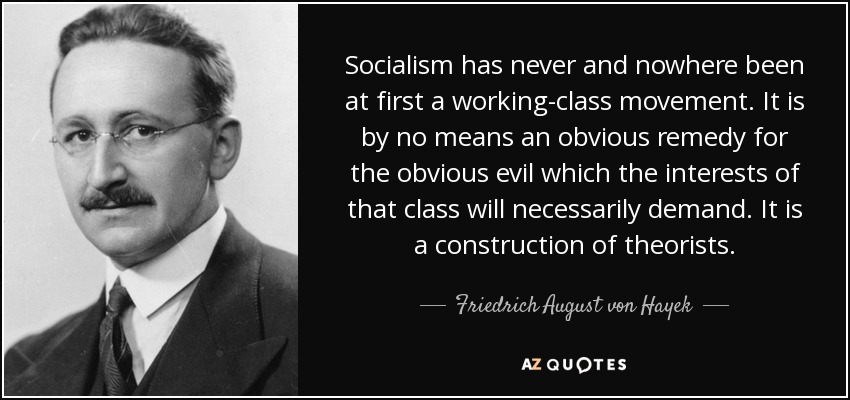
Socialism has never and nowhere been at first a working-class movement. It is by no means an obvious remedy for the obvious evil which the interests of that class will necessarily demand. It is a construction of theorists.
Socialist thought owes its appeal to the young largely to its visionary character; the very courage to indulge in Utopian thought is in this respect a source of strength for socialism which traditional liberalism sadly lacks. Speculation about general principles provides an opportunity for the play of the imagination of those who are unencumbered by much knowledge of the facts of present-day life. Their ideas suffer from inherent contradictions, and any attempt to put them into practice must produce something utterly different from what they expect.
It is perhaps the most characteristic feature of the intellectual that he judges new ideas not by their specific merits but by the readiness with which they fit into his general conceptions, into the picture of the world which he regards as modern or advanced.
Only in the struggle between two philosophies can the weapon of brutal force, persistently and ruthlessly applied, lead to a decision for the side it supports.
I've always believed that a speculative bubble need not lead to a recession, as long as interest rates are cut quickly enough to stimulate alternative investments. But I had to face the fact that speculative bubbles usually are followed by recessions. My excuse has been that this was because the policy makers moved too slowly - that central banks were typically too slow to cut interest rates in the face of a burst bubble, giving the downturn time to build up a lot of momentum.
I, place economy among the first & most important republican virtues, & public debt as the greatest of the dangers to be feared
Only now did I recognize the reciprocal relationship which exists between manufacturing power and the national system of transportation, and that the one can never develop to its fullest without the other.
There is no sense in making statements that will not continue to be true after they are made.
Governments do not necessarily act in the national interest, especially when making detailed microeconomic interventions. Instead, they are influenced by interest group pressures. The kinds of interventions that new trade theory suggests can raise national income will typically raise the welfare of small, fortunate groups by large amounts, while imposing costs on larger, more diffuse groups.
Raising the minimum wage and lowering the barriers to union organization would carry a trade-off - higher unemployment. A better idea is to have the government subsidize low-wage employment. The earned-income tax credit for low-income workers - which has been the object of proposed cuts by both President Clinton and congressional Republicans - has been a positive step in this direction.
The State is the coldest of all cold monsters.
The redistribution of wealth creates dependence on the people to whom it is redistributed, it doesn't incentivize them to create their own wealth.
Used to the conditions of a capitalistic environment, the average American takes it for granted that every year business makes something new and better accessible to him. Looking backward upon the years of his own life, he realizes that many implements that were totally unknown in the days of his youth and many others which at that time could be enjoyed only by a small minority are now standard equipment of almost every household.
German Marxian's coined the dictum: If socialism is against human nature, then human nature must be changed.
What is the use of freedom of the press if the government is in possession of all the printing presses, what does freedom of assembly avail if all the meeting places belong to the government? In a society in which there is no more personal and economic freedom, even the freest form of the state cannot make political independence possible.
This, by the way, is the welfare state in action: Its a whole bunch of special interest groups screwing consumers and taxpayers, and making them think they're really benefiting.
In my opinion nothing has contributed more to the corruption of the original idea of socialism as the belief that Russia is a socialist country.
The liberals who demanded equality of taxation on behalf of the poor, for instance, did not imagine that they would obtain progressive taxation to the disadvantage of the well-off, and that they would end up with an arrangement in which taxes are voted by those who do not pay them.
Tariffs, government contracts, naval and military spending, nationalized industries, tax policy, social welfare, the legal privileging of labor unions were among the means at the disposal of the governing class to exploit the public at large for the benefits of its various clienteles.
The chief value of the rule lies in preventing an immediate and obvious but inferior good from replacing a longer-range, less obvious but superior one.
With virtually no knowledge of or interest in history, the masses simply take their unprecedented high living standards under capitalism for granted.
Protectionism will do little to create jobs and if foreigners retaliate, we will surely lose jobs.
In Asia, a lot of successful economies that had been living on their own saving, decided to open up their financial markets to international capital in the early 1990s. So here were countries doing quite well, but they decided to borrow a bit more and do even better.
Everything done by the state is ultimately done by means of aggression, which is to say violence or the threat of violence against the innocent.
Tax increases appear to have a very large sustained and highly significant negative impact on output. Since most of our exogenous tax changes are in fact reductions, the more intuitive way to express this result is that tax cuts have very large and persistent positive output effects
Follow AzQuotes on Facebook, Twitter and Google+. Every day we present the best quotes! Improve yourself, find your inspiration, share with friends
or simply: