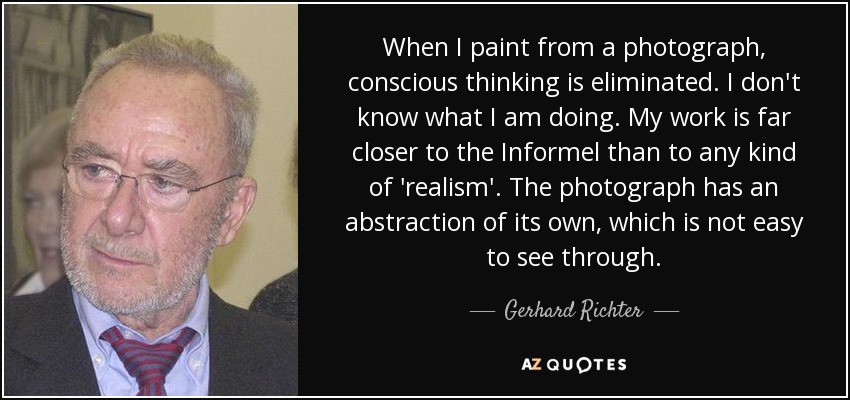
When I paint from a photograph, conscious thinking is eliminated. I don't know what I am doing. My work is far closer to the Informel than to any kind of 'realism'. The photograph has an abstraction of its own, which is not easy to see through.
As far as the surface is concerned - oil on canvas, conventionally applied - my pictures have little to do with the original photograph. They are totally painting (whatever that may mean). On the other hand, they are so like the photograph that the thing that distinguished the photograph from all other pictures remains intact.
Grey. It makes no statement whatever; it evokes neither feelings nor associations: it is really neither visible nor invisible. Its inconspicuousness gives it the capacity to mediate, to make visible, in a positively illusionistic way, like a photograph. It has the capacity that no other colour has, to make 'nothing' visible.
... landscapes or still-lifes I paint in between the abstract works; they constitute about one-tenth of my production. On the one hand they are useful, because I like to work from nature - although I do use a photograph - because I think that any detail from nature has a logic I would like to see in abstraction as well.
But it is also untrue that I have nothing specific in mind. As with my landscapes: I see countless landscapes, photograph barely 1 in 100,000, and paint barely 1 in 100 of those that I photograph. I am therefore seeking something quite specific; from this I conclude that I know what I want.
And then the work bears a strong sense of leave-taking for me personally. It ends the work I began in the 1960s (paintings from black-and-white photographs), with a compressed summation that precludes any possible continuation. And so it is a leave-taking from thoughts and feelings of my own on a very basic level. Not that this is a deliberate act, of course; it is a quasi-automatic sequence of disintegration and reformation which I can perceive, as always, only in retrospect.
Only about one per cent of my paintings show family members. Do they help me deal with problems? It's likely that these problems can only be depicted. But photographs, private ones and others, keep appearing that fascinate me so much that I want to paint them. And sometimes the real meaning these images have for me only becomes apparent later.
I would love to photograph Stephen Hawking. I am just fascinated by science, I really am.
The notion of time bothers me. You look at thirty-year-old photographs and realize how the time has passed.
What do you say to your sister who poses in the nude? It's not like you are really itching to see photographs of your sister naked. I mean, it's just something that is not too exciting.
What I have tried to do is involve the people I was photographing... if they were willing to give, I was willing to photograph.
Recording sessions were stimulating to photograph, because everything was in motion: the subject, the musicians, the technicians and the photographer. You needed fast reflexes to keep up with moving targets, and sensitivity and skill to get the pictures while keeping out of the performers' eyeline so as not to break their concentration.
I photograph different people all the time. I like to shoot all kinds of people.
Composition in photography is almost as varied as composition in music or words -- melodic or atonal, safe or daring -- and can enhance subject, theme, and style. Every photograph you take involves you in some compositional decision, even if this is simply where to set up the camera or when to press the button.
Northern Ireland is part of Ireland, not Britain, as can clearly be seen from aerial photographs.
... to became neighbours and friends instead of journalists. This is the way to make your finest photographs.
Now that you are dead, you are splendid. Photographs of people who have just died are worth twenty percent more, and for suicides there is an additional five percent. Now that you are dead you are much in demand.
With a painting, you're taking basic building blocks and making something that's more complex than what you started with. It is a synthetic process. A photograph does the opposite: It takes the world, and puts an order on it, simplifies it.
Yet another spunky li'l NASA robot lands and begins transmitting back photographs of rocks that appear virtually identical to the rock photos beamed back by all the other spunky li'l NASA robots, thus confirming suspicions that the universe has a LOT of rocks in it.
I would warn very sincerely against the pitfalls of copying photographs. A frozen, split-second bears little relationship to the continuing process of living reality. It is better to look, look again, and keep on looking.
I photograph Nature, which includes human beings.
The main thing about directing is: photograph the people's eyes.
Some photographs are like a Chekhov short story or a Maupassant story. They're quick things and there's a whole world in them. But one is unconscious of it while shooting.
I have a vision of life, and I try to find equivalents for it in the form of photographs.
What I want is the world to remember the problems and the people I photograph. What I want is to create a discussion about what is happening around the world and to provoke some debate with these pictures. Nothing more than this. I don't want people to look at them and appreciate the light and the palate of tones. I want them to look inside and see what the pictures represent, and the kind of people I photograph.
Follow AzQuotes on Facebook, Twitter and Google+. Every day we present the best quotes! Improve yourself, find your inspiration, share with friends
or simply: