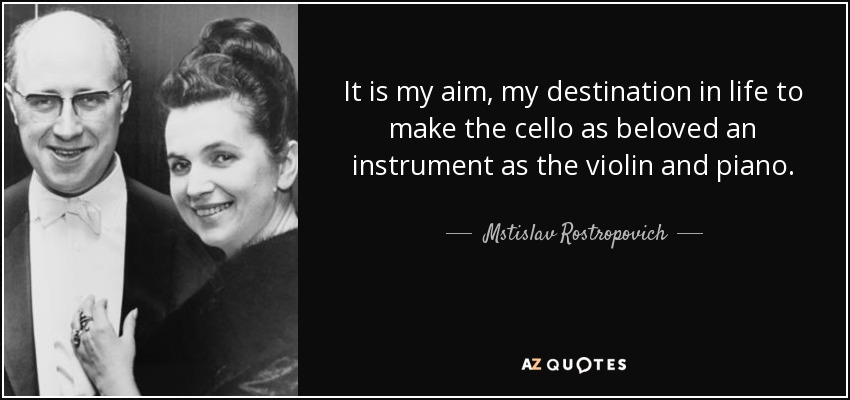
It is my aim, my destination in life to make the cello as beloved an instrument as the violin and piano.
I remember there was a little organ which I'd tap my fingers on all the time. My interest in the instrument was so obvious, one day I got home from school and there was a real piano in my bedroom.
The piano is an orchestra with 88...... things, you know
I took lessons for about everything you could imagine - gymnastics to karate to flute and piano. My mom always definitely kept me in some kind of class or program, but for guitar, I kinda gave up on then kinda just taught myself. Same thing with piano. I've never been good with following lessons.
I never had any social life, just played the piano and studied, studied, studied.
I just love crafting and shaping sounds. Actually, many of the sounds that I work with start off as organic instruments - guitar, piano, clarinet, etc. But I do love the rigidity of electronic drums.
My big influences are piano artists like Billy Joel and Elton John.
When I'm not touring, I sing at home, either at the piano or I'll pick up my guitar, singing old Buck Owens songs.
The Steinway piano - with its beauty and power - is the perfect medium for expressing the performer's art, drama and poetry.
Eric's performance is an awesome and entirely honest expression of the pain and beauty of his music. To watch him play is like riding on the tail of a dragon, but he is so gentle with his rider, you forget how high up you are or how intense the ride is. He is perhaps the most generous performer I have ever watched, every bit of himself is given to the audience. He's like a Marina Abramovic with a piano, completely and deeply committed, regardless of that pain.
Eric Lewis doesn't play the piano, he devours it. He doesn't play music, he channels the divine.
It is only by demanding the impossible of the piano that you can obtain from it all that is possible. For the psychologist this means that imagination and desire are ahead of the possible reality. A deaf Beethoven created for the piano sounds never heard before and thus predetermined the development of the piano for several decades to come. The composer's creative spirit imposes on the piano rules to which it gradually conforms. That is the history of the instrument's development. I don't know of any case where the reverse occurred.
Miss Petrowska,an excellent pianist, held the audience transfixed with Chou Wen-chung’s work. Miss Petrowska was coolness itself in getting the hardware into the piano and out again…in Messiaen, a feeling for the music’s reverent sobriety combined to produce an absorbing performance.
A man of intellect is like an artist who gives a concert without any help from anyone else, playing on a single instrument--a piano, say, which is a little orchestra in itself. Such a man is a little world in himself; and the effect produced by various instruments together, he produces single-handed, in the unity of his own consciousness. Like the piano, he has no place in a symphony; he is a soloist and performs by himself--in soli tude, it may be; or if in the company with other instruments, only as principal; or for setting the tone, as in singing.
You cannot play the piano by telling a pianist what to do, go a little more to the left or to the right. And the same is for the computer, really. You have to play yourself to get the most out of it.
Most of my music theory knowledge is based on piano. But I write on guitar a lot, too. I'm not a great guitar player by any means. I'm not a great instrumentalist. I play piano on stage. I don't play guitar on stage, but I use it to write quite a lot.
Once I started playing the piano, after my first small competition, I realized that the piano was the right instrument for me.
I'm improvising all the time. Everything I do is improvised. On the piano, at least.
My dad was a self-taught stride piano player. The myth is - I don't whether it's true or not - that he taught himself to play by watching a player piano.
I started going to a piano teacher at 5 years old, but pretty soon I started picking things out on my own and stopped taking music lessons. I never could read music very well, but I've still been doing it.
The family story tells, and it was told true, of my great-grandfather who begat eight genius children and bought twelve almost new grand pianos. He left a considerable estate when he died.
And yet we constantly reclaim some part of that primal spontaneity through the youngest among us, not only through their sorrow and anger but simply through everyday discoveries, life unwrapped. To see a child touch the piano keys for the first time, to watch a small body slice through the surface of the water in a clean dive, is to experience the shock, not of the new, but of the familiar revisited as though it were strange and wonderful.
The first song I ever learned to sing and play on the piano was 'I Remember Sky' when I was 10 years old. I remember thinking, This is the most beautiful song I will ever hear. And that remains true for me to this day. His music is the sole reason I wanted to be on Broadway. I wanted to sing music that transports us to the most important place one can travel, our hearts.
I play any piano with a good tune.
I grew up hard. I picked cotton and plowed with the mule and fixed the cars and played with the guitar and the piano.
Follow AzQuotes on Facebook, Twitter and Google+. Every day we present the best quotes! Improve yourself, find your inspiration, share with friends
or simply: