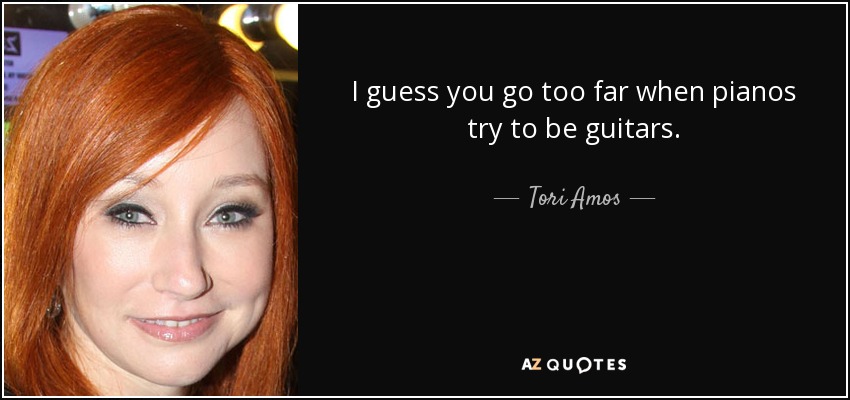
I guess you go too far when pianos try to be guitars.
People say to me now, Oh, youve given up the piano. How can you? Music is a virus.
The study of how substances alter gene expression is part of the field of epigenetics. Some chemical exposures appear to turn on and turn off genes in ways that disregulate cell growth and predispose for cancer. From this perspective, our genes are less the command-and-control masters of our cells and more like the keys of piano, with the environment as the hands of the pianist.
Mr. Bucchino occupies a special niche. His flowing, finely made piano ballads describe an urban single life in which relationships come and go... with high expectations, high anxiety and open hearts.
I haven't had such an overwhelmingly positive response as I have from The Normal Heart directly to me. And it's a blessing. If this is it, if I have a piano dropped on me tomorrow, then I would go down thinking, 'You know what, I did okay as far as my career goes, because that's a gift. That's rare.'
Mom and sister played piano growing up; my grandma still plays piano in church. They always beat me over the head trying to get me to play piano, but I was more interested in riding dirt bikes and playing in the mud.
I sat on the piano bench next to my mother in church. Something happened before I set foot on this planet. I was crawling around inside of her. She was a church pianist. My dad was a brilliant singer. I was hearing it.
I did a concert at five years old in the garden of one of the church members, and we raised some money to buy a new piano in our little church.
Of course, if you think of a European or American household in the '50s, so what were the things that when people started climbing up the ladder, what did they buy? A fridge, a TV, I think piano was the number three item in say '53 or '54.
I sing songs from the theater and pop songs. When I say 'pop songs,' I mean from the 90's. And I tell jokes. So it's sort of a stand up show meets a concert - not your traditional lounging across a piano cabaret show. It's much looser.
As a young composer I had a particular fondness for Liszt's Beethoven Symphony arrangements for the piano, and to this day I enjoy playing non-piano music at the piano.
I enjoy the challenge of taking something which was not meant for the piano, distilling its essence and writing or improvising it for/at the piano, but having the listener forget that he or she is listening to a piano.
A lot of my approach to the instrument, especially as I've gotten older, is to treat the piano in ways that are not very pianistic - to consider the sounds I'm after first, and to deal with technical considerations later.
Mazur was a remarkable artist. During our time in Rome we became friends. I would often perform my works for him at the piano.
Whenever I record something, I always believe that it's worthy of inclusion in the pantheon, and I would certainly like pianists to pay more attention to it. I think it's ridiculous now, because the range of repertoire - or what's considered 'safe' - is so narrow, even though there are pianists who are really trying to push the envelope. There is still a lack of attention, and there's no reason for it. The piano repertoire is so rich, with so many wonderful things that still are not given their due.
Self-expression is something that you've crafted, something that you've found. You've practiced on that piano for hours, you didn't hang out with your buddies, you didn't go after the girls, you stayed in your own little geeky room or you wrote for hours.
I stay glued to my piano and my work. I don't look up. I write, I produce, I do the next project, I do my job. I don't look up, and I try to be kind. I try to be kind to people. That's what I do.
I bet you can't play slide piano.
Hearing is believing...a magician with the piano.
Everybody in my neighborhood in the '40s, they played pianos. That's how people partied. They didn't try the TV, the radio was OK, records was cool, but when people wanted to party, they got around a piano. My mother played piano, my sister played. I've been around a lot of piano all my life.
When I was a little kid wanting to play music, it was because of people like Pete Johnson, Huey Smith, Allen Toussaint, Professor Longhair, James Booker, Art Neville ... there was so many piano players I loved in New Orleans. Then there was guys from out of town that would come cut there a lot. There was so many great bebop piano players, so many great jazz piano players, so many great Latin piano players, so many great blues piano players. Some of those Afro-Cuban bands had some killer piano players. There was so many different things going on musically, and it was all of interest to me.
Solving problems is a practical art, like swimming, or skiing, or playing the piano: you can learn it only by imitation and practice.
You may be perfect in playing the piano, and not be creative; you may play the piano most brilliantly, and not be a musician. You may be able to handle color, to put paint on canvas most cleverly, and not be a creative painter. You may create a face, an image out of a stone, because you have learned the technique, and not be a master creator. Creation comes first, not technique.
A trumpet sounds pretty much like a trumpet, and that's true of a lot instruments; pianos sound like pianos, but there's something about the guitar - the range of possibilities is much broader.
Just with the basic one guitar, one piano and one vocal and an audience, I think that the intimacy comes through more. People feel much more connected to the song because there's nothing in the way, and I actually enjoy doing that.
Follow AzQuotes on Facebook, Twitter and Google+. Every day we present the best quotes! Improve yourself, find your inspiration, share with friends
or simply: