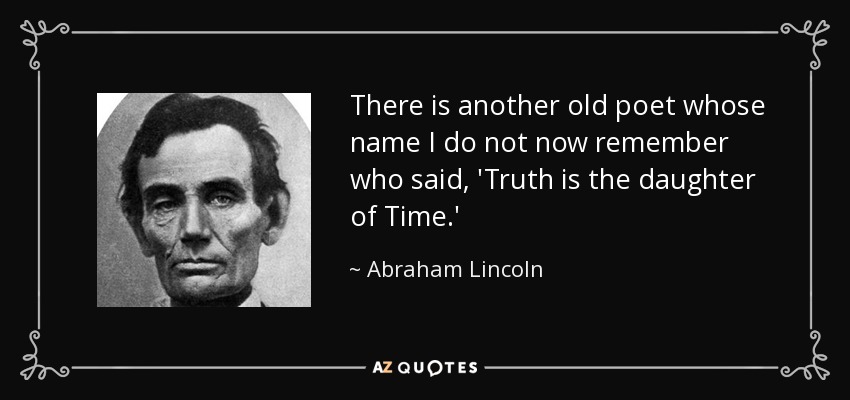
There is another old poet whose name I do not now remember who said, 'Truth is the daughter of Time.'
The human mind is generally far more eager to praise and dispraise than to describe and define. It wants to make every distinction a distinction of value; hence those fatal critics who can never point out the differing quality of two poets without putting them in an order of preference as if they were candidates for a prize.
Rumi, who is one of the greatest Persian poets, said that the truth was a mirror in the hands of God. It fell, and broke into pieces. Everybody took a piece of it, and they looked at it and thought they had the truth.
Example moves the world more than doctrine. The great exemplars are the poets of action, and it makes little difference whether they be forces for good or forces for evil.
A sculptor is a person who is interested in the shape of things, a poet in words, a musician by sounds.
Southern poets are still writing narrative poems, poems in forms, dramatic poems.
Dante Alighieri was not only a Christian poet or a priest, he was a man. He was a real poet. We can understand that the goal of Divine Comedy is beauty. You don't need also to understand Italian or to know Italian, because when Dante's writing, when we recite Dante out loud, it explodes a cosmos of illumination like to recite music, a symphony.
I think one of the most fertile, unexplored areas for poets and fiction writers is the world of science. I become overwhelmed by the science world.
The poet ranks far below the painter in the representation of visible things, and far below the musician in that of invisible things.
I started out as a poet. I've always been a poet since I was 7 or 8. And so I feel myself to be fundamentally a poet who got into writing novels.
A nation's poets are its true owners; and by the stroke of the pen they convey the title-deeds of its real possessions to strangers and aliens.
The poet craves emotion, and feeds the fire that consumes him, and only under this condition is he baptized with creative power.
Much of a poet's experience takes place in imagination only; the life he tells is oftenest the life that he strongly desires to live, and the power, the purity and height of his utterance may not seldom be the greater because experience here uses the voices of desire.
The Greeks, those originators of the intellectual life, fixed for us the idea of the poet. He was a divine man; more sacred than the priest, who was at best an intermediary between men and the gods, but in the poet the god was present and spoke.
The poet gives us his essence, but prose takes the mould of the body and mind entire.
I think it better that in times like these a poet's mouth be silent, for in truth we have no gift to set a statesman right.
I hear poets complaining: 'We face what our forebears did not face. We face TV. We face radio. We face this and that.'
The poet exposes himself to the risk. All that has been said about poetry, all that he has learned about poetry, is only a partial assurance.
Like many modern poets, I tend to conceal rhymes by placing them in the middle of lines, and to avoid immediate alliteration and assonance in favor of echoes placed later in the poems.
But the lover's power is the poet's power. He can make love from all the common strings with which this world is strung.
To be able to write a play a man must be sensitive, imaginative, naive, gullible, passionate; he must be something of an imbecile, something of a poet, something of a liar, something of a damn fool.
No man can be explained by his personal history, least of all a poet.
I've noticed a fascinating phenomenon in my twenty-five years of teaching - that schools and schooling are increasingly irrelevant to the great enterprises of the planet. No one believes anymore that scientists are trained in science classes or politicians in civics classes or poets in English classes. The truth is that schools don't really teach anything except how to obey orders.
The poets needed to learn to pay greater attention to character and to narrative.
When I taught at the University of Houston in the Creative Writing program we required the poets to take workshops in fiction writing and we required the fiction writers to take workshops in poetry. And the reason for that is because the fiction writers seemed to need to learn how to pay greater attention to language itself, to the way that language works.
Follow AzQuotes on Facebook, Twitter and Google+. Every day we present the best quotes! Improve yourself, find your inspiration, share with friends
or simply: