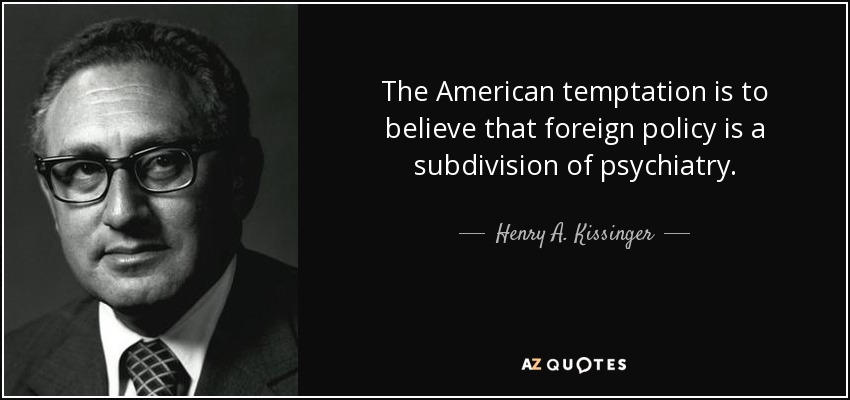
The American temptation is to believe that foreign policy is a subdivision of psychiatry.
Universality has been severely reduced: it is virtually dead as a concept in most areas of public policy.
The greatest difference between now and 1964, when I began teaching, is that public policy has pretty much eradicated the dream of Martin Luther King.
Kings will be tyrants from policy, when subjects are rebels from principle.
The greatest crime since World War II has been U.S. foreign policy.
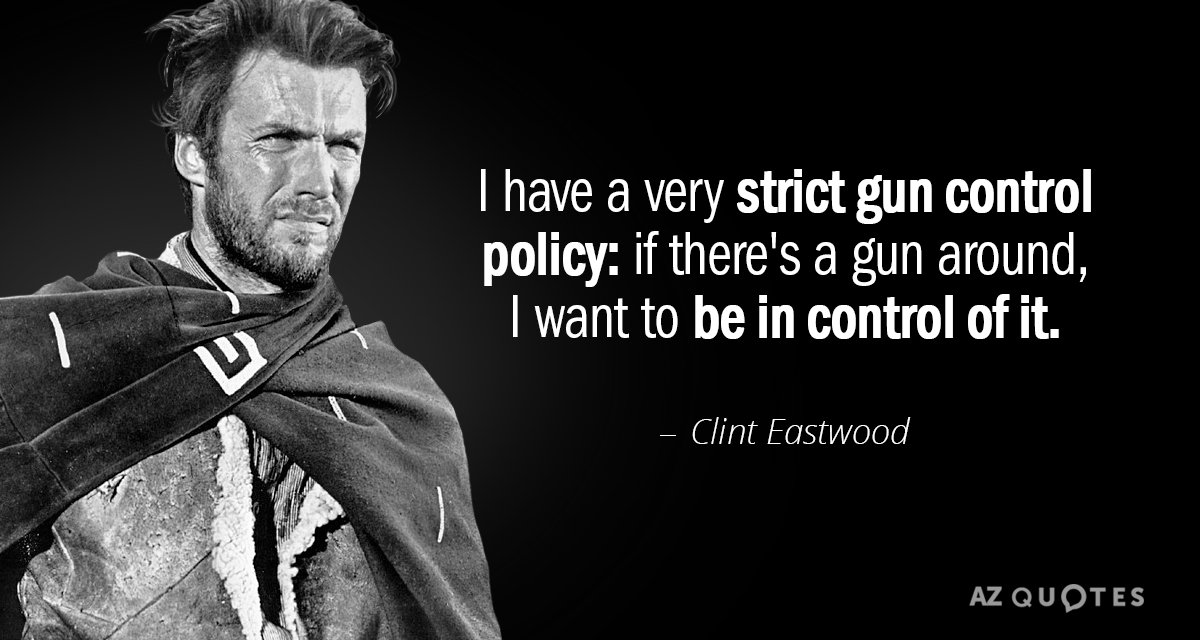
I have a very strict gun control policy: if there's a gun around, I want to be in control of it.
If the Federal Reserve pursues a policy which Congress or the President believes not to be in the public interest, there is nothing Congress can do to reverse the policy. Nor is there anything the people can do. Such bastions of unaccountable power are undemocratic. The Federal Reserve System must be reformed, so that it is answerable to the elected representatives of the people.
The people who make policy decisions should damned well know what they are talking about before they make the decisions. There is nobody who is an expert on cloning who would be afraid after seeing Attack of the Clones.
The coercive effect of this policy is particularly pronounced in the school setting given the age and impressionability of schoolchildren, and their understanding that they are required to adhere to the norms set by their school, their teacher, and their fellow students.
Policies are judged by their consequences but crusades are judged by how good they make the crusaders feel.
The Federal Reserve is the overlord of the money supply. If these two are not steering in the same direction, they can either neutralize each other or have the economy lurching in all directions. This is not a rational system for setting economic policy. It has given us trouble in the past, as the text will establish, and will inevitably in the future.
The risk exists that, with aggregate demand exhibiting considerable momentum, output could overshoot its sustainable path, leading ultimately in the absence of countervailing monetary policy action to further upward pressure on inflation.
Many men without morals have attacked religion because it was contrary to their inclinations. Many wise men have despised it because it seemed to them ridiculous. Many persons have regarded it with indifference, because they have never felt its true disadvantages. But it is as a citizen that I attack it, because it seems to me harmful to the happiness of the state, hostile to the march of the mind of man, and contrary to sound morality, from which the interests of state policy can never be separated.
For truth is strong next to the Almighty. She needs no policies or stratagems or licensings to make her victorious. These are the shifts and the defences that error uses against her power.
We have the most liberal, the most leftist candidate who has ever run for president in my lifetime; he's a sitting duck. This guy's policies are aimed at destroying the age of American greatness.
It's the [George Bush] president's fiscal policies that have driven up the biggest deficits in American history. He's added more debt to the debt of the United States in four years than all the way from George Washington to Ronald Reagan put together.
It should be clear to everyone that the nation's steadfast policy should afford every American of working age a realistic opportunity to acquire the ownership and control of some meaningful form of property in a growing national economy.
The U.S.A. economic policy and practice have been largely influenced by this thought that people shall own property in their own right and in order to be strong enough to control their own government.
Personal religious convictions have no place in political campaigns or in dictating public policy.
Pascal makes no attempt in this most famous argument to show that his Roman Catholicism is true or probably true. The reasons which he suggests for making the recommended bet on his particular faith are reasons in the sense of motives rather than reasons in the sense of grounds. Conceding, if only for the sake of the present argument, that we can have no knowledge here, Pascal tries to justify as prudent a policy of systematic self-persuasion, rather than to provide grounds for thinking that the beliefs recommended are actually true.
By the time the Deputy Minister presents a matter for decision to cabinet, he or she tends to present three options: ' the unacceptable', 'the politically courageous', and 'the bureaucrat-preferred' options. As such, it is usually best to get down into the department to the person doing the first drafts of any policy.
It is the inevitable effect of religion on public policy that makes it a matter of public concern. Advocates of religiosity extol the virtues or moral habits that religion is supposed to instill in us. But we should be equally concerned with the intellectual habits it discourages.
I think evolution should be taught as an accepted principle. I say that also as the daughter of a school teacher, a science teacher, who has instilled in me a respect for science. I think it should be taught in our schools. I won't ever deny that I see the hand of God in this beautiful creation that is earth. But - that is not a part of state policy or a local curriculum in a school district. Science should be taught in science class.
A lot of the things that we passed in the energy policy were embedded in law, and they resulted in tremendous reductions in waste of energy in all kinds of things.
You're always as good as your last movie and that's the same with politics. If you are successful with a certain policy, then you're hot; if you're successful with the economy, or bringing down the unemployment rate, then you're hot. But if you're not successful, then things go south very quickly.
Follow AzQuotes on Facebook, Twitter and Google+. Every day we present the best quotes! Improve yourself, find your inspiration, share with friends
or simply: