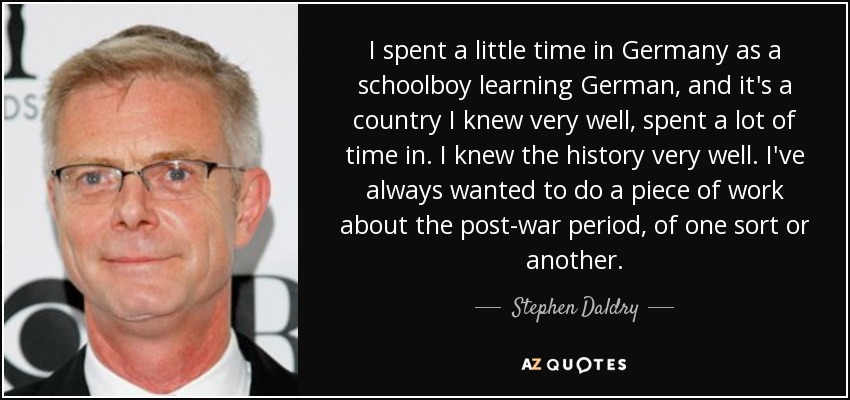
I spent a little time in Germany as a schoolboy learning German, and it's a country I knew very well, spent a lot of time in. I knew the history very well. I've always wanted to do a piece of work about the post-war period, of one sort or another.
The United States basically accepted protection abroad as the price of post-war recovery. Now, that these countries have caught up to our level of prosperity, it is time for them to catch up to our level of openness.
The generation which lived through the Second World War is disappearing. Post-war generations see Europe's great achievements - liberty, peace and prosperity - as a given.
If the Nuremberg laws were applied, then every post-war American president would have been hanged.
In that period, we had the Cold War mentality imbued through us - the Post-war [environment] and the Cold War. I think we were reflecting some of that. This was before the Wall collapsed, etc.
I think the rest of the world will think we're made, and indeed we are. We've turned out the greatest Prime Minister in the post war years simply because of short term nerves.
We're all more or less interested in the 'swinging sixties', of course, but that's not what I mean. I'm interested in the particular naive glamour that clings to the post-war and pre-Hendrix era.
In How to Be an American Housewife Margaret Dilloway creates an irresistible heroine. Shoko is stubborn, contrary, proud, a wonderful housewife and full of deeply conflicted feelings. I wanted to shake her, even as I was cheering her on, and this cunningly structured novel allowed me to do both. It also took me on two intricate journeys, from post-war Japan and the shadow of Nagasaki to contemporary California, and from motherhood to daughterhood and back again. A profound and suspenseful debut.
In one sense, I have always felt glad to have had the war [World War II] in my childhood, because, as a result, nothing that has happened in the world since then has ever seemed quite so bad. On the other hand, I never entirely got over my feeling of being cheated when the promised era of peace in a wonderful "post-war world" failed to materialize. I could not understand how, after all that, people could ever even think of fighting again. And I still can't.
When a new post-war generation has grown to puberty and to youth and to manhood and womanhood, it should read, and it should be realistically told, of the futility, the idiocy, the utter depravity of war. For that matter, this instruction could begin at the age of six with the taking of those toy guns out of those toy holsters and throwing them in the ash-cans where they belong.
A poet is a poet, whether he rides in a Ford or on a donkey; a sage is a sage, whether he plays golf in New Jersey or bathes in the Ganges, or prays in the desert; and a fool is a fool, whether he be a maharaja or a president of a post-war republic.
Post-war filmmakers gave us the documentary, Rob Reiner gave us the mockumentary and Moore initiated a third genre, the crockumentary.
A particular type of film emerged from World War Two, with the Italian neorealist school. It was perfectly right for its time, which was as exceptional as the reality around us. Our major interest focused on that and on how we could relate to it. Later, when the situation normalized and post-war life returned to what it had been in peacetime, it became important to see the intimate, interior consequences of all that had happened.
That's a point that Dan Ellsberg has made for years. He said it's kind of like if you and I go into a grocery store to rob it, and I have a gun. The guy may give you the money in the cash register. I'm using the gun even if I don't shoot. Well that's nuclear weapons - essential to post-war deterrence - they cast a shadow over everything.
Democracy takes work. That's the thing we're really finding out, that, you know, in many ways, you know, the past two decades we've taken for granted all of the extraordinary achievements of the post-war generation. You know, building this global alliance structure that has kept the peace across the North Atlantic since World War II. Building all of these institutions, building all this remarkable technology. And people have privatized. You know, you can now, you don't have to go outdoors much, the whole world comes to you.
The two most potent post-war orthodoxies--socialist politics and modernist art--have at least one feature in common: they are bothforms of snobbery, the anti-bourgeois snobbery of people convinced of their right to dictate to the common man in the name of the common man.
I don't know if Britain ever really achieved that much glamour. We had post-war austerity rather than post-war prosperity, and our cultural products of the time include some pretty dour kitchen-sink dramas of the A Kind of Loving variety. (This kind of film seems disillusioned with the sixties before they've even really begun.)
The Iraqis sat down for talks on how to put together a post-war government. They would have sat down yesterday, but somebody stole all their couches.
To me, the Republican Party is the real great tragedy of the last 25 years because there are lot of good and decent people and a lot of good political points [that have] come from the Republican Party in the post-war period, but it has been hijacked by these fundamentalist wackos.
Government grew under [Ronald] Reagan. He was the strongest opponent of free markets in the post-war history among presidents. But it doesn't matter what the reality is; they concocted an image that you worship.
If you are going to abolish slavery, that opens up all these other questions: what system of labor is going to replace slave labor? What system of race relations is going to replace the race relations of slavery? Who is going to have power in the post-war South? The Emancipation Proclamation doesn't answer that question, but it throws [it] open.
Washington is awash in post-war testosterone.
What's interesting is that when you get into the post-war period, many of the narratives in books and movies conclude that if you killed Hitler, you're actually going to make history worse.
I think Winston Churchill is an appallingly bad politician, and always has been, that he hung onto power long after he should have done, and that his post-war administration was a disaster.
Alexander Trocchi was an existentialist. He was looking at an alienated artist in the post-war period. It's modern because it applies now as well.
Follow AzQuotes on Facebook, Twitter and Google+. Every day we present the best quotes! Improve yourself, find your inspiration, share with friends
or simply: