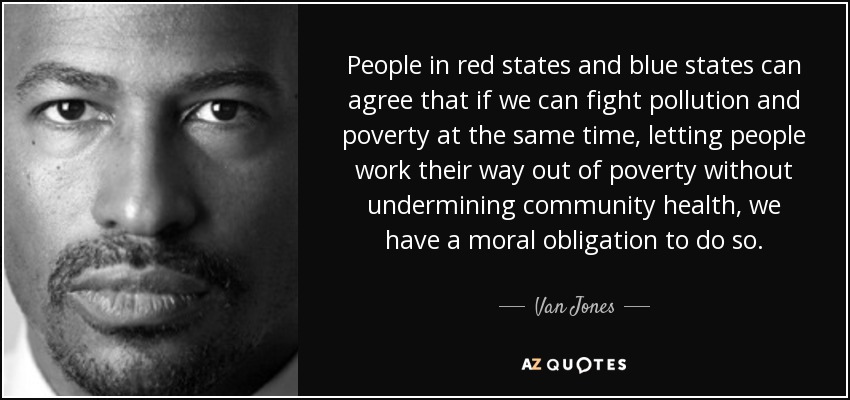
People in red states and blue states can agree that if we can fight pollution and poverty at the same time, letting people work their way out of poverty without undermining community health, we have a moral obligation to do so.
I know she [Hillary Clinton] comes out of a legacy with her husband in which the Democratic Party did more, it seems to me, to subjugate blacks to the dynamics of oppression, poverty. The mass incarceration state.
Job insecurity, debt servitude, poverty, incarceration and a growing network of real and symbolic violence have entrapped too many young people in a future that portends zero opportunities and zero hopes. This is a generation that has become the new register for disposability, redundancy, and new levels of surveillance and control.
Conservative and liberal politicians alike now spend millions waging wars around the globe, funding the largest military state in the world, providing huge tax benefits to the ultrarich and major corporations, and all the while draining public coffers, increasing the scale of human poverty and misery, and eliminating all viable public spheres - whether they be the social state, public schools, public transportation or any other aspect of a formative culture that addresses the needs of the common good.
They're the problems of poverty, of the rights of the individual, of the changes brought about by technology. They're the ones that count, more than religion!
For me the only point that has remained unchanged through the years is that in India there is still so much poverty.
Poverty assumes so many aspects here in India. There aren't only the poor that you see in the cities, there are the poor among the tribes, the poor who live in the forest, the poor who live on the mountains. Should we ignore them as long as the poor in the cities are better off? And better off with reference to what? To what people wanted ten years ago? Then it seemed like so much. Today it's no longer so much.
In the United States we have more women in poverty than any other industrialized nation.
It is important to remember when reading Adam Smith or even when just thinking about Smith that the era that he lived in, we're not talking about poverty in a day when it meant not enough bedrooms for the kids, an old car, a black and white television. We're talking about a whole world where poverty meant not enough to eat.
Barack Obama's been president for about eight hours; President Obama was here for eight years. So if you want to talk about numbers that matter, it's quantifying all the losses - the women who were slid into poverty, those who can't find meaningful work, and their children who deserve a better life.
The matter of social security and these grants is to help to address the levels of poverty in the country.
Wages never seem to go up. The whole economy feels stuck, and millions of Americans, millions of Americans, middle-class security is now just a memory. Progressives like to talk like Barack Obama likes to talk forever about poverty in America. And if a talk did any good, we'd have overcome those deep problems long ago. This explains why under the most liberal president we have had so far, poverty in America is worse, especially for our fellow citizens who were promised better and who need it most.
We have the opportunity now to look at the two billion people in the world who suffer from the most abject poverty, hunger, disease, and devastation. Add to that another two billion people who are just plain poor. If you look into the world of those caught in economic oppression, illiteracy, disease, and sexism, then you'll understand more clearly what we have to do.
I had a very depressing response because I realized that these were my own people, these were Negroes throwing eggs at me. I'm concerned about the fact that maybe all of us have contributed to this by not working harder to get rid of the conditions, the poverty, the social isolation, and all of the conditions that cause individuals to respond like this.
The black socks [on me at Olympics in 1968] emphasized the fact that we had so many Blacks and people of color here in the United States, the greatest country in the world, that was running around in poverty every day, so we wanted to illustrate the fact that these individuals did not have shoes and they had to walk 20 miles to and from school every day with no shoes in the greatest country in the world.
Children in poverty aren't trying to get out of poverty; they're just trying to rip off a pair of Nikes. So we Indian people are a microcosm of what's happening in America. We are now consumers, and our culture has gone.
Sometimes, when you grow up in one of these poverty-stricken neighborhoods where the educational system isn't the best, you don't realize that you have any choices. Often, kids don't appreciate the choices available, as if it's either the street or nothing. I want them to understand that reality is what's relative to you, and that you can make choices that allow you to create a new reality for yourself.
Every other word out of every other Chinese mouth is "development, development, development, development." And that's what they're talking about it - because they believe it, A, enables them, with development, to have the kind of status they want in the world, and B, it enables them to deal with their internal problems, having to do with poverty, urban-rural as well as the environment.
India has to fight poverty, Pakistan too has to fight poverty, why don't we come together to fight poverty?
Today the situation in India is such that we should make the poor strong so that they become partners in defeating poverty.
We must appreciate that all over the world, right down the centuries, there have been great religions that have encouraged the idea of giving - of fighting poverty and of promoting the equality of human beings - whatever their background, whatever their political beliefs.
I have seen a lot of men, for example, who will make a will and include their daughters whether they are married or not. And perhaps the greatest change of attitude is that today, at least in Kenya, if you don't send your child to school - unless it's a matter of poverty or religion, and it is not that there no schools - then people wonder, "why the hell don't you send your children to school?" Now that's a very big jump from when I was going to school and educating girls was an exception to the rule.
Not since the early days of the civil rights movement has America been given an opportunity as great as the opportunity we have now. It's one thing for us to avenge our pain, our anger, and our rage by targeting bin Laden and a handful of men who have wrought this villainy. But one should be wise enough to ask, What fueled all this? What continues to sustain the possibility that this will not go away? I think the answer is poverty.
Common sense, to me, is simple. And I've never understood why there aren't a lot of people trying to figure out how the United States became this special place and then try to replicate it around the world, because that's the solution to the human condition. The solution to poverty, the solution to misery, the solution to backwards living is the United States of America. Why not learn how that happened, learn why and how we happened. What is it that made it special?
You're either in a position of abundance or you're in a position of poverty. Now, that's every area of your life. That's not just financially.
Follow AzQuotes on Facebook, Twitter and Google+. Every day we present the best quotes! Improve yourself, find your inspiration, share with friends
or simply: