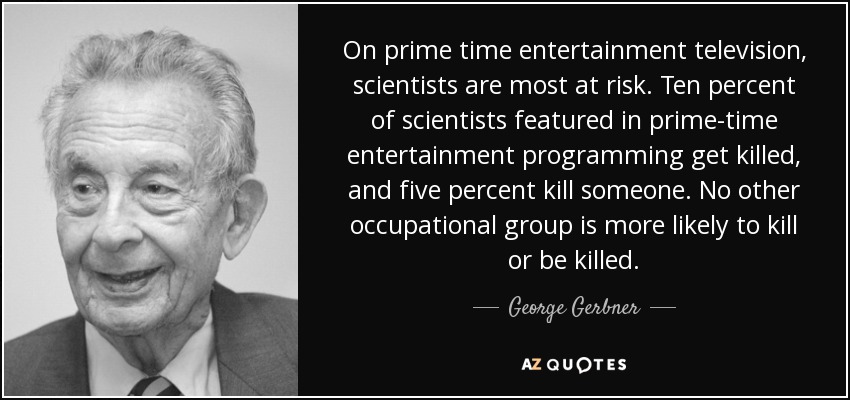
On prime time entertainment television, scientists are most at risk. Ten percent of scientists featured in prime-time entertainment programming get killed, and five percent kill someone. No other occupational group is more likely to kill or be killed.
Sequential programming is really hard, and parallel programming is a step beyond that.
Maybe today we aren't being told that our brains are not capable of such things [like programming], but we [as a women] are being told that we are not good enough or smart enough or that our successes do not belong to us.
I was in Washington, D.C., on the morning show, by the time I was 18, programming a station by 19, No. 1 in the mornings. I think I was making, I don't know, a quarter of a million dollars by the time I was 25.
Program testing can be used to show the presence of bugs, but never to show their absence!
Ads featuring real women and real beauty are such a necessary component to offset the potentially dangerous programming out there for little girls.
Pop music seems to be the way radio programming has chosen to support female artists. They have chosen not to support a more provocative voice from women, which I find disappointing.
There is always a well-known solution to every human problem - neat, plausible, and wrong.
Instructional programming is really great. To me, it's very enjoyable to watch a process.
And ultimately, it's good for all of us to have more original programming on the air. Business doesn't drive the creative. So, in identifying a project like Dovekeepers, looking at something like Extant and looking at Under the Dome, it was about falling in love with a piece of material, getting excited by the creative direction, hearing a vision, and getting excited about the potential for those projects and building the business model around it. And they're not all modeled the same way. Every one is different.
So-called "natural language" is wonderful for the purposes it was created for, such as to be rude in, to tell jokes in, to cheat or to make love in (and Theorists of Literary Criticism can even be content-free in it), but it is hopelessly inadequate when we have to deal unambiguously with situations of great intricacy, situations which unavoidably arise in such activities as legislation, arbitration, mathematics or programming.
Too many managers and executives try to reduce programming to a low-level assembly-line activity. That's inefficient, wasteful, costly in the long run, and inhumane to programmers.
It turns out that style matters in programming for the same reason that it matters in writing. It makes for better reading.
So, what does it mean for teaching and learning programming when the solution to every beginner problem is available on the Internet?
For some reason at Sundance, more than other festivals that I'm aware of, you find filmmakers rushing to screen works that sometimes aren't completed. In my seven years of programming at Toronto, I'm not aware of any documentaries that went back for serious editing after their premiere - other than those presented as works-in-progress. But at Sundance every year there seems to be a few films that push the deadline so hard that they get taken back to the edit room afterwards.
We know about as much about software quality problems as they knew about the Black Plague in the 1600s. We've seen the victims' agonies and helped burn the corpses. We don't know what causes it; we don't really know if there is only one disease. We just suffer - and keep pouring our sewage into our water supply.
The combination of threads, remote-procedure-call interfaces, and heavyweight object-oriented design is especially dangerous... if you are ever invited onto a project that is supposed to feature all three, fleeing in terror might well be an appropriate reaction.
When it comes to storytelling, not taking risks is riskier than swinging for the fences. I have very simple ambitions when it comes to taking risks in storytelling and programming. I try very hard to avoid the expected.
Programming is how we talk to the machines that are increasingly woven into our lives. If you aren't a programmer, you're like one of the unlettered people of the Middle Ages who were told what to think by the literate priesthood. We had a Renaissance when more people could read and write; we'll have another one when everyone programs.
I think that's so particularly exciting about this moment in time is all the new platforms that are now existing, the Netflixes and the Hulus and Amazons and so and so forth; I mean they are really doing what pay TV was doing twenty years ago. So a show like Dancing On The Edge gets to have a digital life after it's playing on Starz. I think what's exciting is how these new platforms are providing more opportunities both for first-run programming on the one hand but also for second plays for shows that have appeared first either on traditional broadcast or on cable.
I think that the marketplace has changed in many dramatic ways but actually in some sense it's remained the same because the challenge of creating quality programming is the same, and I've always thought that if you follow the great material everything else will fall in to place.
Every time someone does a Western movie, people flock to it. It's like, we're continually programming to people who are least likely to watch us. People in Nebraska aren't watching things on the computer, they're watching television. Why aren't we programming things for them? We only program things that appeal to New York and Los Angeles and in many ways spit on the rest of the country.
If God eliminated evil by programming us to perform only good acts, we would lose this distinguishing mark - the ability to make choices. We would no longer be free moral agents. We would be reduced to the status of robots.
People are hypocrites. If you ask them what they want to see on TV, they'll tell you they want better quality programming. And then what do they watch? 'Gilligan's Island.'
Any programming language is at its best before it is implemented and used. Anything is possible, anything can happen. On a flimsy ground of reality, imagination spins marvelous patterns.
Follow AzQuotes on Facebook, Twitter and Google+. Every day we present the best quotes! Improve yourself, find your inspiration, share with friends
or simply: