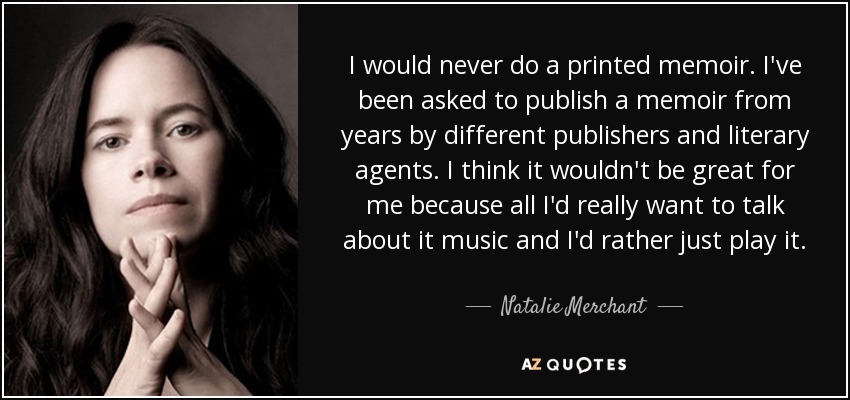
I would never do a printed memoir. I've been asked to publish a memoir from years by different publishers and literary agents. I think it wouldn't be great for me because all I'd really want to talk about it music and I'd rather just play it.
It's interesting to me that really one of the first things she [Eleanor Roosevelt]did as First Lady was to collect her father's letters and publish a book called The Letters of My Father, essentially, hunting big game, The Letters of Elliott Roosevelt. And it really was an act of redemption, really one of her first acts of redemption as she entered the White House. She was going to redeem her father's honor. And publishing his letters, reconnecting with her childhood really fortified her to go on into the difficult White House years.
When email and the Internet came along, I never publish an email address. I just stuck with this P.O. Box address.
Nobody wanted to publish a book about fairies; they said people wouldn't be interested. Luckily, I discovered Lady Cottington and her pressed fairies, which revived a huge amount of interest in fairies, so I could go ahead and do the book I wanted to do.
So the aim for the press was a mixture of things: to publish under-represented writing, which is an intersection of original language, style, content, and often its author's gender. To publish it properly, in a way that makes it clear that this is art, not anthropology. To spotlight the importance of translation in making cultures less dully homogenous.
Khairani Barokka is a writer, spoken-word poet, visual artist and performer whose work has a strong vein of activism, particularly around disability, but also how this intersects with, for example, issues of gender - she's campaigned for reproductive rights in her native Indonesian, and is currently studying for a PhD in disability and visual cultures at Goldsmiths. She's written a feminist, environmentalist, anti-colonialist narrative poem, with tactile artwork and a Braille translation. How could I not publish that?
I think in terms of educating a group of readers, MFA programs are very good. I just think the model of MFA programs in which a young poet goes through the program, publishes a series of books, gets teaching jobs, that's a bit at risk.
It is clearly important for all leadership candidates to be open and transparent about their tax affairs. I was very happy to publish mine today, and hope others will follow suit.
Andrea Leadsom promises to publish tax return tomorrow if she gets on ballot - it's boring.
I want our children's children to be free to walk safely down the street, girls to attend school, and women to work. I hope we continue to have freedom to wear what we want, worship how we want, study what we want, publish what we want while assuming personal responsibility for one's moral character.
You know how they say, "Find your voice"? That's your voice, in your pajamas. And it doesn't mean that you're going to publish it or print it or people are going to see you in your pajamas. It just means you are going to construct the foundation in your pajamas, in that voice.
You want to publish with a publisher because a publisher knows how to publish a book. And you don't. You really don't.
I have students that I tell, "If your book doesn't sell or you can't publish it, write another book. Quit sitting around." The publishing world is a business, but it's not any big deal. An editor is not your guru. Your agent is not your guru.
People who travel in China tell me that the mood there is still very upbeat, because their media is different from our media. Chinese media emphasize how well things are going and suppress the bad news and publish the good news.
[Mid-list writers are now] less greed on the part of both publishers and chain booksellers. It is easier for them to publish and sell only blockbusters and leave the real work to small presses.
Fewer publishers mean you have a limited set of aesthetics, so you know who can and can't send your work to. You have more situations where you take the offer or don't get published or you learn to self-publish.
First-book novelists and storywriters haven't yet failed and so it's easier to publish them - you can gamble on a success. Whereas someone who has written four books that are highly literary and demanding and require you as a reader. They may not be republished.
If a source gives us material that is of political, diplomatic, ethical or historical significance that has not been published before and is comprised of official documents or recordings, then we will publish it.
I think that in the first place, why we can get excited about [Buckminster ] Fuller, why it's plausible that people might - why my publisher would publish this book [You belong to the universe] about it long after he's dead and irrelevant by many standards has to do with the fact that he was in a sense coming up with this job for himself that is the job that we now refer to when we speak about world change.
I don't need to publish anything to make a living, so to speak, and I think it is much more important to spread information about our European religion than it is to make money from doing so.
I did a lot of music criticism. I don't think much of it was any good. I think I wanted to show off a lot when I was younger. Now I just want people to enjoy the story. If it were possible to publish anonymously, that would be awesome.
My main interests right now are to publish, to write, to explicate various views which I hope have an impact on thinking people.
I notice that I only publish once every four years. It takes a couple of years to write a book and then, for me, for one reason or another, it usually takes about a year of sort of dicking around before I start up. I write a review or little magazine pieces and touring with the other book. But mainly it's just you're not ready, I'm not ready to start another. You're just not up for it.
If I did not publish this autobiography [Les Mots] sooner and in its most radical form, it is because I considered it exaggerated.
I actually wanted to publish [ interview with Donald Trump about Citizen Kane] in the New York Times, but the circumstances under which I did that movie made me vulnerable to a lawsuit and at this point in my career, I don't want to go there. But it's amazing.
Follow AzQuotes on Facebook, Twitter and Google+. Every day we present the best quotes! Improve yourself, find your inspiration, share with friends
or simply: