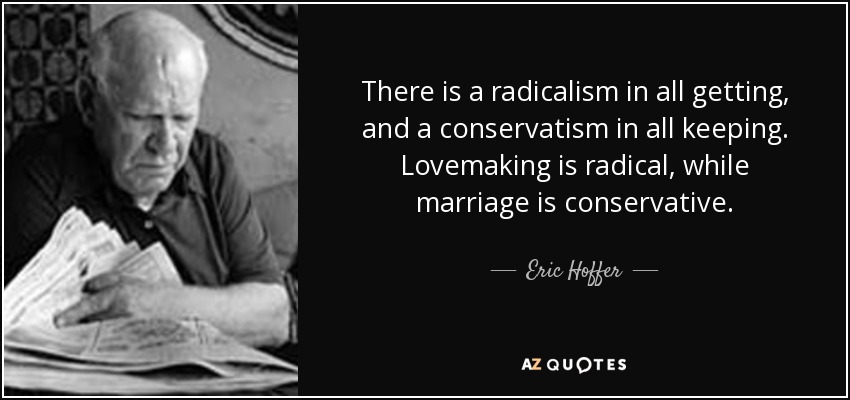
There is a radicalism in all getting, and a conservatism in all keeping. Lovemaking is radical, while marriage is conservative.
It is my feeling that as we grow older we should become not less radical but more so. I do not, of course, mean this in any political-party sense, but rather in a willingness to struggle for those things in which we passionately believe. Social activism and the struggle for social justice are often thought of as the natural activities of the young but not of the middle-aged or the elderly. In fact, I don't think this was ever true.
Women tend to be conservative in youth and get more radical as they get older because they lose power with age. So, if a young woman is not a feminist, I say, just wait.
The message that underlies healing is simple yet radical: We are already whole.... Underneath our fears and worries, unaffected by the many layers of our conditioning and actions, is a peaceful core. The work of healing is peeling away the barriers of fear that keep us unaware of our true nature of love, peace, and rich interconnection with the web of life. Healing is the rediscovery of who we are and who we have always been.
And that sort of victimization narrative is something we shouldn't contribute to. On the other hand, we have to acknowledge that there is a radical element in Islam, jihadism, that needs to be called by name and needs to be confronted.
We each have a litany of holiday rituals and everyday habits that we hold on to, and we often greet radical innovation with the enthusiasm of a baby meeting a new sitter. We defend against it and - not always, but often enough - reject it. Slowly we adjust, but only if we have to.
Not only is true love rare and true rebellion rare, real love is itself a radical form of rebellion - engagement, thinking, and being - and therefore happens in the context of a larger project of justice, liberation, and critical thinking.
Radical feminism, male lesbians, transsexuals, musical condoms with suspenders, and lotsa drummers drumming are all manifestations of a political agenda with roots in the 1960s. This is all fruit we are reaping from the sexual revolution.
No influence so quickly converts a radical into a reactionary as does his election to power.
The conservatives have already accepted a large part of the collectivist creed-a creed that has governed policy for so long that many of its institutions have come to be accepted as a matter of course and have become a source of pride to "conservative" parties who created them. Here the believer in freedom cannot but conflict with the conservative and take an essentially radical position, directed against popular prejudices, entrenched positions, and firmly established privileges. Follies and abuses are no better for having long been established principles of folly.
I would say that deconstruction is affirmation rather than questioning, in a sense which is not positive: I would distinguish between the positive, or positions, and affirmations. I think that deconstruction is affirmative rather than questioning: this affirmation goes through some radical questioning, but it is not questioning in the field of analysis.
telling the truth about children's lives is radical.
I like to remind people what radical means -- 'at the root of things.' It shouldn't be considered a pejorative. There isn't a great name out of history you can pick who wasn't 'radical.
Bigotry is ever the child of ignorance, and the cultivation of the understanding is the only radical cure for it.
Many spiritual people are involved in a radical denial of what is happening. They want to transcend it, get rid of it, get out of it, get away from it. There's nothing wrong with that feeling, but the approach doesn't work because it's escapism in spiritual clothing. It's wearing spiritual clothing and spiritual concepts, but it is really no different than a drunk in the gutter who doesn't want to feel the pain anymore. When you abide and accept everything completely and fully, you automatically go beyond.
A good deal of so-called atheism is itself, from my point of view, theologically significant. It is the working of God in history, and judgement upon the pious. An authentic prophet can be a radical critic of spurious piety, of sham spirituality.
Perhaps unsurprisingly, there's a paradox here! Kierkegaard's own indirect communication proposes that we start with the experience of those who don't believe and meet them on their own ground. His success in doing this is evidenced by the fact that, at least for some periods of the 20th century, aspects of his work became a major focus for radical thinkers of various kinds, including the non-religious and, interestingly, a significant number of Jewish thinkers (Buber, Rosenzweig, Taubes, and others).
Nobody wants anybody who's radical, who wants to move in here to be able to gain access. I said we should take a pause on these Syrian migrants. And I believe we should do that.
The Middle East has gone through periods of turmoil before. In the 1950s and 1960s, there were revolutions. When monarchies were collapsing in a number of countries, we had radicals and we had Nasserism. Today it's a little bit more complicated.
The war in Yemen is not a war that we wanted. We had no other option - there was a radical militia allied with Iran and Hezbollah that took over the country. It was in possession of heavy weapons, ballistic missiles and even an air force. Should we stand by idly while this happens at our doorstep, in one of the countries in which al-Qaida has a huge presence? So we responded, as part of a coalition, at the request of the legitimate government of Yemen, and we stepped in to support them.
I think my view is rather more radical than Pete Mandik's. Both of us want to show that colour perception doesn't transcend what can be conceptualized, but I don't think he goes so far as to deny that it doesn't involve different responses to all the discriminable surfaces.
I think the debate was really some powerful moments of clarity. We saw that Donald Trump, substantively, has the same issues on issue after issue as Hillary Clinton. He agreed with Hillary Clinton on Libya, toppling the government in Libya. That led directly to Benghazi, led to handing that country over to radical Islamic terrorism.
I think that so many actors are defined by the first thing that people see them do, and there were people who simply couldn't accept the fact that I was doing something that they perceived as being a radical departure from Avenue Q.
Alongside Han Kang, there's only one other author I've chosen to translate so far - Bae Suah. Her work is radical both stylistically and politically, influenced by her own translation practice (she's translated the likes of Kafka, Pessoa, and Sadeq Hedayat into Korean). Her language is simply extraordinary.
Beliefs have become unimportant to me. Faith as radical trust became even more important to me.
Follow AzQuotes on Facebook, Twitter and Google+. Every day we present the best quotes! Improve yourself, find your inspiration, share with friends
or simply: