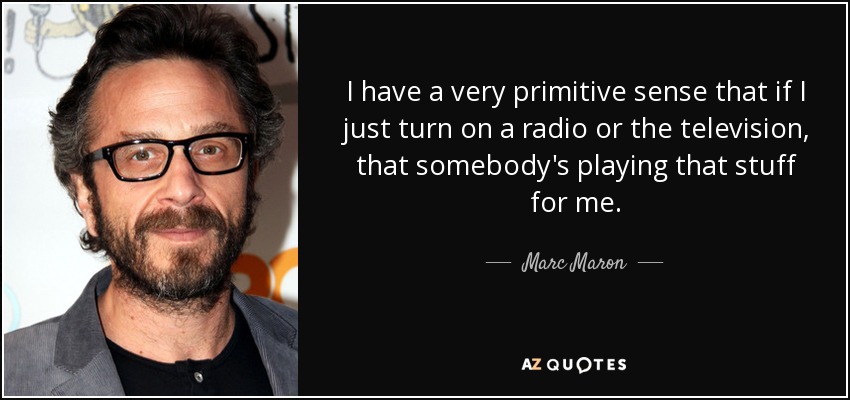
I have a very primitive sense that if I just turn on a radio or the television, that somebody's playing that stuff for me.
My heart goes out to DJs who are governed entirely by playlists. Being allowed the freedom of choice, that - for me - is what makes radio special.
Here's the tragedy of the modern record business: It's radio. If you're not on radio, nobody really is going to hear you or see you or care about you.
The thing with animation is that you record the actors like a radio show and then the animators become actors in their own way because it's their job to take this puppets and make them seem alive. They bring their own personalities to the way they move these puppets.
I've turned down songs that would be much easier to play on the radio that I don't think should be on the album. Maybe I've shot myself in the foot.
All the things I used to count on to get my music out there - record companies, they're all gone. And radio stations, they're gone - they're completely controlled by the government. If they're not controlled by the government, they're controlled by a programmer who's controlled by the government. Mainstream radio is suspect. You can't trust it.
I learned the game on the radio. Russ Hodges and Lon Simmons were the Giants broadcasters when I was growing up in the Bay area, and they taught me about the game. They taught me about the subtleties of the game, but they also gave me the game and let me enjoy it. That's the main thing, whether it's TV or radio. You have to give the fans the game, and if it's a Giants broadcast, the vast majority are Giants fans. In terms of story lines, most would be about the Giants.
It was the White Man who spanned the continents of the world with railroads and super highways and electrical power lines. It was the White Man who created the miraculous world of electronics, ushering in the telephone, the radio and television. It was the White Race, who in a combined burst of energy and genius sent rockets to the moon and planted the feet of the White Man on extra-terrestrial territory in the last decade.
I've done a lot of radio in my life. I've done radio plays for the BBC when I was young so I was absolutely used to that style of work, of working with the voice. I have a very distinctive voice so it's always great for me because I open my mouth and everybody knows who it is.
I could do whatever I liked to do during the day. I didn't have to work in an office. I could work at home. I could work at my leisure. I worked 'til four in the morning. I worked with the TV and radio on - it was a great setup. I was a night person and still am.
In my childhood everything you heard, you could imagine what it looked like. Even singers that I would hear on the radio, I couldn't see what they looked like, so I imagined what they looked like. What they were wearing. What their movements were. Gene Vincent? When I first pictured him, he was a tall, lanky blond-haired guy.
There were no horror movies or horror books to speak of in the '40s. I picked the '50s because that pretty well spans my life as an appreciator - as somebody who's been involved with this mass cult of horror, from radio and movies and Saturday matinees and books. In the '40s there really wasn't that much. People don't want to read about horrible things in horrible times. So, in the '40s, there was Val Lutin with The Cat People and The Curse of the Cat People and there wasn't much else.
There is a core of loneliness. It's partly existential. Secondly, I was raised a loner. My parents were not there. My father was asked to leave because he couldn't metabolize ethanol. Actually, my mother ran away with us when I was 2 months old and my brother was 5. Real dramatic stuff: down the fire escape, through backyards. So, I sort of raised myself. I was alone a lot and I invented myself - I lived through the radio and through my imagination.
Any comic can get on the radio show and be funny. You can get that on any morning radio show or afternoon radio show. There are plenty of people who do that. It's not a difficult format, to sit around with two or three comics and be funny.
I wasn't wattching television when I was a youngster; there was the radio.
To be honest with you, I'm not sure what a pop tune is. I'm sure if I hear it on the radio, I'd say that's pop or this or that. But, really, what I pay attention to the most is just music that moves me. It's all at least a root-type music instead of a formula.
The Internet made the world smaller, so it's easier for people to hear your music. You don't necessarily need a radio record.
Most of the music you hear on the radio today is developed for making money. It doesn't feel true or honest. You can feel it in the music.
I hate going to bed. I read scripts, clean, listen to the radio - I've fallen asleep to 'This American Life' more times than I can count!
You move differently than you do when you're filling the stage at Radio City. You have to be bigger than life there.
If it weren't for radio programs like 'The George Jarkesy Show,' no one would know about 'The Amateur'.
Just as someone who's been interested in radio and programming for so long, I can usually tell when an interviewer is doing a segment just to fill a programming slot. They ask questions, but they don't care about the answers.
Mainly I've been back to my books and writings and being nice and quiet and lazy. As I'm writing this, the radio says there's a foot of snow falling on Long Island. I really love snow and wish I could take a long walk in it right now.
The real reason we ended up getting into that type of music was our dad worked for an oil company so we spent a year overseas when we were young kids. Because of that, it was all Spanish TV and radio so we ended up having these '50s and '60s tapes, tapes of that music.
Sometimes, you can't seem to find any song on the radio that you like.
Follow AzQuotes on Facebook, Twitter and Google+. Every day we present the best quotes! Improve yourself, find your inspiration, share with friends
or simply: