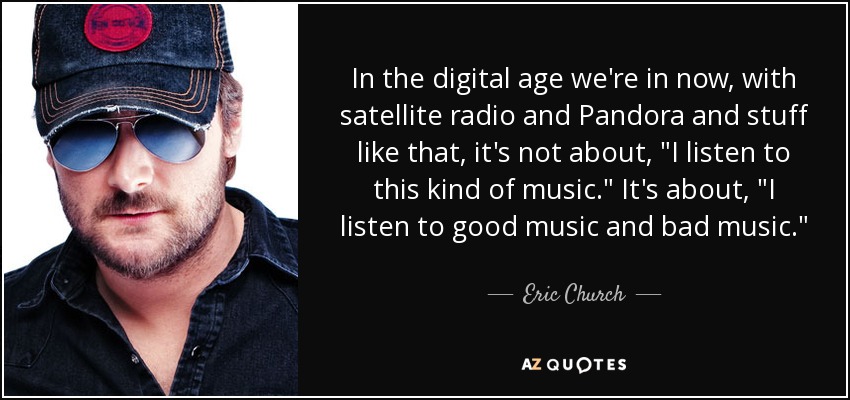
In the digital age we're in now, with satellite radio and Pandora and stuff like that, it's not about, "I listen to this kind of music." It's about, "I listen to good music and bad music."
So many sins against the poor cry out to high heaven! One of the most deadly sins is to deprive the laborer of his hire. There is another: to instill in him paltry desires so compulsive that he is willing to sell his liberty and his honor to satisfy them. We are all guilty of concupiscence, but newspapers, radios, television, and battalions of advertising men (woe to that generation!) deliberately stimulate our desires, the satisfaction of which so often means the degradation of the family.
I'm very lucky to be able to work in print and radio. I'm very lucky to be able to work at a time when finance and economics are really important. And the number of people who tell finance and economic stories in a kind of accessible storytelling way, there's much more demand than there is supply.
When I started in radio, I worked for free. I lived at the radio station. Then I worked for very little money.
You can get an awful lot of effects into the customer's mind for a great deal less time and money in radio than you can in television.
When I was growing up, Nashville was the place to go if you had songs to sell and thought you had talent and wanted to tour and be on Grand Ole Opry [radio show]. It was the big deal back in those days to play the Grand Ole Opry. And you could travel around the world saying, "Hi, I'm Willie from the Grand Ole Opry".
I'm probably the only person who actually remembers pirate radio.
We now assume that when people turn on the evening news, they basically already know what the news is. They've heard it on the radio. They've seen it on the Internet. They've seen it on one of the cable companies. So that makes our job a bit different.
I always wanted to be a comedian, even when I was a little kid. I had a funny father who was in the news business, by the way. He was a radio news guy. So the news was always in my house, and funny was always in my house. It was sort of just baked into the DNA that I would do this for a living, but I can remember being less than 10 years old and dreaming about being a comedian.
I want to be a race car passenger: just a guy who bugs the driver. Say man, can I turn on the radio? You should slow down. Why do we gotta keep going in circles? Can I put my feet out the window? Man, you really like Tide.
The outstanding scientific discovery of the twentieth century is not television, or radio, but rather the complexity of the land organism.
Between 9 and 10 AM the American radio is concerned almost exclusively with love. It seems a little like ending breakfast with a stiff bourbon.
I think that you will see different types of content emerging, just the same as new media generates new content in the physical world. TV created new content, but it didn't mean that radio disappeared.
Don't ever call me a bottler on the radio with thousands of people listening
I'm extremely surprised to learn that a story, which has become familiar to children through the medium of comic strips and many succeeding novels and adventure stories, should have had such an immediate and profound effect upon radio listeners.
Power is the band that we perceive things on. In radio we have stations. Frequencies vibrate at certain rates and within those frequencies we transmit information and receive information.
I did some professional radio acting as a teenager, and I essentially put myself through college with radio acting in Montreal. When I graduated, I got jobs in professional theatres, repertory, and stock theatres in Canada for a couple of years. And then I went to Stratford, Ontario, where I spent three years with a Shakespeare company. We took a classical play from Stratford to New York City, and I got some good notices there and essentially stayed and did live television. And that brings you to the beginning of filming.
For many people, Mrs. Brown has come from the middle of nowhere. But Mrs. Brown was first written for radio. I wrote it for a radio series in 1992. It was a five-minute piece for radio, and it's been absolutely astonishing.
I miss him already. He was a unique person and a dear friend. If a record came on the radio, you'd know it was Waylon Jennings.
I listen to KCRW in the car and Pandora radio, which I stream through the stereo from my iPhone. I've been listening to everything from Caribou to Conway Twitty. If I'm going on a longer car ride, I'll download some podcasts.
I like radio because you can do an hour-long interview and then three days later have a finished piece.
There is not a lot that keeps me glued to the radio as I used to be.
I found out about college radio and this whole noise genre blew me away. When I saw that guys could just get up there and have no traditional music ability and be in a band, it was really appealing to me.
Supposing we knew that up there is some alien civilization and it's sending radio signals our way we should not tell the public where that is. We could say that we've picked up a signal, but we should not tell them where for the simple reason that anybody could commandeer a radio telescope, set themselves up as some self appointed spokesperson of mankind and start beaming all sorts of crazy messages back to the aliens.
I started a radio show where I interviewed comics. And I interviewed Leno and Seinfeld and John Candy and Father Guido Sarducci and Garry Shandling, all when I was 16. And they kind of told me what to do.
Follow AzQuotes on Facebook, Twitter and Google+. Every day we present the best quotes! Improve yourself, find your inspiration, share with friends
or simply: