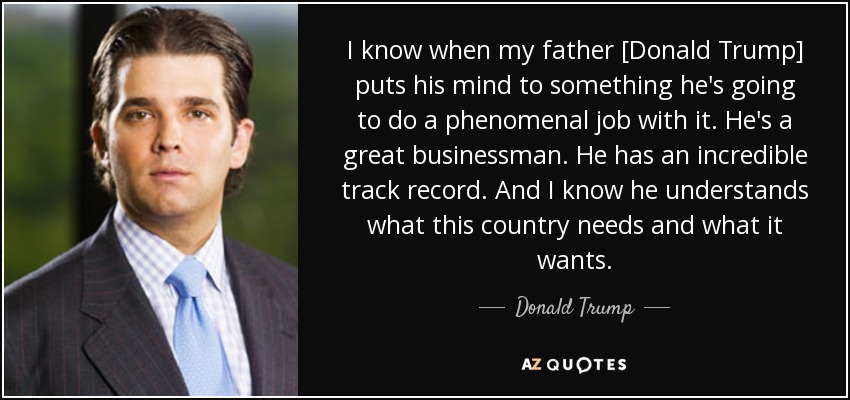
I know when my father [Donald Trump] puts his mind to something he's going to do a phenomenal job with it. He's a great businessman. He has an incredible track record. And I know he understands what this country needs and what it wants.
Ultimately, these fans that we're blessed enough to have, the ones who pay money for tickets to come see us live, that's the bread and butter. That's the basis of what this is. Before I ever had the chance to record an album, the live show is what it's been about.
I really tried to push every genre that I could into this record. I wanted every song to have this feel, where as soon as the listener tunes in, they say "That's CoJo, that's Cody right there." That being said, it is a little different. There's Americana, there's Bluegrass, there's some rock, there's some really George Jones-style stuff on it, slow-style Ray Price country elements, there's some modern country, a little of this and a little of that. We tried to push a lot for show versatility, because I grew up with a lot of versatility in my music.
We talked a lot about Donald's [Trump] record on immigration. There is irony that he has made the center of his entire campaign immigration, given that he faced a $1 million court judgment for being part of a conspiracy to hire illegal aliens, given that news broke that he is hiring foreign workers at his fancy hotel in Florida.
I think that the most significant, guiding principle was that we wanted to return to a three-piece live form, whereas we became a four-piece for the last record because the songs had more extensive arrangements and we needed a keyboard player to pull off a lot of those songs. We missed the energy, and more push-and-pull of the three-piece.
The fact that these scientific theories have a fine track record of successful prediction and explanation speaks for itself. (Which is not to say that I don't directly discuss the work of those philosophers who would disagree.) But even if we grant this, many will argue that scientific knowledge in humans, and, indeed, reflective knowledge in general, is quite different in kind from the knowledge we see in other animals.
I've been really fortunate to have Bridge Records interested in publishing my music for the past 25 years. Most of my music is available in their catalog.
Albums aren't even selling anymore and there's a reason for that. Record companies are just signing single and ring tone deals and it doesn't seem like they're focusing on albums.
What I wanted was just to make music, and so, originally I just wanted to hide behind the album cover of the last record, and I wanted it to be almost anonymous.
Somebody who knows all about how to make the record, or how to make records, they know how to work the EQ and they know how to work the stuff, but they don't know what I want it to sound like. So it's just easier for me to do it myself.
I feel like every great record is like a world in itself.
All the songs on Yankee Hotel Foxtrot are the encapsulation of heterosexual love. I have different records for gay sex.
I want to make music that I know that ten years from now, you can put it on and say "This is a great record".
There was no indie rock band in the 90s at the level of, like, Grizzly Bear. I listen to their records and it's crazy how good they sound. That really freaks me out.
In reality, there's a limit to putting a record out yourself. When it comes to working with major record companies in the context of them owning anything, though, that will never happen. Ever. In my life.
I didn't want to make a record that was just guitar and voice, that was just the technology available to me. At the time, I remember thinking, "I am making a Faust album." That didn't translate.
My big regret is that my brother and I didn't start doing what we did like, 10 years before. I feel like then we would have sold some records. We started pretty late - I was 27 when our first album came out.
I haven't been walking around for years with some burning desire to do a solo record. If I had, maybe I'd have made a record that was experimental. Usually, the idea of a solo record is to get some weird stuff out of your system, but I don't think like that. I wasn't interested in making something that was a hard listen - maybe I'll get around to that some other time. I wanted it to sound effortless, not like I was trying to reinvent the wheel.
In the earlier part of the 90s, I was really hell-bent on discovering how new technology works and how to make records entirely without a producer, which isn't necessarily what fans wanted. But I had to do it because I felt it was in my destiny or whatever.
I have heard a lot of stories - we're putting this in for the monitors, we've got this other set of records. This is a relatively new field, but they're getting better. They're getting more resources from the companies. At some point the factories say, okay, this is here to stay.
For me able to do the records I want to do and not have to worry about this producer or that producer or that trend, I'm not really interested in that.
I had an all-Fear of Music iPod, just versions of the 11 songs from the record. No other songs allowed.
I was always concerned with making cool-sounding rock records.
I'd stopped doing music all of a sudden, and because of Chill and Jay and B, I got half of my album on a solo project. Then I get a call a week later and Jay is like, "Yo, Janet [Jackson] likes one of the records. We'll take five but are you cool with giving Janet one?" I was like, dude, we can do whatever you want to do.
No one's selling records anymore, so there's no income you're being robbed of. I think that you should be in alignment with the world. The world is about sharing now, so as long as it's out there, it should be there. I think it's fine.
Follow AzQuotes on Facebook, Twitter and Google+. Every day we present the best quotes! Improve yourself, find your inspiration, share with friends
or simply: