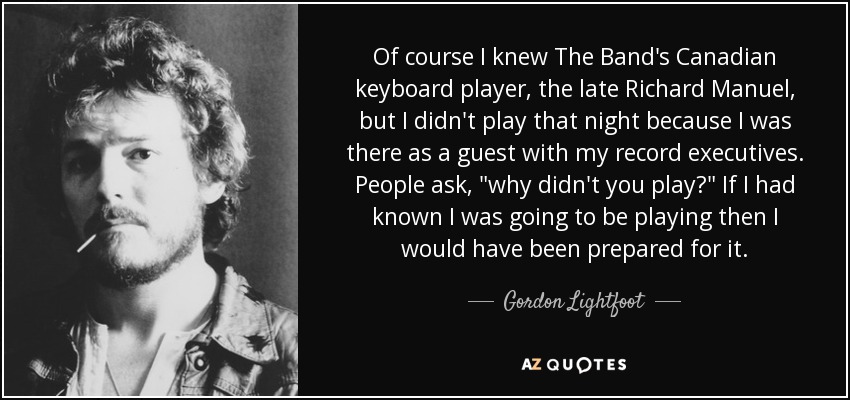
Of course I knew The Band's Canadian keyboard player, the late Richard Manuel, but I didn't play that night because I was there as a guest with my record executives. People ask, "why didn't you play?" If I had known I was going to be playing then I would have been prepared for it.
Only a very small proportion of us take those excesses with us into later life. In the age before everyone had a camera, it was worthwhile, in my opinion, to record those excesses. Sometimes, many times actually, the young people I photographed were only dressed that way for one night; that one night that they got snapped by me.
Nowadays everyone has a camera and the Internet means everything is instantly accessible. Unlike some photographers, I don't see this as a problem. If anything interesting happens in the world today, there will be someone around to record it.
My first record wasn't even with the Fugees. I was signed to Big Beat Records, so I was signed back in 1989 to the label that the Knocks are on now. You can always tell which generation had the pulse based on how they see things.
Since I shoot, record audio and edit, I was able to begin the filming without hiring a crew and create a sample to show broadcasters and grant organizations.
I really got to fuse some of my hip hop & R&B background into the Jessica 6 album since I was really hands on with Morgan & Andrew while writing and producing the record.
What happened in the interim is, billions of records have been digitized. Historians and scholars have always used genealogical records to tell the story of American history. It takes months and years of research. I can't even tell you how laborious that is. You have to be somebody who has a lot of free time, like a professor who can take tenure or someone with a great deal of leisure.
I guess my biggest influence was actually my Grandfather. He used to play old records on vinyl, and would play old jazz and soul music like Ella Fitzgerald, Billie Holiday and The Rat Pack and swing music.
I don't think that there's a target audience at all. These stories were in circulation. The stories were told by men, told in the marketplace by men, but also behind doors by women, but there's no real record of this. It's likely they were told by women to children in their interior rooms. The story could be a negative story, they could be presented as a, "Watch out! Women will get round you, do things to you, weave you in their toils." It could be buried in it an old cautionary story about women and their wiles.
I was a sound engineer, and all of these gurus and shamans would come, and I would record the workshops they were teaching. And I took part in a shamanic journeying workshop, and this woman leading the workshop had brought Ayahuasca, which is a Peruvian hallucinogen and contains DMT.
Music is so incredible, the most healing force in the world along with love of course which all things are created and essentially are. I want to make films that can equal the energy experience of music, the experience of a record that sends your soul to heaven; a film can do this. I've seen films get in this area. Hopefully I've made some; I don't know but I want to make them like this, with the power of musical energy,that's one of my soul-goals for I am in awe of this love called music which I participate in everyday.
I feel connected to every song on this record [ 'Modern Vampires Of The City' ], but yeah I think there's something special about 'Young Lion'. It's pretty different from any song that we've had before because the vocals are kind of between two different very simple instrumental piano melodies and it's almost like something that we call a vignette, it's sort of like a miniature.
I'm trying to figure out how to record at home because I have a tiny house and a seven-year-old and my wife also works at home. So I can't work in the house because she's trying to write, so I pitched a tent in the backyard. I'm literally trying to record in the tent.
Having solidarity is important and having conviction and sticking with it and also consistency. You can't just have one good record, or a couple of good singles, you have to continue making good music to be considered to be a great band. Having some degree of integrity, that's it in one word.
We definitely needed to spend a good solid year just finding ourselves before anyone would even notice us. We had our fan-base growing around here in Los Angeles, but I wouldn't even have wanted anyone to come out to see us that was from a record label or something like that at that time, because we really needed to feel ourselves out as a live band.
I definitely didn't have a lot of money. I had been fired from a record store. I was just trying to get by. I was on unemployment. I didn't have anything going full-time.
I don't release many records just as "Fennesz," so when I do, I want to plan everything in detail. It's not that I want to really lead the listener somewhere; it's more about me being satisfied with a project.
I still make music. I still write music and I record music, I just don't trust music promotion [and] distribution right now enough to record a new set of diligently worked-upon compositions. I do trust the audience and the audiences very much.
I valued the experience of making the recordings, and I value the performances contained therein, and I value so much of what they can represent. I also think they're a terrific listening experience. Putting them out this way was a way of trying to maintain and nurture the relationship with the audience and also shine a light on the recent past, because we are so apt to be forgetful as human beings that there was such a thing as a recent past. These are some of the reasons for making this record.
If we were making a record in Kentucky, there might be some more elements that recall a time, a place, or a relationship. Recording for the BBC you enter into this strange and wonderful, but kind of sterile, place with which you have no personal history, and that's the Maida Vale Studios at BBC in London.
My dream many years ago would've been to continue to write and record songs in record/album form for years to come, but now records aren't what they were then - and so it doesn't actually feel very good to make a record of songs.
"I Wish It Could Be Christmas Every Day," which I actually recorded on "Quality Street" because I don't think anyone has ever covered it before. You hear it every single Christmas, and it is a great record. That's by Wizzard. It is a really great record, but I don't think anyone's ever covered it before, so I had to go it doing it differently. It's quite different from how the original goes.
I've been writing music since I was about eight. I would write sporadically. I wrote a lot of music in high school. I guess the oldest song on the record ("I Thought I Saw Your Face") is about eight years old. It's the old "I had my whole life to write my first album and six months to write the second one." I did, to some degree, but actually, a lot of the songs that ended up on the record, I wrote really recently. So it varies.
It's great, because we've had some really great people playing with us who really have studied the record and been able to recreate a lot of what was done. But I would need a choir of eight, probably, to do all of the backup vocals.
In a sense, I like to think of the live performance as something different than the record, not necessarily looking to exactly recreate the record. Sometimes Matt and I just do duets folk-style. Part of the fun of seeing a live show is having it be different from the way that you hear it in your bedroom or wherever you listen to music.
Follow AzQuotes on Facebook, Twitter and Google+. Every day we present the best quotes! Improve yourself, find your inspiration, share with friends
or simply: