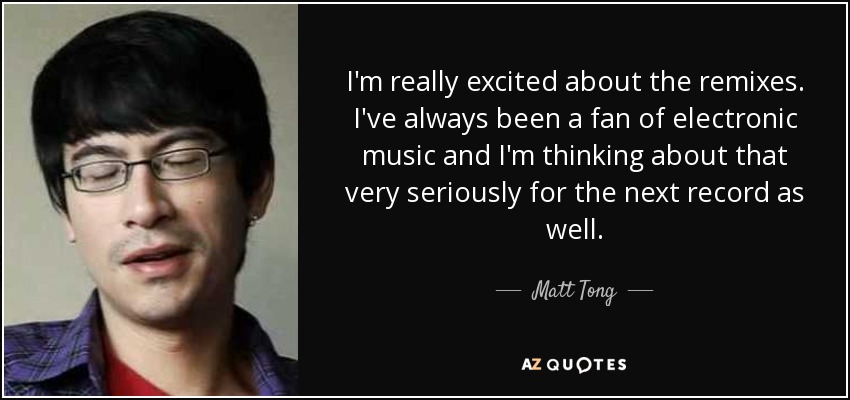
I'm really excited about the remixes. I've always been a fan of electronic music and I'm thinking about that very seriously for the next record as well.
I write about my life and the lives of people around me and situations, and the idea's for each record to try to make you a better person, to understand the life that you lead more.
How many records you sell really does not matter. It's whatever you give.
I finally realized that so much of the music world is about how much money you've got, how much you can pay to make your record successful.
When I was writing some of songs for the record in Galapagos it was the feeling of being there I wanted to evoke more than anything. I remember hearing all the parts of the songs in my mind when I was walking around over the lava fields.
In the process of making the record, I was just so bored all the time working whatever stupid job. I felt like a stagnant pond that has algae and mildew and weird animal cells, and I felt like if I sat around not doing anything long enough, that I'd probably end up going a little bit crazy.
I always listen to records that I've been a part of with a grain of salt.
For the most part I stand by all of records. I just always like the one I've done most recently the best and I think that's the whole point.
It takes so long to make a record and then it takes so long again to release it.
I've always been doing stuff, being creative. But I got to the point where I starting to feel this longing, craving, itchy feeling - which was the first sign that it was time. I've made a few attempts to make other solo records, but when I've looked back at the body of work I've always felt like I was never quite there.
A record is worth 10,000 live shows.
Some kid can say, "Hey, I really want you to play my town in Switzerland, or Sweden, or Latvia," and they could have a fun night at the show. On the other hand, all those kids could have a record that means something to them in a more personal way a couple months down the road. The live band is a really important thing for us, but my focus is on the album now.
I had these glorified ideas about San Francisco and its drug culture - I thought inspiration would just hit me and I would get these San Francisco drugs in my system and all of a sudden an amazing record would come out. But that's not really what happened at all.
Generally, I think people are just going through the motions now. There's so much stuff that people are doing today that has already been done. I kind of like that new Savages record, but I don't know why they take themselves so seriously.
I didn't have to see this big clock on the wall and worry. Most of the record I made was experimental. If you have a lot of time to do that you don't have to worry about the money, plus, I had no money. It was more out of necessity than choice.
I used to tell myself when I was much younger that I didn't want to wake up one day and be 32 years old and still playing records. It's just not going to happen. Well, the joke is on me, because I'm 56 years old now.
It is nice to travel the world and sell records and meet fans and that is so much fun. But I want to always remember that music can heal and it can make someone's day.
We have to wake up early and make songs everyday. I run my record label. You work at hours where your body isn't designed to work. But it's fun.
When I started Fool's Gold and producing consistent records that were like electro beats with rapping on it that was experimental and weird. I made a mixtape called Dirty South Dance where I put rap vocals over dance music. That was literally an experiment. Now all these rappers are rapping on dance music. This is something I've been trying to build for a while.
When I discovered blues - I was 12-years-old - I didn't discover it in America where it was from; I discovered it from Fleetwood Mac - the original Peter Green Fleetwood Mac, Saveloy Brown - like British blues interpretations of it,' which then, when I started the liner notes and seeing all these names, I was like, 'Who's Willie Dixon?' Then I go to the record store and ask the guy there and he goes, 'Oh, you don't know anything.' And so, to me, that's the root of most of it anyway.
If you listen to old Jerry Lee Lewis records, he'll always - about nine times out of 10 have the lyrics different than the original record is.
I don't know what people think in making record is like. But basically, I got a bunch of spaghetti and spaghetti sauce, and the whole band was staying at my house and we had a ball.
Once you got three records, you pretty much got 10.
I admire Chris Martin. Coldplay have made some wonderful records for the genre they're involved in, but I would consider them to be more of a pop act. The music is much more cerebral than it is animalistic.
In my book "Sound Unbound" we traced the guy who actually came up with the main concept for the graphic design of the record cover sleeve. His name is Alex Steinweiss. And one of the things in my book that we really tried to figure out was the revolution in graphic design that occurred when people put images on album covers.
Follow AzQuotes on Facebook, Twitter and Google+. Every day we present the best quotes! Improve yourself, find your inspiration, share with friends
or simply: