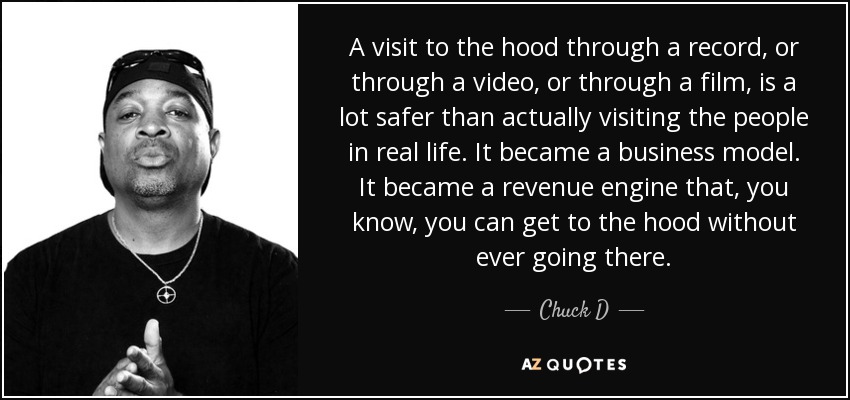
A visit to the hood through a record, or through a video, or through a film, is a lot safer than actually visiting the people in real life. It became a business model. It became a revenue engine that, you know, you can get to the hood without ever going there.
I want the material I make to be mine; that's always the goal of the record and of the show.
When you're young, you're not really worried too much about what people think. You're just in this beautiful, natural place with creativity, and it's just flowing through you, whereas after a few years and a few records, you have all these pressures starting to build on your back.
In fact, on a side note, after the success of the first record, I got asked to write for some pop artists, as everybody does, and I did a couple songs for some of these massive stars and the review that I got back was, "This artist likes the song but it's too POP-y for them." I was like, "What do you mean, I thought I was writing for a pop star."
I kind of rely on my artist friends to make my physical music worth buying by having them all come together and create beautiful artwork that everyone is gonna want to own to support my record.
You don't need a record deal. You'll have the industry begging for you, when you build your buzz.
I signed Jay-Z because he was on fire. I wasn't a genius. The record was great. I put it on The Nutty Professor soundtrack and we signed him.
I have a great family that loves me, a record deal at 14, and I get to do what I love every day.
I would probably creepily follow my kids around, see how they act, see what they talk about. I record my daughter just talking because the things she says are so funny. I could watch her talk all day.
The first rap record came out in '79, but hip-hop began in '69.
In the '70s, anybody who was a connoisseur of collecting vinyl had the velvet brush. Remember the velvet brush? It would clean the record, and you would only grab the record from the sides and you would carefully slide it into the jacket. I never had a velvet brush.
"Rock Candy" was my first record. I had never been in a studio, so I was in shock and I had no idea if it was great or if it stunk. I was just putting in my heart and soul, and closing my eyes and keeping my fingers crossed. I gave it everything.
We always sold 4 or 5 million records no matter what we did.
God works funny so it might have just been meant for me to be an artist that doesn't sell two million records. Maybe my records might change somebody's life rather than sell thru the roof.
Maybe my records might make the next Ja Rule or Jay-Z want to rap.
It could be the old man I see at the store or the chick I see walking down the block. Normal people that are everywhere you go. That's who I make records for and I don't expect all of them to give me pay $11.99 to hear my record.
It used to be when a good record was about to drop you heard it out of every car and every kid with a boom box was playing it 3-4 weeks before it came out. Now it's not like that you just see ipods left and right and there's no anticipation factor. I have yet to see something drop with the anticipation that Illmatic had or that Ready 2 Die and Cuban Linx had. Those records had real anticipation factors.
What was really interesting in his speech, which, by the way, had (inaudible) footnotes - the written version of it - which might be a personal record for Donald Trump - the source of a lot of his numbers on the free trade section of the speech came from an organization called the Economic Policy Institute, which was a think tank or is a think tank that was founded by labor unions to promote the labor unions' point of view on free trade agreements.
I don't make my living making records. Maybe someday I will.
I told all kinds of stories about going to Japan, about playing ball with my father... I wanted to record my life in case it was going to end soon. So, I wrote that and it was very comforting to have that practice in the afternoons in my living room. I just wrote about my life.
Everybody talks about candidate tax returns, and they release those - well, most. But medical records, that's another thing, and that arguably might be more important or relevant than somebody's tax return.
Turning music into digital was just a con, a record-company con.
I remember the first time I saw a CD, a technology guy brought one to my house and said we will be able to sell millions and millions of players, and people will have to restock their record collections. It was all about money. It was all about how much money we would make, "we" being "him."
More recently I've come to terms with what I'm doing and why I'm doing it. That's why you start to see me recoiling from 'let's put out radio records, let's get rich and get on out of here.' I have gone towards more speaking to kids and putting out records that I like.
People keep asking me if recently performing the Betty album will influence the song-writing and I think it might. There's songs on that record that I forgot about and it's really nice to have that variety in the set along with tracks from Strap It On, Meantime, Aftertaste, Size Matters, Monochrome, and Seeing Eye Dog.
Follow AzQuotes on Facebook, Twitter and Google+. Every day we present the best quotes! Improve yourself, find your inspiration, share with friends
or simply: