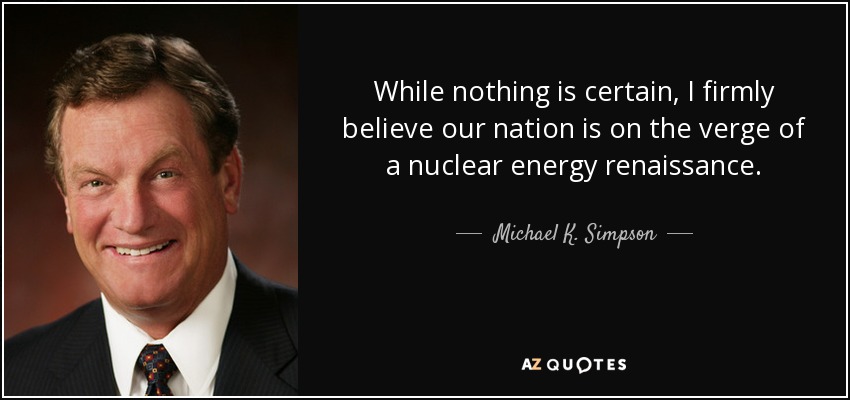
While nothing is certain, I firmly believe our nation is on the verge of a nuclear energy renaissance.
In a sense, Open City is a kind of Wunderkammer, one of those little rooms assembled with bric-a-brac by Renaissance scholars. I don't mean it as a term of praise: these cabinets of curiousities contained specific sorts of objects - maps, skulls (as memento mori), works of art, stuffed animals, natural history samples, and books - and Open City actually contains many of the same sort of objects. So, I don't think it's as simple as literary inclusiveness.
We are in the middle of a tough, ideological conflict that is being waged across the entire continent. On the one side are those who say that global challenges like migration and terror cannot be met with national parochialism. On the other side are those who would like to see a renaissance of the nation-state.
Renaissance or the reawakening of Europe. And, and this reawakening actually involved an era during which the people of Europe, who were coming out of the Dark Ages, were then adopting the value system of the people in the East, in the, of the oriental society.
I do feel we live through what I like to call The 2nd Renaissance, but although I foresee a widespread return to the European religion I don't foresee a return to the past. The world has changed, everything is different today, and so will Paganism be.
It seems to me that the modern painter cannot express this age, the airplane, the atom bomb, the radio, in the old forms of the Renaissance or of any other past culture. Each age find its own technique.
The Nineties was such an incredible period. There was this real sense of community and such a uniqueness to it. There were unique personalities, unique bands, unique lyrical takes. A lot of artistic expression. It was this real renaissance that was exciting to be a part of. It's hard to not look back on that period and say, "Yeah, it was crazy. But it was crazy good."
These three qualities I recommend to you; tenacity, goodness, and intelligence. They are as valuable today as they were in the time of the ancient Greeks, Romans and during the renaissance. They will help make you good professionals.
Pathology, probably more than any other branch of science, suffers from heroes and hero-worship. Rudolf Virchow has been its archangel and William Welch its John the Baptist, while Paracelsus and Cohnheim have been relegated to the roles of Lucifer and Beelzebub. ... Actually, there are no heroes in Pathology-all of the great thoughts permitting advance have been borrowed from other fields, and the renaissance of pathology stems not from pathology itself but from the philosophers Kant and Goethe.
This is why it might be more useful to understand the proliferation of interactive media as an opportunity for renaissance: a moment when we have the ability to step out of the story altogether. Renaissances are historical instances of widespread recontextualisation. People in a variety of different arts, philosophies and sciences have the ability to reframe their reality. Renaissance literally means 'rebirth'. It is the rebirth of old ideas in a new context.
I am what I have always been: the last Renaissance man, if I may be allowed to say so.
I am particularly conscious of my connection to the poets of the Harlem Renaissance because I, too, am a Black poet, born into, and shaped by, the very community in which those poets of the past produced so much of the work we associate with the Harlem Renaissance. We speak from the same place, both literally and metaphorically.
When I think of the Harlem Renaissance, I think of bright colors, and bold, dynamic art. African American artists of the period were, in large measure, breaking out of the constrictions white society had set for them. They were claiming and remaking their own images, and doing so in bold and striking ways.
I like things that are kind of eclectic, when one thing doesn't go with another. That's why I love Rome. The town itself is that way. It's where Fascist architecture meets classic Renaissance, where the ancient bangs up against the contemporary. It has a touch of everything. That's my style, and that's what my work is about.
When we talk about the future, we often talk about it as damage and limitation exercise. That needn't be the case - it could be a Renaissance.
Eric Walrond, handsome, cosmopolitan, and beguilingly enigmatic, may have been the most promising literary talent of the Harlem Renaissance.... James Davis's finely written, beautifully paced Eric Walrond is a major biography of a fascinating figure.
A housing renaissance has begun. This may be hard to believe after the dizzying, six-year-long crash in home sales, construction and house prices. But housing turned the corner last year, and it will take off in 2013.
I'm old-fashioned. I think William Blake and people in the Renaissance people were multi. Look at da Vinci, he was involved in science; and Michelangelo was dabbling in poetry. Both of them were painters and sculptors but they also involved themselves with architecture. I honestly don't know what happened in the '60s and '70s. If you sang rock and roll in America at that time or were involved in expressing yourself through music like that, then many thought you couldn't possibly be an artist. That thinking is archaic.
It is part of what makes America great. That tradition of the free press, and also the tradition of this highly competitive market for investigative journalism. We're seeing, there's no question, that we're seeing a renaissance of that.
Leisure was the sine qua non of the full Renaissance. The feudal nobility, having lost its martial function, sought diversion all over Europe in cultivated pastimes: sonneteering, the lute, games and acrostics, travel, gentlemanly studies and sports, hunting and hawking, treated as arts.
Senegal needs a renaissance.
I feel like it's almost a Renaissance thing, a painting, a modern version of a painting. I think it's important for Kim [Kardashian] to have her figure. To not show it would be like Adele not singing.
The things that I look at include Renaissance art. I'm obsessed with churches and paintings of saints.
That's where I got the idea to paint the walls of the gallery with varied colours [at the Whitechapel show]. I tried to figure out how all these Renaissance paintings manage to work together.
We may affirm, then, that the main drift of the later Renaissance was away from a humanism that favored a free expansion toward a humanism that was in the highest degree disciplinary and selective.
Follow AzQuotes on Facebook, Twitter and Google+. Every day we present the best quotes! Improve yourself, find your inspiration, share with friends
or simply: