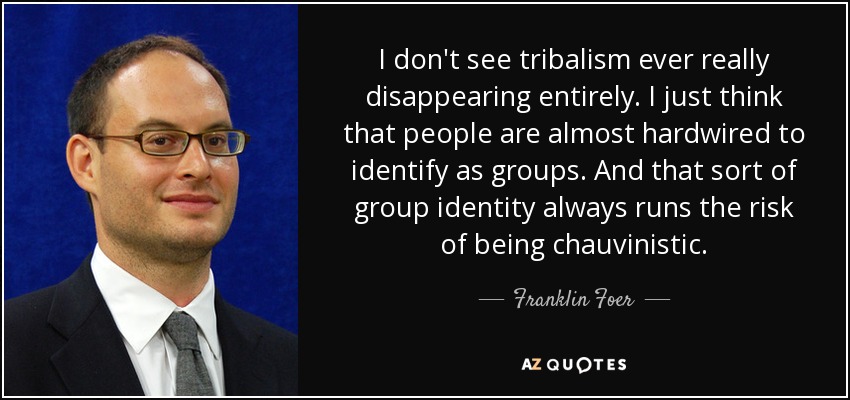
I don't see tribalism ever really disappearing entirely. I just think that people are almost hardwired to identify as groups. And that sort of group identity always runs the risk of being chauvinistic.
Awkwardness is when there's a risk of a perception gap between what you mean and what you appear to mean.
I think I just do what I feel is good to do. Everybody can give me their suggestions, but at the end, the final risk is mine because it's my name on the magazine. So I only do what I really feel. Everybody tries to influence you, of course: "Oh, this is the right moment to do this" and "This is the right photographer to choose," and "This is the right model to have . . ." I listen, but I must go my own way. When you take risks, it means that you know every month people are there to judge you.
I like to be risky every day, changing minds every day. I'm not reliable at all in my ideas. I can change my ideas three times a day. I change different things, the parts of the content. But I never change the content of who I am. So my challenge every day is to change and to take risks.
The problem Philip Morris had with electronic cigarettes since the beginning of development was the satisfaction of the smoker. Because the taste is dramatically different and, at the initial stages, the nicotine pharmacokinetics were very slow. You could not get the satisfaction. It's not so easy to crack this code. The taste satisfaction is very important. The closest you are to this, the more chances you have to switch people. It's very nice to have a zero-risk product, but if nobody uses it, you don't have any reduction in public health risk.
Any sign that says we're going to leave Iraq before the job is done simply emboldens terrorists and creates a certain amount of doubt for people, so they won't take the risk necessary to help a civil society evolve in the country.
My personal philosophy is, talk about whatever you want on a show, but it better be good. And especially if it's something that challenges folks. You don't want to be on the side of power to demean a group that is at risk. Because that's propaganda. Whenever you're on the side of power, you're not making art. Art upends power.
My life philosophy and personality has been driven by the fact that I am incapable of really understanding the future, on some level. I am in this moment. I take risks because I really don't think that far ahead.
I think we should be organized in something called an Alliance Against Nuclear Terrorism. In the same way that NATO was the great alliance of the Cold War and served a great purpose then, we need now, in the war on terrorism, a new alliance, the mission of which would be to minimize the risk of nuclear terrorist attacks, and the members would agree to sign on to the gold standard.
In the war time many of the publishing houses were privately owned, a single publisher or a publisher and a few associates who were responsible for everything. They could take whatever risks they wanted, could essentially publish what they liked according to their taste. Publishers today are working for big corporations. They have different pressures. I don't think they can make decisions quite as independently as they used to be able to. They have more corporate and financial responsibilities weighing on them. They're not free to go broke or go to jail.
Once upon a time, an editor could try out one or two wacky books, knowing full well that their list would counterbalance any risk with a stable of best-sellers and safe bets. Nowadays, every book must earn its own bread. With low overheads and an often episodic operating status, the small independent press is nicely placed to snap up the most innovative literature going at the moment. To take the risks. Meaning that small presses are no longer just outfits set up to publish your or your friends' work. They have something genuinely important to offer.
You risk everything if you so much as join a legal protest demonstration in Russia. It raises the stakes.
We give up and don't try. We don't take sufficient chances or risks. We aren't resilient in the face of failure. We follow the "rules" too much and don't push the envelope.
When CNN launched in the early 1980s, everybody said: A 24-hour news network won't work. They launched, they did ok, CNN went almost bankrupt because of the risks they had taken, they got bailed out, and 25 years later CNN is a huge global brand. I think the same is going to happen in digital. If you look at the younger generation, there is a huge consumption of digital media and almost no consumption of print or traditional television. Eventually money will follow that. It is just a question of which companies win, how long it takes to get there and what kind of model you need to apply.
I'm an indulgent writer - I'm not sure, however, that's something I'm interested in changing. Writing should be indulgent: you should take big risks on the page, you should make big mistakes, you should be excessive at times. I let myself do as a writer what I probably would be less likely to allow as an editor.
As a country, Americans have to find a way to keep our cities solvent. If large numbers of cities no longer have the necessary tax base, we have to find federal methods to intervene. If we don't, there's a risk of dozens of cities simply being left to their bankrupt fates - and I can't see how that serves anybody's interests in the long run.
Something that I wanted to do through the film is try to explore the roots of belief, because everything has to do with beliefs. When I studied the side of the rationalists and the skeptics, and the side of the believers and so-called psychics, I found out that both of them, no matter what they claim to do, behave in a very similar way. They only accepted what confirmed their previous positions, and tended to reject everything that put them at risk.
When I look in the mirror, I see a God-fearing man who would risk it all for family and his beliefs.
You can't really get the full joy out of life unless you really go for it. You just have to go into it and stay under some kind of hope or illusion that it's going to work. But as you get older, or the more experiences you have, or whatever it is that tells you how this stuff works, you also know that if you go all the way into it, there's the risk of losing everything but you don't have a choice.
We're living in a literary age, at least in America, that is marked by a sense of distance, a coolness, in all senses of that word. To be too obviously, unapologetically emotional is to risk being considered foolish, or at the very least not serious.
The most profound question is, "What would I risk dying for?" The natural answer is "for my family." But for most of history, we didn't live in families. We lived in small communities that gave us our sense of safety and place in the world, so the natural answer would be "for my people." The blessing and the tragedy of modern life is that we don't need our community to survive anymore. When we lose that idea, we lose a sense of who we are.
I'm not interested in safety. A great risk in writing is imagining you have something to protect. Playing it safe to placate someone or something. People talk about compromise, but often people don't even know when they're compromising, because they're not conscious of contradictions.
Designful companies are those that weave design thinking into the fabric of the company. In a designful company, innovation is rewarded instead of punished. Risk taking is the norm instead of the exception. Some companies have already embraced this type of culture change with impressive results.
I can actually approve of some of Donald Trump's North Korea policy, the sanctions, for example, doing things that other presidents would have done. But it's impossible to imagine any other president going before the U.N. General Assembly and referring to the dictator of North Korea as "Rocket Man," or issuing this series of blustery threats, which, frankly, are terrifying, and are raising the risk of a needless war.
If we were a culture of high-risk alcoholics, and suddenly we had Jack Daniels piped into our houses, we would be feeding that fire. Social networking, and the internet as a whole, seems to have simply landed in an extremely fertile place in an extremely fertile time in history, when we all have these narcissistic tendencies anyway - you can go further back into the self-esteem movement, and Dr. Spock, and the 'everybody gets a ribbon at the track meet' sort of thing, which preceded the internet - and then you drop the internet into the middle of this, and we've all gone haywire.
Follow AzQuotes on Facebook, Twitter and Google+. Every day we present the best quotes! Improve yourself, find your inspiration, share with friends
or simply: