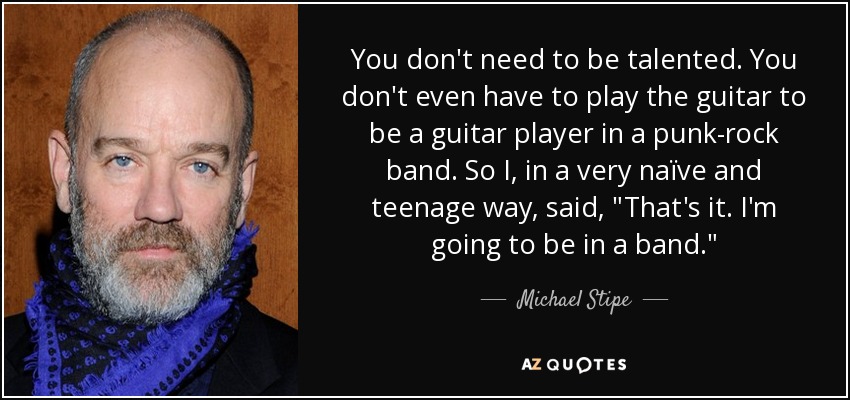
You don't need to be talented. You don't even have to play the guitar to be a guitar player in a punk-rock band. So I, in a very naïve and teenage way, said, "That's it. I'm going to be in a band."
As a woman, you listen to more female singers, like guys listen to more rock bands. So in that way, they influence you because you're trying to create an identity; you look to others to model.
Even though were not the most punk rock band, the way weve done things is pretty punk rock. Just kinda say it with a big middle finger to the record labels and do it ourselves.
Punk-rock gave music back to people. For a long time, when I was very young, I went to go see arena rock bands. I was 16 and it was all I could get in to see, legally. And I saw Led Zeppelin and Ted Nugent and Van Halen and all that. Me and [Minor Threat and Fugazi vocalist] Ian MacKaye would go to these concerts, and it was fun.
Well, in some ways I had sort of the opposite experience of other people that are sort of dreaming of being in a rock band. I was dreaming of like corporate lunches and just like, and I'm not really joking. Like the whole idea to me was really appealing.
Getting on stage, for me, was a huge thing when I first started. And back in high school, everyone was in rock bands and I was a singer/songwriter. It just seems kind of lame.
The Rolling Stones are constantly changing, but beneath the changes they remain the most formal of rock bands. Their successive releases have been continuous extensions of their approach, not radical redefinitions, as has so often been the case with the Beatles.
When I was nine years old, I started playing guitar, and I took classical guitar lessons and studied music theory. And played jazz for a while. And then when I was around fourteen years old, I discovered punk rock. And so I then tried to unlearn everything I had learned in classical music and jazz so I could play in punk rock bands.
Me personally, I side more with punk rock bands. I grew up with The Misfits, The Dead Boys, The Damned, Dropkick Murphys, and early AFI. That was the stuff that really got me into music. Song writing wise, bands like Alkaline Trio were very important to me for beginning to write songs.
As much as being in a rock band can be really glamorous and exciting - and it can be a lot of things that people imagine it to be - if you just live that lifestyle, you're gonna burn out really quickly.
Every improv must be song specific. It has to grow organically out of the particular elements involved or it's just glib self-expression. I hate when I feel like I'm the lead guitarist in a rock band. We all gotta be going somewhere strong together, you know?
I have my small little cult following, I play random shows from house parties to opening up for rock bands.
I've never recognized 'emo' as a genre of music. I always thought it was the most retarded term ever. I know there is this generic commonplace that every band that gets labeled with that term hates it. They feel scandalized by it. But honestly, I just thought that all the bands I played in were punk rock bands. The reason I think it's so stupid is that - what, like the Bad Brains weren't emotional? What - they were robots or something? It just doesn't make any sense to me.
I’ve been making electronic music for twenty some odd years but, because I grew up playing in punk rock bands, when I started touring, I thought in order to be a viable touring musician I had to do it with a band. I would DJ or tour with a full rock band.
With Rock Band, you can play along to Black Sabbath or Nirvana and possibly find new ways of appreciating their artistry by being allowed to perform parallel to it. Rock Band puts you inside the guts of a song.
I started out as a drummer, and now play with a back-to-basics rock band called the 'Luddites.' I'm happiest when I'm behind the kit.
I listen to all kinds of bands. I like rock music, like, male rock bands. I'm more into that instead of female singers. I like Nirvana, Green Day, System Of A Down. I also like punk rock, and I love bands like Coldplay.
Rock & roll mostly is a very butch thing, and it appeals to one hard side of the masculine character. But I don't think the Rolling Stones are only a rock band. They can be other things. They can be very feminine.
I don't know what happened. I just exploded. I'd never sung like that before. I used to stand still and sing simple, but you can't sing like that in front of a rock band. You have to sing loud and move wild with all that in back of you. Now, I don't know how to perform any other way.
My friend Fred Coury, the drummer in '80s rock band Cinderella, told me that in the rock world, you're either still there, or you're struggling to get back to where you were.
I love dancing, but I'm not that good of a singer. I sang in punk rock bands in high school and college and stuff, but that mostly involved lots of screaming.
In a way, as much as we love to be a big, loud rock band, the acoustic album was a lot easier to make than the rock records. I think because it was brand new territory for the band.
People are wrong when they say that everything should be more diverse, even, say, rock bands. It's an error, an overgeneralization.
I started just concentrating on songwriting when I was abut 20; I'd been in rock bands six or seven years, kinda got that out of my system, I said, "ok, you ain't gonna be a rock star, you don't look like a rock star, it probably ain't gonna happen. So what you should do is write songs and maybe other people will do your songs."
I don't want to say that most rock bands live these formulaic biography existences - but they kinda do. There's always a divorce. There's always an OD. There's always a bad business manager.
Follow AzQuotes on Facebook, Twitter and Google+. Every day we present the best quotes! Improve yourself, find your inspiration, share with friends
or simply: