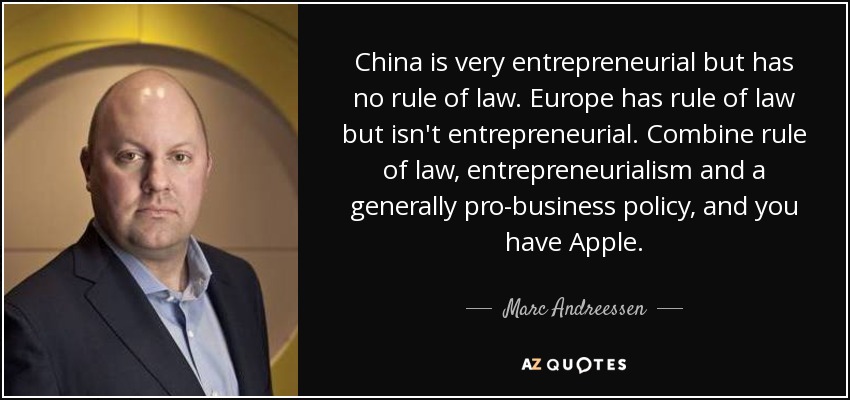
China is very entrepreneurial but has no rule of law. Europe has rule of law but isn't entrepreneurial. Combine rule of law, entrepreneurialism and a generally pro-business policy, and you have Apple.
Often, we take stability - peace in terms of security and economic activity - to mean a country is doing well. We forget the third and important pillar of rule of law and respect for human rights, because no country can long remain prosperous without that third pillar.
I think the United States is still the indispensable force for positive change and for rule of law and for order and structure.
There was a real choice when [Barack Obama] became president. It was a very difficult choice - to say, "We're not going to hold senior officials to account with the same laws that every other citizen in the country is held to," or "This is a nation that believes in the rule of law."
Once I spoke about this subject among a group of English intellectuals. One of them was a professor on Roman Law at one of the leading British universities. I asked him,what was the official language of the Byzantine Empire? He said, maybe sometime in the sixth or the seventh century.The Justinian Codex, the rule of law in the Byzantine Empire which was produced by Emperor Justinian, it was written in Latin.And he looked at me ,he knew that I knew already that the only original copy was found in the beginning of the sixteenth century.
Together, America and the United Kingdom are a beacon for prosperity and the rule of law. That is why the United States respects the sovereignty of the British people and their right of self-determination.
We want to have trade agreements that give us a level playing field, get other countries to respect the rule of law, intellectual property rights, lower their taxes to our barriers, that`s good for us, and that is something that I do believe that President [Donald] Trump agrees with.
I want people to understand that, look, we're in a period of democratic deficit, democratic recession. There are fewer democracies in the world today than in 2005, and in many of the countries that are still technically democracies, we're seeing a reduction in the rule of law. And that's especially true in Central Europe, but it's also true of places like South Africa, the Philippines.
The IMF and the World Bank, the most opaque and secretive entities, put millions into NGOs who fight against "corruption" and for "transparency." They want the Rule of Law - as long as they make the laws. They want transparency in order to standardise a situation, so that global capital can flow without any impediment.
Everyone who chooses to live in Europe must accept the basic values. This includes the rule of law as well as equality of men and women and non-discrimination against religious and other minorities.
Why is it Muslims from Pakistan or from Egypt come to America and thrive, and they are frustrated back home? It's about clean government. It's about a rule of law. It's about intellectual property protection. They've got all the talent and energy of anybody else. As new immigrants they may have more of it, so you put them in our system and they become doctors, lawyers, and businessmen and entrepreneurs.
Good, healthy democratic societies are built on three pillars: there's peace and stability, economic development, and respect for rule of law and human rights. But often, we take stability - peace in terms of security and economic activity - to mean a country is doing well. We forget the third and important pillar of rule of law and respect for human rights, because no country can long remain prosperous without that third pillar.
The idea was to restore the rule of law, to bring order to a chaotic situation. The results became more and more apparent. Crime rates went down in the border region. Today, the number of migrants crossing is at a 30-year low. That's because of years of bipartisan work on this issue.
Deanell Tacha and I decided to write an editorial, because both of us have had experiences in countries where the rule of law is not strong. Uh, where there is civil war. Where there is disorder. And, it, it seemed to us important to underscore that this is a treasure, our rule of law, our judiciary independent from politics, and it's in jeopardy.
Of course, in the states, about half the states elect their judges, and that's an even more direct involvement with politics. But I think it's not the same as the elections of many other candidates. People who run for the judiciary, I think are pretty careful to indicate that they will adhere to the rule of law.
Donald Trump has laid out a priority to remove criminal aliens, remove people that have overstayed their visas. And - and once we have accomplished all of that, which will - which will strengthen our economy, strengthen the rule of law in the country and make our communities safer once the criminal aliens are out, then we'll deal with those that remain.
Ratings are king and the money keeps flowing, and partisanship is so strong today that people rely on a few sources absolutely instead of thinking critically. So even being a cheerleader for a gameshow-host president with no respect for the rule of law or America's reputation in the world may not be a career-ending move.
We like to say that India has the advantage of being a large market. We have provinces, we have the rule of law, we have a system of justice. But those are also weaknesses when compared with China. On the other hand, one of our strengths is that we are very individualistic, and as individuals we are very creative. But that, too, is a weakness, because it keeps us from working well together. Everyone thinks only about his own profit.
The great ideas of the West - rationalism, self-criticism, the disinterested search for truth, the separation of church and state, the rule of law, equality before the law, freedom of conscience, thought, and expression, human rights, and liberal democracy- quite an achievement, surely, for any civilization- - remain the best, and perhaps the only, means for all people, no matter of what race or creed, to reach their full potential and live in freedom.
Since natural law was thought to be accessible to the ordinary man, the theory invited each juror to inquire for himself whether a particular rule of law was consonant with principles of higher law. This view is reflected in John Adams' statement that it would be an 'absurdity' for jurors to be required to accept the judge's view of the law, 'against their own opinion, judgment, and conscience.'
I have no doubt that there will continue to be bumps, some serious crises indeed in our relationship with China.... Neither membership in the WTO nor normalized trade relations with the United States will magically impose the rule of law on China or institute deep-seeded respect for human rights. But it certainly has potential to advance those purposes.
British Conservatives base their entire approach to politics on the rule of law, and rightly so.
The Universal Declaration of Human Rights recognizes that 'if man is not to be compelled to have recourse, as a last resort, to rebellion against tyranny and oppression', human rights should be protected by the rule of law. That just laws which uphold human rights are the necessary foundation of peace and security would be denied only by closed minds which interpret peace as the silence of all opposition and security as the assurance of their own power.
Transparency and the rule of law will be the touchstones of this presidency.
I believe in the Constitution. I believe in separation of powers. I believe in the rule of law. I believe in limited government. And these are principles and policies that apparently neither the national Republican nor the national Democrat Party believes in. I believe great damage is being done to our Constitution, and I see no remedy at all, no likelihood of that changing, if we rely on the two parties to field our candidates for national office.
Follow AzQuotes on Facebook, Twitter and Google+. Every day we present the best quotes! Improve yourself, find your inspiration, share with friends
or simply: