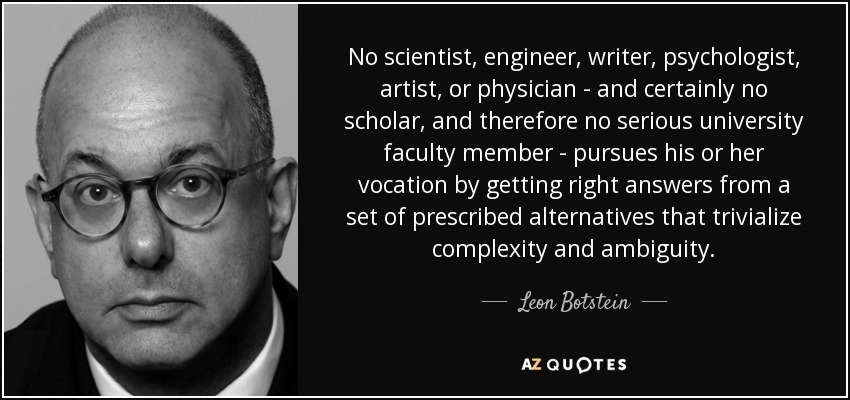
No scientist, engineer, writer, psychologist, artist, or physician - and certainly no scholar, and therefore no serious university faculty member - pursues his or her vocation by getting right answers from a set of prescribed alternatives that trivialize complexity and ambiguity.
The new painters do not propose, any more than did their predecessors, to be geometers. But it may be said that geometry is to the plastic arts what grammar is to the art of the writer. Today, scholars no longer limit themselves to the three dimensions of Euclid. The painters have been lead quite naturally, one might say by intuition, to preoccupy themselves with the new possibilities of spatial measurement which, in the language of the modern studios, are designated by the term fourth dimension.
In the School of Coquettes Madam Rose is a scholar,-O, they fish with all nets In the School of Coquettes! When her brooch she forgets 'Tis to show her new collar; In the School of Coquettes Madam Rose is a scholar!
The Bible is not primarily a written or printed text to be scrutinized in private, in a scholar's study or a contemplative cell. It is a body of oral messages, announcements, prophecies, promulgations, recitals, histories, songs of praise, lamentations, etc., which are meant either to be uttered or at least read aloud, or chanted, or sung, or recited in a community convoked for the purpose of a living celebration.
The words of the scholar are to be understood. The words of the master are not to be understood. They are to be listened to as one listens to the wind in the trees and the sound of the river and the song of the bird. They will awaken something within the heart that is beyond all knowledge.
Silence is a trick when it imposes. Pedants and scholars, churchmen and physicians, abound in silent pride.
Recall that the United Nations commissioned Arab scholars and analysts to publish the Arab Human Development Report. What causes the backwardness, the scholars wondered, of 22 Arab states, covering nearly 300 million people? Their conclusion? Of all world regions, the Arab countries scored the lowest in freedom, media independence, civil liberties, political process and political rights.
Scientists and scholars should constitute themselves as an international NGO of exceptional authority.
Civilizations evolve over time, and most scholars of civilization, including people like Carol Quigley, argue that they go through periods of warring states, and eventually evolve into a universal state.
The mind of the scholar, if you would have it large and liberal, should come in contact with other minds. It is better that his armor should be somewhat bruised by rude encounters even, than hang forever rusting on the wall.
America has not always been kind to its artists and scholars. Somehow the scientists always seem to get the penthouse while the arts and humanities get the basement.
What is needed desperately today is prophetic insight. Scholars can interpret the past; it takes prophets to interpret the present.
Phillip Roth uses his Black women characters to make anti intellectual remarks about Black history month, begun by a man who reached intellectual heights that Roth will never attain. Roth is a petty bigot and his ignorant remarks about black culture expose him as a buffoon to scholars the world over.
I would probably have been very content as a scholar to have carried on organising exhibitions and writing books and teaching.
More than any other contemporary British playwright, Tom Stoppard populates his plays -- from Rosencrantz and Guildenstern Are Dead to The Invention of Love (his portrait of the poet and scholar A. E. Housman) -- with characters from life and literature. But one cannot always tell the difference between those who are real and those who are imaginary.
What of the Exodus? That too, is a wonderful story, but from the viewpoint of an historian, it is - to use a word scholars love - problematic. Let's say there are doubts, to say the least, among many scholars, as to whether the Exodus actually occurred. That's a historical issue.
In the Marquette Lecture volume, I focus on the question in the title. I emphasize the social and political costs of being a Christian in the earliest centuries, and contend that many attempts to answer the question are banal. I don't attempt a full answer myself, but urge that scholars should take the question more seriously.
Slavery is no scholar, no improver; it does not love the whistle of the railroad; it does not love the newspaper, the mailbag, a college, a book or a preacher who has the absurd whim of saying what he thinks; it does not increase the white population; it does not improve the soil; everything goes to decay.
If you would learn to write, it is in the street you must learn it. Both for the vehicle and for the aims of fine arts, you must frequent the public square. The people, and not the college, is the writer's home. A scholar is a candle which the love and desire of all men will light.
The John F. Kennedy Institute of Politics was originally intended to bring scholars and politicians into closer contact, on the assumption that other office-holders can use academics as profitably as Kennedy did during his political career.
BBC Radio is a never-never land of broadcasting, a safe haven from commercial considerations, a honey pot for every scholar and every hare-brained nut to stick a finger into.
The scholar may lose himself in schools, in words, and become a pedant; but when he comprehends his duties, he above all men is arealist, and converses with things.
Can we expect the redemption of the world from scholars? I doubt it. But the time has come for all artists to join together as a confederation in an eternal league.
It has been remarked that when one passes among the patients of the psychiatric ward, he encounters among the several sufferers every aspect of normal personality in morbid exaggeration. ... As one passes through the modern centers of enterprise and of higher learning, he is met with similar autonomies of development. ... The scientist, the technician, the scholar, who have left the One for the Many are puffed up with vanity over their ability to describe precisely some minute portion of the world. Men so obsessed with fragments can no more be reasoned with than other psychotics.
No life, my honest scholar, no life so happyand so pleasant as the life of a well-governed angler; for when the lawyer is swallowed up with business, and the statesman is preventing or contriving plots, then we sit on cowslip-banks, hear the birds sing, and possess ourselves in as much quietness as these silver streams, which we now see glide so quietly by us.
Follow AzQuotes on Facebook, Twitter and Google+. Every day we present the best quotes! Improve yourself, find your inspiration, share with friends
or simply: