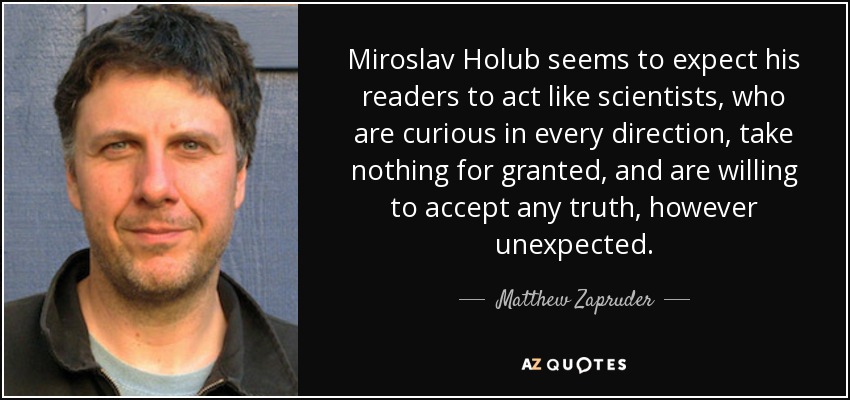
Miroslav Holub seems to expect his readers to act like scientists, who are curious in every direction, take nothing for granted, and are willing to accept any truth, however unexpected.
It is a fact that scientists have deposited dye in certain lakes around Orlando and tracked the effluent to Florida Bay. There is a lake near Everglades City, Deep Lake, and large tarpon show up in that lake, 30 miles from the sea.
I always assumed scientists were free to ask any question, pursue any line of inquiry without fear or reprisal.
Scientists say over the next hundred years, the coast of California will sink almost five feet. So the presidential candidates need to do something. Mitt Romney is conflicted. On one hand, he denies that global warming exists. But if California is under water, he would definitely win the next election.
Poorly secured nuclear material in the former Soviet Union, or secrets from a scientist in Pakistan could help build a bomb that detonates in Paris. The poppies in Afghanistan become the heroin in Berlin. The poverty and violence in Somalia breeds the terror of tomorrow.
Jesus was the consummate scientist. He knew the omnipresence of Light which we have expressed in radio, radar and television, but all He could say in His day was: "I have yet many things to say unto you, but ye cannot bear them now."
The three most effective incentives to human action may be ... classified as creed, greed and dread. ... In examining the scientist it is perhaps worth while to examine how far he is moved by these three incentives. I think that, rather peculiarly and rather exceptionally, he is very little moved by dread. ... He is in fact essentially a person who has been taught he must be fearless in his dealing with facts.
When people start using science to argue for their specific beliefs and delusions, to try to claim that they're supported by science, then scientists at least have to speak up and say, You re welcome to your delusions, but don't say that they're supported by science.
Plot idea: 97% of the world's scientists contrive an environmental crisis, but are exposed by a plucky band of billionaires & oil companies.
Rather than being an interpreter, the scientist who embraces a new paradigm is like the man wearing inverting lenses.
But, as all scientists know, there is a time lag of 12 to 18 months between the time a manuscript is submitted and the time it is published in a scientific journal.
I do not personally want to believe that we already know the equations that determine the evolution and fate of the universe; it would make life too dull for me as a scientist. ... I hope, and believe, that the Space Telescope might make the Big Bang cosmology appear incorrect to future generations, perhaps somewhat analogous to the way that Galileo's telescope showed that the earth-centered, Ptolemaic system was inadequate.
[The scientist] believes passionately in facts, in measured facts. He believes there are no bad facts, that all facts are good facts, though they may be facts about bad things, and his intellectual satisfaction can come only from the acquisition of accurately known facts, from their organization into a body of knowledge, in which the inter-relationship of the measured facts is the dominant consideration.
It can be said with complete confidence that any scientist of any age who wants to make important discoveries must study important problems. Dull or piffling problems yield dull or piffling answers. It is not enough that a problem should be "interesting".
No scientist is admired for failing in the attempt to solve problems that lie beyond his competence. ... Good scientists study the most important problems they think they can solve. It is, after all, their professional business to solve problems, not merely to grapple with them.
[Newton wrote to Halley ... that he would not give Hooke any credit] That, alas, is vanity. You find it in so many scientists. You know, it has always hurt me to think that Galileo did not acknowledge the work of Kepler.
Ever since the beginning of modern science, the best minds have recognized that "the range of acknowledged ignorance will grow with the advance of science." Unfortunately, the popular effect of this scientific advance has been a belief, seemingly shared by many scientists, that the range of our ignorance is steadily diminishing and that we can therefore aim at more comprehensive and deliberate control of all human activities. It is for this reason that those intoxicated by the advance of knowledge so often become the enemies of freedom.
There is a great deal of emotional satisfaction in the elegant demonstration, in the elegant ordering of facts into theories, and in the still more satisfactory, still more emotionally exciting discovery that the theory is not quite right and has to be worked over again, very much as any other work of art-a painting, a sculpture has to be worked over in the interests of aesthetic perfection. So there is no scientist who is not to some extent worthy of being described as artist or poet.
DURING THE PAST TWO TO THREE DECADES, we have acquired substantial evidence that most chronic diseases in America can be partially attributed to bad nutrition. Expert government panels have said it, the surgeon general has said it and academic scientists have said it. More people die because of the way they eat than by tobacco use, accidents or any other lifestyle or environmental factor.
... yet there is a difference between scientific and artistic observation. The scientist observes to turn away and generalize; the artist observes to seize and use reality in all its individuality and peculiarity.
Fossey, Fossey, you cranky difficult strong-arming self-destructive misanthrope, mediocre scientist, deceiver of earnest college students, probable cause of more deaths of the gorillas than if you had never set foot in Rwanda, Fossey, you pain-in-the-ass saint, I do not believe in prayers or souls, but I will pray for your soul, I will remember you for all of my days, in gratitude for that moment by the graves when all I felt was the pure, cleansing sadness of returning home and finding nothing but ghosts.
When I'm asked about the relevance to Black people of what I do, I take that as an affront. It presupposes that Black people have never been involved in exploring the heavens, but this is not so. Ancient African empires - Mali, Songhai, Egypt - had scientists, astronomers. The fact is that space and its resources belong to all of us, not to any one group.
Everyone is free to set up an opinion and to adduce proofs in support of it. Whether, though, a scientist shall find it worth his while to enter into serious investigations of opinions so advanced is a question which his reason and instinct alone can decide. If these things, in the end, should turn out to be true, I shall not be ashamed of being the last to believe them.
The scientist keeps the romantic honest, and the romantic keeps the scientist human.
You scientists are the worst photographers in the world and you need the best photographers in the world and I'm the one to do it.
Follow AzQuotes on Facebook, Twitter and Google+. Every day we present the best quotes! Improve yourself, find your inspiration, share with friends
or simply: