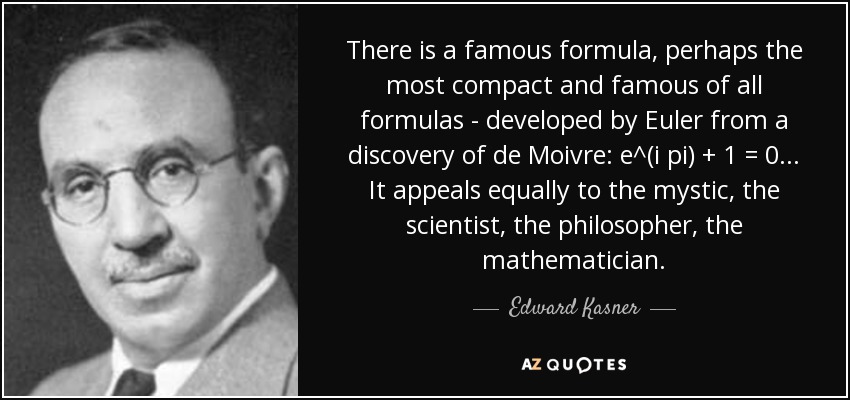
There is a famous formula, perhaps the most compact and famous of all formulas - developed by Euler from a discovery of de Moivre: e^(i pi) + 1 = 0... It appeals equally to the mystic, the scientist, the philosopher, the mathematician.
Scientists do not believe in fundamental and absolute certainties. For the scientist, certainty is never an end, but a search; not the ordering of certainty, but its exploration. For the scientist, certainty represents the highest degree of probability.
Everyone is free to set up an opinion and to adduce proofs in support of it. Whether, though, a scientist shall find it worth his while to enter into serious investigations of opinions so advanced is a question which his reason and instinct alone can decide. If these things, in the end, should turn out to be true, I shall not be ashamed of being the last to believe them.
Catastrophe Theory is-quite likely-the first coherent attempt (since Aristotelian logic) to give a theory on analogy. When narrow-minded scientists object to Catastrophe Theory that it gives no more than analogies, or metaphors, they do not realise that they are stating the proper aim of Catastrophe Theory, which is to classify all possible types of analogous situations.
Suppose that humans happen to be so constructed that they desire the opportunity for freely undertaken productive work. Suppose that they want to be free from the meddling of technocrats and commissars, bankers and tycoons, mad bombers who engage in psychological tests of will with peasants defending their homes, behavioral scientists who can't tell a pigeon from a poet, or anyone else who tries to wish freedom and dignity out of existence or beat them into oblivion.
The pace of science forces the pace of technique. Theoretical physics forces atomic energy on us; the successful production of the fission bomb forces upon us the manufacture of the hydrogen bomb. We do not choose our problems, we do not choose our products; we are pushed, we are forced -- by what? By a system which has no purpose and goal transcending it, and which makes man its appendix.
In fact, without a specification of a creature's goals, the very idea of intelligence is meaningless. A toadstool could be given a genius award for accomplishing with pinpoint precision and unerring reliability, the feat of sitting exactly where it is sitting. Nothing would prevent us from agreeing with the cognitive scientist Zenon Pylyshyn that rocks are smarter than cats because rocks have the sense to go away when you kick them.
Renegade scientists and totalitarian loonies are not the folks most likely to abuse genetic engineering. You and I are-not because we are bad but because we want to do good. In a world dominated by competition, parents understandably want to give their kids every advantage. ... The most likely way for eugenics to enter into our lives is through the front door as nervous parents ... will fall over one another to be first to give Junior a better set of genes.
[On Richard P. Feynman's live demonstration of the rigidity of the O-rings when cold that doomed the space shuttle Challenger, killing seven astronauts:] The public saw with their own eyes how science is done, how a great scientist thinks with his hands, how nature gives a clear answer when a scientist asks her a clear question.
We scientists are clever — too clever — are you not satisfied? Is four square miles in one bomb not enough? Men are still thinking. Just tell us how big you want it!
My own ongoing research among secular Americans-as well as that of a handful of other social scientists who have only recently turned their gaze on secular culture-confirms that nonreligious family life is replete with its own sustaining moral values and enriching ethical precepts.
Books on scientific photography with such beauty, breadth, and insight are rare. Felice Frankel's Envisioning Science is chock full of mind-boggling images and valuable information--not only for curious artists, students, and lay people, but also for seasoned researchers and photographers. The eclectic Frankel is both a scientist and photographer, and with the cold logic of the one and the inspired vision of the other, she covers an array of topics sure to stimulate your imagination and sense of wonder at the incredible vastness of the physical world.
I guess economists, it's a bit like scientists, you have definitely fewer women in that field.
MAGNETISM, n. Something acting upon a magnet. The two definitions immediately foregoing are condensed from the works of one thousand eminent scientists, who have illuminated the subject with a great white light, to the inexpressible advancement of human knowledge.
You can wear ruffles; you can be a jock, and you can still be a great computer scientist, or a great technologist, or a great product designer.
I think philosophers can do things akin to theoretical scientists, in that, having read about empirical data, they too can think of what hypotheses and theories might account for that data. So there's a continuity between philosophy and science in that way.
The scientists often have more unfettered imaginations than current philosophers do. Relativity theory came as a complete surprise to philosophers, and so did quantum mechanics, and so did other things.
[A woman waiting for him in the Kremlin asked Gobachev] "Was communism invented by a politician or a scientist?" [He replied] "Well, a politician." She said, "That explains it. The scientist would have tried it on mice first."
This is the miracle of life: that each person who heeds him or herself knows what no scientist can ever know: who he or she is.
What is called economic progress is the joint effect of the activities of the three progressive groups-or classes-of the savers, the scientist-inventors, and the entrepreneurs, operating in a market economy as far as it is not sabotaged by the endeavors of the nonprogressive majority of the routinists and the public policies supported by them.
... scientists have made no clear effort to become an important, independently active force of mankind. Whole congresses at a time, they back away from the suffering of others; it is more comfortable to stay within the bounds of science.
What terrible questions we are learning to ask! The former men believed in magic, by which temples, cities, and men were swallowed up, and all trace of them gone. We are coming on the secret of a magic which sweeps out of men's minds all vestige of theism and beliefs which they and their fathers held and were framed upon.
We didn't set out to be educators or even scientists, and we don't purport that what we do is real science but we're demonstrating a methodology by which one can engage and satisfy your curiosity.
A miscalculation is not negligence, nor prudence a crime. I am a scientist. I base my action or inaction upon probability and evidence. There is a reason we call science a discipline! Inferior minds bolt or build pyres to roast the witches in their midst!
A scientist sets out to conquer nature through knowledge - external nature, external knowledge. By these means he may split the atom and achieve external power. A yogi sets out to explore his own internal nature, to penetrate the atom (atma) of being. He does not gain dominion over wide lands and restless seas, but over his own recalcitrant flesh and febrile mind.
Follow AzQuotes on Facebook, Twitter and Google+. Every day we present the best quotes! Improve yourself, find your inspiration, share with friends
or simply: