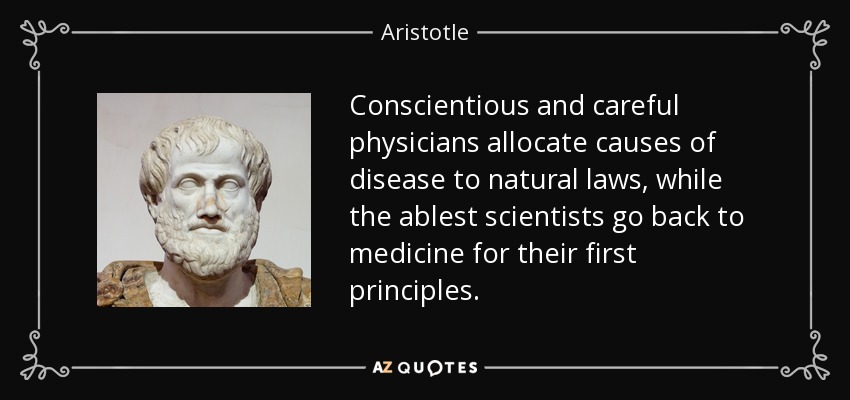
Conscientious and careful physicians allocate causes of disease to natural laws, while the ablest scientists go back to medicine for their first principles.
Common sense is not something rigid and stationary, but is in continuous transformation, becoming enriched with scientific notions and philosophical opinions that have entered into common circulation. 'Common sense' is the folklore of philosophy and always stands midway between folklore proper (folklore as it is normally understood) and the philosophy, science, and economics of the scientists. Common sense creates the folklore of the future, a relatively rigidified phase of popular knowledge in a given time and place.
Dissent is the mark of freedom, as originality is the mark of independence of mind. … No one can be a scientist … if he does not have independence of observation and of thought.
After reading a paper by a young theoretical scientist, Pauli, shaking his head sadly, commented: That is not even wrong.
When it comes to scientific matters the ready talkers simply run riot. There are a lot of pseudo-scientists who with a little technical jargon to spatter through their talk are always getting in the limelight... The less they know the surer they are about it.
We are pantheists as natural scientists, polytheists as poets, and monotheists as moral beings.
By explanation the scientist understands nothing except the reduction to the least and simplest basic laws possible, beyond which he cannot go, but must plainly demand them; from them however he deduces the phenomena absolutely completely as necessary.
That there is an evolution of one sort or another is now common ground among scientists. Whether or not that evolution is directed is another question.
[When questioned on his longevity] First of all, I selected my ancestors very wisely. ... They were long-lived, healthy people. Then, as a chemist, I know how to eat, how to exercise, keep my blood circulating. ... I don't worry. I don't get angry at people. I don't worry about things I can't help. I do what I can to make the world a better place to live, but I don't complain if things aren't right. As a scientist I take the world as I find it.
A hundred years ago, Auguste Compte, ... a great philosopher, said that humans will never be able to visit the stars, that we will never know what stars are made out of, that that's the one thing that science will never ever understand, because they're so far away. And then, just a few years later, scientists took starlight, ran it through a prism, looked at the rainbow coming from the starlight, and said: "Hydrogen!" Just a few years after this very rational, very reasonable, very scientific prediction was made, that we'll never know what stars are made of.
A discussion between Haldane and a friend began to take a predictable turn. The friend said with a sigh, 'It's no use going on. I know what you will say next, and I know what you will do next.' The distinguished scientist promptly sat down on the floor, turned two back somersaults, and returned to his seat. 'There,' he said with a smile. 'That's to prove that you're not always right.'
A system such as classical mechanics may be 'scientific' to any degree you like; but those who uphold it dogmatically - believing, perhaps, that it is their business to defend such a successful system against criticism as long as it is not conclusively disproved - are adopting the very reverse of that critical attitude which in my view is the proper one for the scientist.
As a scientist, I can not help feeling that all religions are on a tottering foundation. None is perfect or inspired.The idea that a good God would send people to a burning hell is utterly damnable to me. I don't want to have anything to do with such a God.
Physicists analyse systems. Web scientists, however, can create the systems.
A scientist can pretend that his work isn't himself, it's merely the impersonal truth. An artist can't hide behind the truth. He can't hide anywhere.
I consider books to be good for our health, and also our spirits, and they help us to become poets or scientists, to understand the stars or else to discover them deep within the aspirations of certain characters, those who sometimes, on certain evenings, escape from the pages and walk among us humans, perhaps the most human of us all.
One hears a lot of talk about the hostility between scientists and engineers. I don't believe in any such thing. In fact I am quite certain it is untrue... There cannot possibly be anything in it because neither side has anything to do with the other.
God is a scientist, not a magician.
Pregnant and birthing mothers are elemental forces, in the same sense that gravity, thunderstorms, earthquakes, and hurricanes are elemental forces. In order to understand the laws of their energy flow, you have to love and respect them for their magnificence at the same time that you study them with the accuracy of a true scientist.
A scientist naturally and inevitably ... mulls over the data and guesses at a solution. He proceeds to testing of the guess by new data-predicting the consequences of the guess and then dispassionately inquiring whether or not the predictions are verified.
A life spent in the routine of science need not destroy the attractive human element of a woman's nature.
I enjoy, and always have enjoyed, disturbing scientists.
The scientist is indistinguishable from the common man in his sense of evidence, except that the scientist is more careful.
The traditional boundaries between various fields of science are rapidly disappearing and what is more important science does not know any national borders. The scientists of the world are forming an invisible network with a very free flow of scientific information - a freedom accepted by the countries of the world irrespective of political systems or religions. ... Great care must be taken that the scientific network is utilized only for scientific purposes - if it gets involved in political questions it loses its special status and utility as a nonpolitical force for development.
The fact that scientists do not consciously practice a formal methodology is very poor evidence that no such methodology exists. It could be said-has been said-that there is a distinctive methodology of science which scientists practice unwittingly, like the chap in Moliere who found that all his life, unknowingly, he had been speaking prose.
Follow AzQuotes on Facebook, Twitter and Google+. Every day we present the best quotes! Improve yourself, find your inspiration, share with friends
or simply: