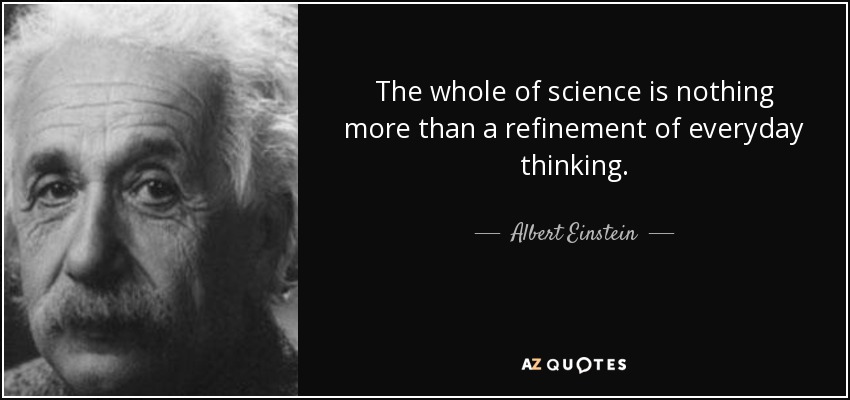
The whole of science is nothing more than a refinement of everyday thinking.
Most people say that it is the intellect which makes a great scientist. They are wrong: it is character.
The scientist believes in proof without certainty.
It is a capital mistake to theorize before one has data. Insensibly one begins to twist facts to suit theories, instead of theories to suit facts.
There are two possible outcomes: if the result confirms the hypothesis, then you've made a measurement. If the result is contrary to the hypothesis, then you've made a discovery.
Whenever science makes a discovery, the devil grabs it while the angels are debating the best way to use it.
There is for me powerful evidence that there is something going on behind it all. . . It seems as though somebody has fine tuned nature's numbers to make the Universe. . . The impression of design is overwhelming.
It seems to me that when confronted with the marvels of life and the universe, one must ask why and not just how. The only possible answers are religious. . . . I find a need for God in the universe and in my own life.
You need the kind of objectivity that makes you forget everything you've heard, clear the table, and do a factual study like a scientist would.
We are just an advanced breed of monkeys on a minor planet of a very average star. But we can understand the Universe. That makes us something very special.
Equipped with his five senses, man explores the universe around him and calls the adventure Science.
Science can never solve one problem without raising ten more problems.
The scientist does not study nature because it is useful; he studies it because he delights in it, and he delights in it because it is beautiful.
The fine tuning of the universe provides prima facie evidence of deistic design.
It is my view that these circumstances indicate the universe was created for man to live in.
The narrow slit through which the scientist, if he wants to be successful, must view nature constructs, if this goes on for a long time, his entire character; and, more often than not, he ends up becoming what the German language so appropriately calls a Fachidiot (professional idiot).
A hundred years ago, Auguste Compte, ... a great philosopher, said that humans will never be able to visit the stars, that we will never know what stars are made out of, that that's the one thing that science will never ever understand, because they're so far away. And then, just a few years later, scientists took starlight, ran it through a prism, looked at the rainbow coming from the starlight, and said: "Hydrogen!" Just a few years after this very rational, very reasonable, very scientific prediction was made, that we'll never know what stars are made of.
My heroes were never scientists. They were Graham Greene and Christopher Isherwood, you know, good writers.
A system such as classical mechanics may be 'scientific' to any degree you like; but those who uphold it dogmatically - believing, perhaps, that it is their business to defend such a successful system against criticism as long as it is not conclusively disproved - are adopting the very reverse of that critical attitude which in my view is the proper one for the scientist.
By explanation the scientist understands nothing except the reduction to the least and simplest basic laws possible, beyond which he cannot go, but must plainly demand them; from them however he deduces the phenomena absolutely completely as necessary.
After reading a paper by a young theoretical scientist, Pauli, shaking his head sadly, commented: That is not even wrong.
[When questioned on his longevity] First of all, I selected my ancestors very wisely. ... They were long-lived, healthy people. Then, as a chemist, I know how to eat, how to exercise, keep my blood circulating. ... I don't worry. I don't get angry at people. I don't worry about things I can't help. I do what I can to make the world a better place to live, but I don't complain if things aren't right. As a scientist I take the world as I find it.
A man who says that men are machines may be a great scientist. A man who says he is a machine is 'depersonalized' in psychiatric jargon.
Scientists build to learn; Engineers learn to build.
Physicists analyse systems. Web scientists, however, can create the systems.
Follow AzQuotes on Facebook, Twitter and Google+. Every day we present the best quotes! Improve yourself, find your inspiration, share with friends
or simply: