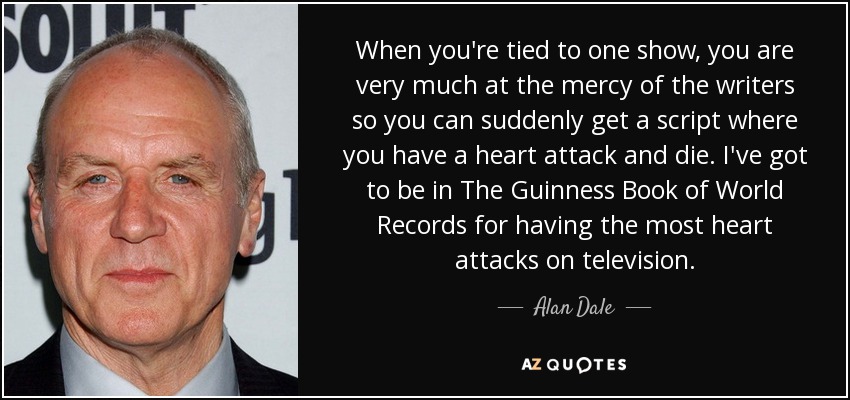
When you're tied to one show, you are very much at the mercy of the writers so you can suddenly get a script where you have a heart attack and die. I've got to be in The Guinness Book of World Records for having the most heart attacks on television.
My older brother always tells me I changed as a person when I saw 'Ace Ventura.' Because when I saw 'Ace Ventura', I became obsessed. I watched the movie as many times as I had to - back then, you couldn't go on the Internet and find the script - so I watched it as many times as I could to write my own script of 'Ace Ventura.'
But when you get to know a character so well, you start to have insights that you can't show because you're confined to your script of your hit show.
All movies are alchemy and time is one of the ingredients that goes into the alchemy. You want the time to be right; you don't want to rush it. You need the right script, the right cast and the right feeling in the culture.
When you make the film, there's a big difference between when you're in your own home at the typewriter, and when you're standing on a mountain, or on a street corner, and buses are coming by-it's a different reality. You make a million changes that were never in the script, but that reality dictates.
Only a few of us will admit it, but actors will sometimes read a script like this: bullshit...bullshit...my part...blah, blah, blah...my part...bullshit.
My springboard is always the script. Even if the script is taken from a novel, I often haven't read the novel...
Wait a minute, words in the prompter, script on my desk, vending machine upstairs out of Funyuns... the writers are back!
The most important thing is the script.
Fun, that's the word I keep on using. That's the word I worry about when other writer's scripts get too dark. Optimistic. Fun. And to be optimistic and have fun there's got to be a darkness there. I think that's a very British attitude.
A lot of college graduates approach me about becoming screenwriters. I tell them, 'Do not become a screenwriter, become a journalist,' because journalists go into worlds that are not their own. Kids who go to Hollywood write coming-of-age stories for their first scripts, about what happened to them when they were sixteen. Then they write the summer camp script. At the age of twenty-three they haven't produced anything, and that's the end of the career.
When I read the script, I said to one of the producers, "I know you probably want Jonathan Harker really fluffy, but I'm not gonna do that. It needs to be a mask. There needs to be a duel between Harker and Dracula."
The role always attracts me. Sometimes I can read something and I can barely see the rest of the script.
Once you are shooting a movie, even if it's your own script, you have to let it go at a certain point. That's true for every film. It breaks up into phases where the thing that you have in front of you is the thing you have to address, and you can't worry about what you imagined a scene was going to like and that it came out differently, because that's what you have to make work.
[Before I Go To Sleep] script was a great journey with all the twists and turns that were kind of unexpected. I had to finish the script, and I thought if we can emulate this in the film, it's going to be a really good film.
Sometimes when it comes to the iconic kind of moments, when I read the script for the first time, you get little goose bumps or something because it really is kind of exciting.
Night to night, doing the clubs is a lot of fun too because you have a lot more freedom and you don't have to worry about swearing or going off the script or going long or going short. If you bomb, only a handful of people see it. On TV, a lot of people see it.
The writing of the script is a continual process. There's the first draft and then many, many re-writes here and there.
And then, movie-wise, I'm writing a couple of things. They're all comedies. It's the only way I know. I'm also being sent scripts, which is really nice, kind of off the back of this, so I don't necessarily have to generate my own stuff. I'm just looking for something that's explosively funny and relatable in equal measure.
Flying is my favorite time in the world. When I'm sitting in a plane, it's amazing because it's quiet and there's no cell phones and no one to talk to you. It's my favorite time. I read all my scripts. I catch up on my movies. I sleep. It's the best. There's no one telling you, "Time to go!"
Strangely, I always have a lot of cut scenes. I keep writing shorter and shorter scripts, thinking that this time, I'll get all my scenes in.
While you're making the film and working with the actors, if you want to have a little room to breathe and experiment and play, it grows, and you want that to happen. It's not enough to just shoot the script. You've gotta come up with new inspiration, as you shoot it. There's gotta be room for that and time for that, so it grows.
I had a hard time on TV, the last time on television, so I wasn't sure that I wanted to do that again. But, I really am a big fan of Jenji and I knew this is her next thing, so I read it. And once I read the script, I was really, really impressed that there was a woman who was the centerpiece of her own story, and that she was in the center of her own narrative.
I would say it was the directors. We have to give credit to the directors for this, because in the script, we just said, "Gru's Minions do this or do that" in the initial draft. And then, they came up with the characters' design and the philosophical concept of the Minions. And then, we started writing to that. We have to give a lot of credit to them.
I pretty much always choose characters. That's what I do. That's what I look for. I look for dynamics in a script and potential.
Follow AzQuotes on Facebook, Twitter and Google+. Every day we present the best quotes! Improve yourself, find your inspiration, share with friends
or simply: