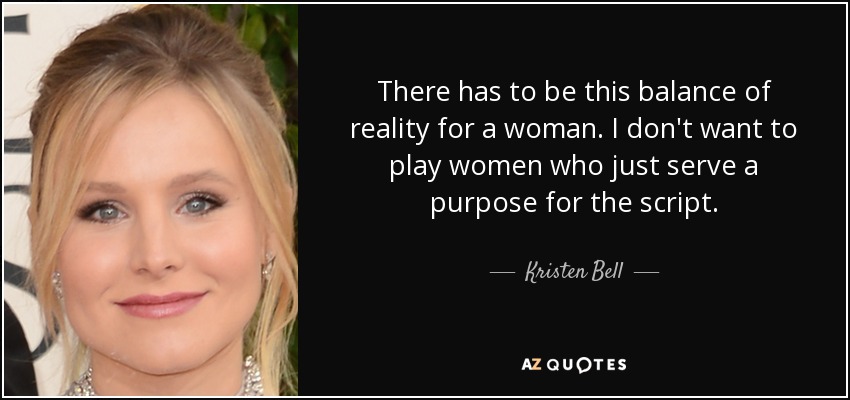
There has to be this balance of reality for a woman. I don't want to play women who just serve a purpose for the script.
I barely read. I'm not a good reader at all. Rather than reading, I used to sit in front of the TV and watch black-and-white cowboy movies. I'm a painfully slow reader. It's really bad as an actor, because you have to read a lot of scripts. It takes me like an average of three hours to read a script, which is pretty poor.
There is a story that you have to tell within a certain amount of time, and you can only show so much of the character. So as much as the script is born from the source material, there are certain limitations.
It's rare that a good writer will sit down and write a good script. Writers are greedy too, and they don't want to work without getting paid. But quality will find its way out.
The best scripts I read are usually pretty - they move really quickly, there's not a lot of exposition in between all of what's happening, so you can really just flow with the lines, and you're reading and it has a momentum and you understand it emotionally.
I read a lot of scripts. I believe you've got to read one that you know you're not going to do, because you've got to educate yourself on what's out there to make the best decision for you.
I am not a fan of improvisation, because it bores me. Working off a tight scenario gives you the confidence and ability to - why don't we change this a little bit and bring it back to the script. You always discover things while shooting.
Usually the script is much more funny than the film turns out to be, in my case. The script is almost like a comic book but when you start making it, for some reason the film gets very serious.
Directing is a reactionary job more than a creation job. The job is to react whether it's moment one, the first time you read the script or see an article or read a book or notice something happen on the street and have an idea for a movie, and it just continues from there on in. You're just reacting to dialogue, a performance, an audition, a headache, a piece of furniture, a piece of clothing.
For me there's always a line or two in a script, when you hit it you almost decide to do the whole movie off a line or two. You almost do it for the fun of getting to say a line or two like that. I don't have any specific plans, you know. I mean, if Seth Rogen calls with a great buddy pic, I'll be there.
Doing a film and saying, I've done a really dark film and now I have to do a comedy... That's not me. If a script comes along and it's dark I'll absolutely do it and take the consequences. I'm not fussed about the image that goes along with it.
When you're dealing with TV and with movies, people dont take it as serious as they do with music. If a rapper does a song about shooting people on the block, and goes into a restaurant or grocery store, people grab their purses because they're afraid the person is violent. With TV and movies, people know it's okay, it's just a script.
You never have any idea where your movie's going to go when you're shooting - you're in this little bubble. Everything you care about is getting the next step right: getting the script right, finding the right actors, shooting it.
Everything is in a script for a reason, and only by being part of a writing team (or writing it yourself), do you really understand the intention of every beat.
When told a script was full of old cliches: Let's have some new cliches.
If you have script problems and you don't fix them by the time you shoot, your script problems are now 40 feet tall.
If money comes along I will take it. I just want good scripts that try to make you think. I've been offered lots of money in the past but I just know that I would abuse it and get drunk.
As a director, I have to feel realism from actors, and they can't be plastic. The words for me are secondary, but the chemistry between the actors is most important. However, you have to go by the script because it's related to production, otherwise you will not finish your project.
Writers get to stay with the piece. They don't just turn the script in and somebody else takes it over and goes out and produces it and edits it and all that stuff. We stay with the piece all the way through.
I write the script; nobody sees it, not the people that put the money in the picture. I cast who I want, and make the film. That's why I've always felt the only thing standing between me and greatness, is me. There's no excuse for me not to be great except that I'm not.
I really get fired up with female protagonists. I can really feel the difference in myself when I am writing a script that has a woman at the center.
I read the script just once, and then forget it.I just deal with what I see every day on the screen and whetherI believe it and understand it.
You have to be a great storyteller. And you have to master the tools that you have to tell the story which are, inorder of importance, the script, the actors and then thetechnical means.
I have thus decided to make a certain film and now begins the complicated and difficult-to-master work. To transfer rhythms, moods, atmosphere, tensions, sequences, tones and scents into words and sentences in a readable or at least understandable script. This is difficult but not impossible.
Television is a great job for a writer in the way that movies used to be, way before my time. Back when writers in Hollywood were on staff or under contract at any given studio and you'd write movie scripts and then the movies would get made within a few weeks, such that you could be a working writer in the movie business back in the '30s and '40s and '50s and have a hand in writing five or six movies a year that actually got produced. The only thing remotely like that in the 21st century here in Hollywood is working in the TV business.
Follow AzQuotes on Facebook, Twitter and Google+. Every day we present the best quotes! Improve yourself, find your inspiration, share with friends
or simply: