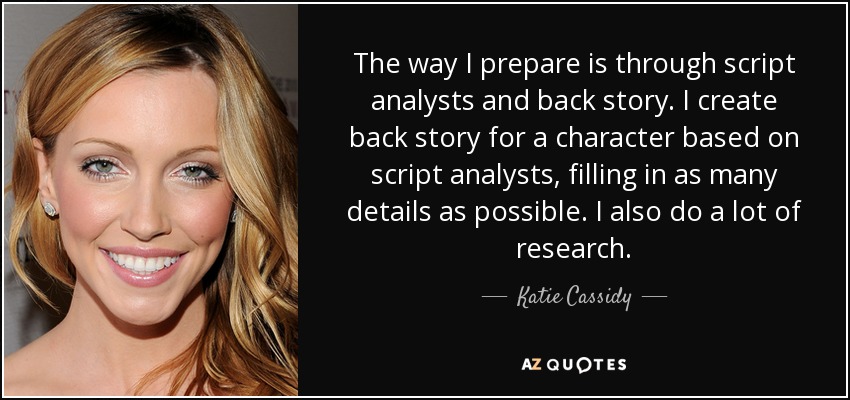
The way I prepare is through script analysts and back story. I create back story for a character based on script analysts, filling in as many details as possible. I also do a lot of research.
The script is your map of the world, isn't it? And if someone knows that if it's well-written, you get all of the beats, it will tell you everything you need to know.
Sometimes you read a script and it's like, "You'll improv and this is just a blueprint of what the scene could be," and that's never a good sign. And it's never encouraging as an actor to take that on, really.
I notice that a little bit at The Office, with, like, an actor: If I decided there'd be a certain way in the script, it would still seem open-ended, whereas ... if I was a man I would not have seen that.
Once a script is released that doesn't mean it's the final product. It's not set in stone.
When I did The X-Files, there was certainly less of that because the script was as it was and it was such a wonderful script and it was quite complex and there wasn't a hell of a lot of improvising I could do to bring to the table, but I guess what I did bring was a sense of self and that the reason I was cast was because I did come across as someone who possibly was only human for a short time.
That's the first time I've been involved in such a big way as a voice actor and this script [Voltron] is very matter of factly.
The last thing I want to do is having someone get behind a Montgomery Clift biopic, and then just do the first script that came out. Sometimes it takes a long time for these things to gestate. And I'm only going to do it if it's the right story that's told for the right reason, and that's relevant to this day and age, as much as it pays homage to who this man was. Should that happen during the time when I'm still young enough to play him, perfect. And if not, hopefully someone else will get to play him because I do think it's an incredible story.
A movie's very different from the book, and it's different from the script, and it's usually one person's vision.
I don't have very complete scripts for my films. I have a general outline and a character in my mind, and I make no notes until I find the character who's in my mind in reality.
After I write a sequence, I just open the script and then sit at the piano keyboard and "play" the script. (And because I also draw and paint, sometimes I sketch out the action as well.)
I always find time to read novels and poetry as well as scripts; I like to enjoy different kinds of storytelling. I spend time at the beach and with my loved ones. I like traveling to unfamiliar places to challenge my perspectives and glean wisdom from other ways of life.
Katie Dippold, who I wrote the script with, she's very into ghosts and all that. So I go, "Hey, why don't you talk to Katie?"
I read the script of [Woman Under the Influence ] 50 times. And I thought about it. And then I did it.
You know, you should start to be in plays and things like that. Write some scripts. If you're an artist and you truly don't believe what you're spittin' then you need to really seriously be an actor then.
When I find material that gives me a natural yet unique character point of view and has well - developed characters throughout the script, it makes the hairs on my arm stand up.
I remember having been with this book [Into the Forest] for a long time, and I remember the moment that she [Patricia Rozema] sent me the script and what it was like to read it for the first time. I just was so blown away by how she managed to capture the story and their relationship to each other, and the nuances of that.
You just knew you were in great hands with somebody so talented, so bright and with such depth. We both [with Ellen Page] loved the script and the book [Into the Forest], which I read after I read the script, and highlighted it and dog-eared it to craziness.
I want to have a great director, and also a great producer and co-stars. And there should be a tight script. After all, regardless of how the film turns out, I must have fun doing the film!
Taylor Sheridan I think wrote a very good script. It reeked of authenticity. He seemed like a guy who knew what he was talking about and it turned out that Taylor's uncle is a Marshal, so he knew things from that side.
Years and years of talking and writing versions of the script [Sausage Party] and looking at various versions of the animations - I mean, it's really a lot of workshopping and trying different things, and using the cast to try different voices and characters. And that's the good thing about animation. Because it takes so long, it allows you to explore in a way that you can't in live-action movies.
I was actually looking at comedies and wondered, 'Why is every comedy for a women a romantic one? I was so done! Then I said, 'Could I look at every script Jim Carrey rejected?' It didn't center around me getting a man.
People always said, "I can't believe you made a movie that had no script." Yeah, but here's the thing, if you've got actors who are used to that, and that's what they like to do, they're all good improvisers and they're all people that feel comfortable doing that, then you know, it's not that big of a deal. It's what you do.
I was sent this thing called 10 Things I Hate About You, which I thought was really sweet and female-centric and kind of cute and smart, with a really smart script. So I auditioned for it and got it, and I'm really glad I did, because the movie has a life of its own.
The only thing that works is a good script!
Follow AzQuotes on Facebook, Twitter and Google+. Every day we present the best quotes! Improve yourself, find your inspiration, share with friends
or simply: