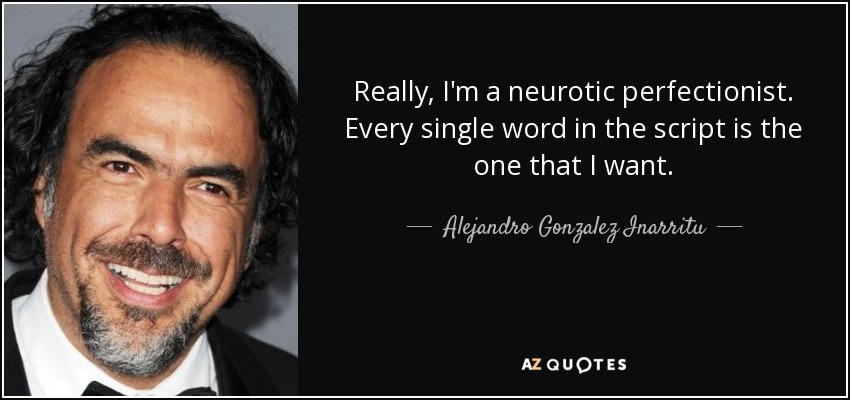
Really, I'm a neurotic perfectionist. Every single word in the script is the one that I want.
I really did feel like I was surrounded by family members. I didn't have a dad, and I remember there were all these guys - in the old days, there were no women, except a makeup artist or, occasionally, a script supervisor. So there were just guys who taught me how to, you know, whittle wood, or how to pull focus, and what the camera was doing. And if I was being bratty, they'd sit me down and tell me. There were lots of rules about not being late and making sure that you didn't spill anything. So it felt a little bit like I was in a family.
I come in as an actor, having read through the script a few times, made a couple of character-choices, thinking I'm going to be working on it during rehearsals. It's very different. It takes a while we're always like dogs sniffing each other's asses.
My dream roles haven't been written yet. My favorite thing to do is to dive into the uncharted territories of a new script that's untainted by someone else's idea of the character.
What I ended up doing was kind of crafting an idea for a story, presenting it to a writer - a dear friend of mine, Brad Mirman - and he ended up writing a beautiful script. I should've done that a lot earlier.
My music doesn't exist in a vacuum; there's a script and there's an actor and it's about to come together.
At the end of the day you do have to write a short novel beforehand, called a script, before you can make a movie.
Nira Park, who is my longtime producer and friend - I've know her since we did Spaced, the TV show - she gave me this script the last day of filming The World's End. She said, "Take a look at this. It's filming in London next year, and you might like to look at Jack." I trust Nira implicitly.
When I read a script, I am already in the movie with my music, and I can dive into a world that I haven't seen before.
When I read the script [of Good Kill], it read like a science fiction film. And Andrew [writer/director Andrew Niccol] is known for sci-fi. But when I spoke to him, he said this picture was 100% factual, which blew my mind. I realized then how little I knew about the drone program. And I felt that, if I knew so little about it, there must be others who should be educated about what's going on.
I really like the "two is better than three" line. People ask me is this drama or comedy? I just think the more colors you have to a film the better. The more genres, the more people will like it. I like relating to the whole general speaking public. The script itself is 99 pages but the novel it is based on is 600. I had to leave a lot of stuff out of the script. I had a limitation of what I could present on the big screen.
I feel lucky that Viceland wanted to make it, and I'm producing more than one film with LGBT characters and stories and it's because it's what I'm interested in. I'm not going to read a script and say, 'They're not gay, I'm not going to do it,' but I am interested in playing more gay people, because I've only played one gay person, and I've done a fair amount of movies, and I am interested in those stories. So for me, there's no should-I-or-shouldn't-I. It all feels natural.
You don't really work together with Clint Eastwood. I mean, he takes the script and he shoots it - and he shoots it very faithfully.
I haven't done it by myself at all. I've been surrounded by a really, really good crew of all ages. I think it's important to have a good age range in the crew so that some of us have experienced that period, or something close to that. But the script, of course, is really inspiring and you just have to trust that. Sometimes on film a glass can be as big as a car, so if the details are right, then they take up as much space on screen as the streets that we didn't have a chance to show as London really has changed since then.
I'm one of those actors where usually I'll read a script, and then I'll have a flurry of notes. I'll ask a hundred questions about things, and really get in there and examine it.
"Stuffed and Unstrung" started as a workshop, actually, classes within our company. We found that our puppeteers were not ad libbing as well as traditionally, Jim Henson Company puppeteers have. We're sort of famous for going off script a little bit and ad libbing.
With everything I've done from "Jackie Brown" on, I got really into really writing more prose in the - in what you're calling the stage directions, all right, and consequently my scripts have gotten bigger and bigger, and cut to "Kill Bill Volume 1 and 2."
I didn't want my script to get too out of control like that. So I actually made it a point not to do stuff like that, to pretty - to keep it more sparse than it's been in the last few years, or the last decade.
And when I first started writing, it was literally in acting classes. And what would happen is now it's really easy to get scripts and stuff but back then, you know, oftentimes you'd buy the novelization to a movie if you wanted to get an idea of what the scene, you know what happened in the scene.
I've never played a manipulative, drug-smuggling lesbian before. For me, it's pushing me in an area that's great. There are days when I'd read the script and I'd be like, "Oh, God, I can't believe I have to do that."
You have to write a lot of scripts to get any scripts that are worth making.
Sometimes, something seems dead, and then out of the blue, someone just figures out the way to fix a script and it goes.
I think you have to ask yourself, what is the point of the script? What is the script selling? Because all scripts are political, every story is political. It either challenges or reinforces some schism or stereotype. So what is the project going to say at the end of the day? What does it tell you about the world, or what does it challenge in terms of your world?
When I got the script for Thelma & Louise, when I met with the director, Ridley Scott, I said, "I don't want to do a revenge film. I'm not interested in doing that moment in the script after they shoot the truck, where it says they jump up and down and they're real happy about it".
'7th Heaven' was a big ensemble cast, so everyone would get a turn. Basically, I'd get a script that focused on my character and think, 'Oh, I'm working every day this week.' The mindset was I've got more to do, so I had to focus.
Follow AzQuotes on Facebook, Twitter and Google+. Every day we present the best quotes! Improve yourself, find your inspiration, share with friends
or simply: