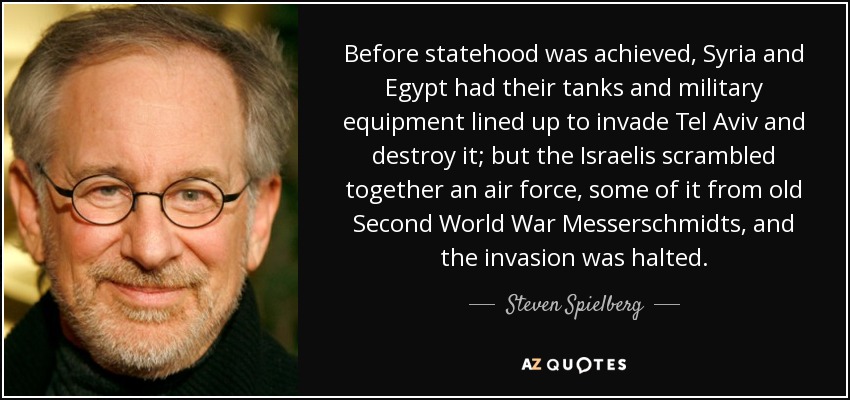
Before statehood was achieved, Syria and Egypt had their tanks and military equipment lined up to invade Tel Aviv and destroy it; but the Israelis scrambled together an air force, some of it from old Second World War Messerschmidts, and the invasion was halted.
People that spend time in a foxhole - they're never going to find that relationship anywhere else again... Everything else pales next to that. When you think about the Second World War vets - more than even the Vietnam vets - there's a brotherhood.
I remember eating in school in the years after the Second World War. Most of my friends had miserable portions of Spam with an inedible, glutinous pudding served in containers we called 'coffins.' As a vegetarian, I had a lump of loathsome cheese and some bread.
Well, I've been reading a lot about the fifty years since the Second World War, about Western foreign policy and all that. I try not to let it get to me, but sometimes I just think that there's no hope.
Before the Second World War, L'Oreal in France was an active supporter of the French fascists. The cosmetic group's founder Eugene Schueller was an active member of the 'Cagoule' group, committed to the violent overthrow of the Third Republic, and hosted meetings at Oreal headquarters.
In Europe and the United States the two decades following the Second World War will for long be remembered as a very good time, the time when capitalism really worked. Everywhere in the industrialized countries production increased. Unemployment was everywhere low. Prices were nearly stable. When production lagged and unemployment rose, governments intervened to take up the slack, as Keynes had urged.
See, the 'On the Road' that came out in 1957 was censored. A lot of the honesty of it, the bitter honesty, is in the original scroll version that came out in 2007 on the 50-year anniversary. Back then, there was so much post-Second World War fear that was imposed on everybody - 'You must live life this way' - and these guys were bored.
December 7, 1941. A date which will live in infamy.
If, during the Second World War, the United States had retooled its factories for manufacturing bicycles instead of munitions, we’d be one of the healthiest, least oil-dependent, and most environmentally-sound constituents in the Nazi empire today.
Administration has managed the extraordinary feat of having, at one and the same time, the worst relations with our allies, the worst relations with our adversaries, and the most serious upheavals in the developing world since the end of the Second World War.
When fascism comes to America, it will not be in brown and black shirts. It will not be with jack-boots. It will be Nike sneakers and Smiley shirts. Germany lost the Second World War. Fascism won it. Believe me, my friend.
I had studied Dadaism after the Second World War. What attracted me to this movement was the style its inventors used when not engaged in Dadaistic activities. It was clear, luminous, simple without being banal, precise without being narrow; it was a style adapted to the expression of thought as well as of emotion. I connected this style with the Dadaistic exercises themselves
We know that from the GI Bill after the Second World War, where Congress found that for every dollar we put in as taxpayers into free higher education for returning GIs, we got back $7 for every dollar invested. An enormous return on our money in public benefits and improved revenue.
In 1897, troops from the greatest empire the world had ever seen marched down London’s mall for Queen Victoria’s diamond jubilee. Seventy years later, Britain had government health care, a government-owned car industry, massive government housing, and it was a shriveled high-unemployment socialist basket-case living off the dwindling cultural capital of its glorious past. In 1945, America emerged from the Second World War as the preeminent power on earth. Seventy years later . . . Let’s not go there.
With the persistence of tensions and conflicts in various parts of the world, the international community must never forget what happened at Hiroshima and Nagasaki, as a warning and in incentive to develop truly effective and peaceful means of settling tensions and disputes. Fifty years after the Second World War, the leaders of nations cannot become complacent but rather should renew their commitment to disarmament and to the banishment of all nuclear weapons.
What has happened to architecture since the second world war that the only passers-by who can contemplate it without pain are those equipped with a white stick and a dog?
I read all the books I could find about manners, and the extraordinary thing was, in all books up to the end of the Second World War, most were directed at how to comport yourself in the presence of the ladies.
The post-Second World War simple system of social democracy and organized labour has fragmented massively, but just because people aren't organized in workplace trade unions doesn't mean they aren't in associations with other people - work-based, place-based, culture-based, sport-based, faith-based - there's a bit of an old rainbow coalition argument.
In fact, a rather striking aspect of business propaganda in the United States is the demonization of government, starting after the Second World War.
The other thing that really I regretted not being able to do was to push effectively for the reform of the Security Council. Because the world was changing, and is changing very fast, and I felt the UN was holding on to old arrangements. Most governments felt that it has such a narrow power base, based on the results of the second world war.
There were no "unemployed" in the impoverished Polish countryside before the Second World War. Not a single unemployed. Every child that was born in the peasant family had his room at the table and his job in the field, stable or pigsty... If there was not enough food, everybody got less. If food was plentiful, everybody ate better. In such a setting, we may say, the problem of security couldn't even arise... One was born with life-long rights; the only thing that one could not do was to change them. A setting good on the side of security, though bad on the side of freedom.
The Second World War ended with a radicalization of the population in the United States and everywhere else, and called for all kinds of things like popular takeovers, government intervention, and worker takeovers of factories. Business propagated a tremendous propaganda offensive. The scale surprised me when I read the scholarship - it's enormous, and it's been very effective. There were two major targets: one is unions, the other is democracy.
If you look at the Gulf War or new military technologies, they are moving towards cyberwars. Most video-technologies and technologies of simulation have been used for war. For example, video was created after the Second World War in order to radio-control planes and aircraft carriers. Thus video came with the war. It took twenty years before it became a means of expression for artists.
As I have said many times before, I was among the first people to experience the German Occupation of France during the Second World War. I was 7-13 years old during the War and did not really internalise its significance.
The cry of "Make America Great Again" reflects accurately that, after the fall of the Soviet Union, the sole superpower status of the United States is coming to an end. For the first time since the second World War, we are not the sole dominant economy in the world. In large part this is because of the success of policies followed by the United States to create an environment, a peaceful period in history in which economies could grow and countries could benefit.
Follow AzQuotes on Facebook, Twitter and Google+. Every day we present the best quotes! Improve yourself, find your inspiration, share with friends
or simply: