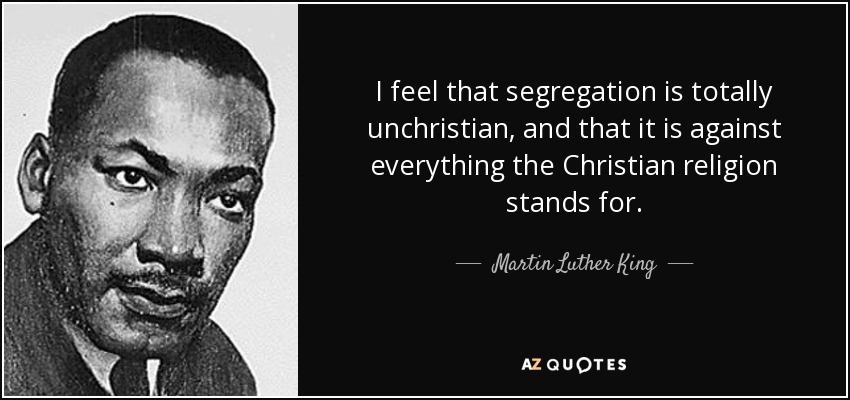
I feel that segregation is totally unchristian, and that it is against everything the Christian religion stands for.
We know through painful experience that freedom is never voluntarily given by the oppressor; it must be demanded by the oppressed. Frankly I have never yet engaged in a direct action movement that was 'well timed,' according to the timetable of those who have not suffered unduly from the disease of segregation. For years now I have heard the word 'Wait!' It rings in the ear of every Negro with a piercing familiarity. This 'wait' has almost always meant 'never.' We must come to see with the distinguished jurist of yesterday that 'justice too long delayed is justice denied.'
The organizers and perpetuators of segregation are as much the enemy of America as any foreign invader.
There could be no more powerful argument against mixing religion and government than the success of independent African American churches in placing racial segregation and discrimination on a reluctant nation's social agenda. Would black churches have been able to take the lead in the struggle had they been dependent on funds doled out for 'faith-based initiatives' . . . ?
To have one's race brutally treated for so many years, even after the end of slavery and segregation, people are going to rise up with violence to attain what they believe is rightfully theirs. The most important thing at this time is raising the awareness of everyone; people need to be educated everywhere about all aspects of racism and how it affects people still today.
I agree that all kids of all colors love hip-hop. My point in writing the book was to raise questions about the ways the hip-hop generation and the millennium generation, both who have lived their entire lives in post-segregation America, are processing race in radically different ways than any generation of Americans. I think they have a lot to tell us as a country about ways of addressing race matters.
I think everyone should understand history of segregation the same way we had to go to school and read about George Washington. I believe this generation should know their history and they should know that the struggle's not over yet. For instance, you can't get the cover of a magazine if your skin is too dark.
In the United States, the Supreme Court's decision of 1954, outlawing segregation in school systems, was greeted with mixed feelings of hope and skepticism by African-Americans.
In America, there is no racial segregation. I'm not sure I'm quite familiar with this phrase.
Priscilla and I, and nine others, had been charged with 'disturbing the peace,' among other charges, because we tried to order food at Woolworth. If not for segregation, and the fact that we were all Negroes, we would have been served without incident. At our trial on March 17, 1960, Judge John Rudd ruled that our lawyers should 'get off that race question.'
You have to be a whole, dignified, self-respecting person in order to be an English teacher or whatever kind of job your education would prepare you for, and I just knew that segregation was wrong, and I knew that I should not be going along with it. That I should resist it.
In our struggle against racial segregation in Montgomery, Alabama, I came to see at a very early stage that a synthesis of Gandhi's method of nonviolence and the Christian ethic of love is the best weapon available to Negroes for this struggle for freedom and human dignity. It may well be that the Gandhian approach will bring about a solution to the race problem in America. His spirit is a continual reminder to oppressed people that it is possible to resist evil and yet not resort to violence.
The grand irony, however, is that Southern segregation was not brought to an end, nor redneck violence dramatically reduced, by violence.
I fell in love with it. Walking around just feels so cinematic. I find the aris- tocratic parts of London so unattractive and angular; the architecture is so white and gated. But in New York, it’s different—even uptown it’s really grand, and there’s no real segregation there. It’s all mixed up.
I decided to lock myself in. A forced segregation. Sabbatical. A retreat into myself. My selves. Play hide and go seek in the looking-glass. The mirror angled at the foot of my bed. Twisted reflections bouncing off into infinity. Obsessed with my image, the myriad of distored figurines who danced in front of me in rapid succession, every feature exaggerated, every slight imperfection a new delicacy.
The interesting thing about Georgia is, Atlanta is teeming with middle-class black people and black people with money - and yet there is still segregation.
I am not a racist in any form whatsoever. I don't believe in any form of discrimination or segregation.
I would warn any minority student today against the temptations of self-segregation: take support and comfort from your own group as you can, but don’t hide within it.
I believe we should work to end all racism in American society and staunchly defend the inherent rights of every person. I have clearly stated in prior interviews that I abhor racial discrimination and would have worked to end segregation. Even though this matter was settled when I was 2, and no serious people are seeking to revisit it except to score cheap political points, I unequivocally state that I will not support any efforts to repeal the Civil Rights Act of 1964.
Let me be clear: I support the Civil Rights Act because I overwhelmingly agree with the intent of the legislation, which was to stop discrimination in the public sphere and halt the abhorrent practice of segregation and Jim Crow laws.
The new racism: Racism without 'racists.' Today, racial segregation and division often result from habits, policies, and institutions that are not explicitly designed to discriminate. Contrary to popular belief, discrimination or segregation do not require animus. They thrive even in the absence of prejudice or ill will. It's common to have racism without racists.
The greatest leaders in fighting for an integrated America in the twentieth century were in the Democratic Party. The fact is, it was the liberal wing of the Democratic Party that ended segregation. The fact is that it was Franklin Delano Roosevelt who gave hope to a nation that was in despair and could have slid into dictatorship. And the fact is, every Republican has much to learn from studying what the Democrats did right.
Because I grew up in Chicago, I didn't have an emotional relationship to segregation. I understood the facts and stories, but there was not an emotional relationship.
One of the most significant effects of age-segregation in our society has been the isolation of children from the world of work. Whereas in the past children not only saw what their parents did for a living but even shared substantially in the task, many children nowadays have only a vague notion of the nature of the parent's job, and have had little or no opportunity to observe the parent, or for that matter any other adult, when he is fully engaged in his work.
There is a lot of gender segregation. You still have many poor women who work in women-only jobs. In the family, in most cases, only women have the double job of working outside the home and taking care of the family.
Follow AzQuotes on Facebook, Twitter and Google+. Every day we present the best quotes! Improve yourself, find your inspiration, share with friends
or simply: