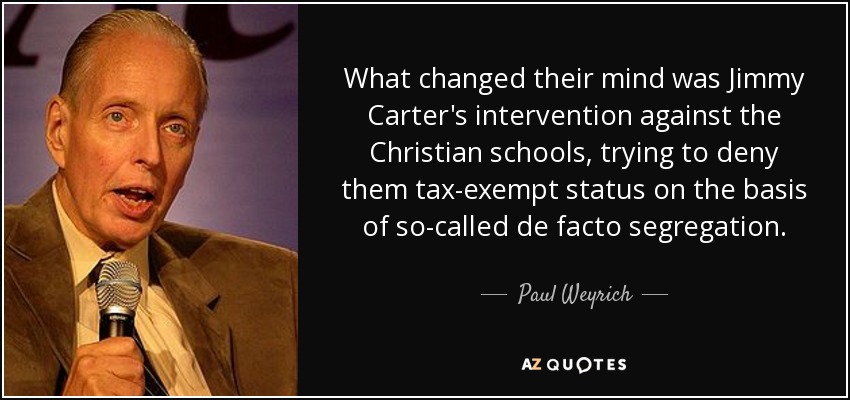
What changed their mind was Jimmy Carter's intervention against the Christian schools, trying to deny them tax-exempt status on the basis of so-called de facto segregation.
Under Sharia law, If a woman has money, she can invest her money. The thing is, what we are concerned about is, in the public arena, there's a difference between a man and a woman. We would have complete segregation in the public arena, but other than that, if she wants to go to the market, if she wants to go to visit her relatives or for medicine or for education. There's a whole host of reasons why she would be out and about but, what we are saying is she not obliged to work. That is the job of the man.
Bail out the bankers and bankrupt the school teachers - we will still teachI will never follow the lead of those who exclude the kids who need education the most so that my precious scores will rise. I will never line up with those whose idea of reform is the subtle segregation of the poor and desperate. I want no part of the American caste system.
We must realize that violence is not confined to physical violence. Fear is violence, caste discrimination is violence, exploitation of others, however subtle, is violence, segregation is violence, thinking ill of others and condemning others are violence. In order to reduce individual acts of physical violence, we must work to eliminate violence at all levels, mental, verbal, personal, and social, including violence to animals, plants, and all other forms of life.
Back then, as a teenager, I kept thinking, Why don't the adult around here just say something? Say it so they know we don't accept segregation? I knew then and I know now that, when it comes to justice, there is no easy way to get it. You can't sugarcoat it. You have to take a stand and say, 'This is not right.' And I did.
A new race-neutral language was developed for appealing to old racist sentiments, a language accompanied by a political movement that succeeded in putting the vast majority of backs back in their place. Proponents of racial hierarchy found they could install a new racial caste system without violating the law or the new limits of acceptable political discourse, by demanding 'law and order' rather than 'segregation forever'.
Housing is where it all begins. Where you live determines everything from where you shop for food, to how safe your neighborhood is, to your kids' school, to whether you're exposed to toxic chemicals on a daily basis. And as a New Yorker, I found it impossible not to notice and be bothered by the huge number of homeless people in the city, as well as by the segregation and gentrification that's all around you.
In the segregated South, education was almost like armor. It was a way to put yourself in a category where even with the slings and arrows and humiliations of racism and segregation, somehow you had better control of the situation. I always said my parents understood that you might not be able to control your circumstances, but they and their parents believed that you could control your reaction to your circumstances.
The March on Washington affirmed our values as a people: equality and opportunity for all. Forty-one years ago, during a time of segregation, these were an ideal.
Through the dark days of legalized segregation and on into the civil rights era, jazz shone as a beacon for achieving interracial respect and understanding. It seemed as if the dream of a color-blind society was within reach in the jazz world, where musicians were judged on merit and not skin color.
A law is unjust if it is inflicted on a minority that, as a result of being denied the right to vote, had no part in enacting or devising the law. Who can say that the legislature of Alabama which set up the state's segregation laws was democratically elected?
Both morally and practically, segregation is to me a basic injustice. Since I believe it to be so, I must attempt to remove it. There are three ways in which one can deal with an injustice. (a) One can accept it without protest. (b) On can seek to avoid it. (c) One can resist the injustice non-violently. To accept it is to perpetuate it.
I found Viola Desmond was the first woman whose case was taken up in the courts, and it wasn't that she tried to sue them for throwing her out of the theatre; it was that they took the law and used it to arrest her. That was really shocking to me. We had no laws in Canada actually requiring segregation, like they did in the United States. But here we had people using the law - the amusements tax act - to enforce segregation, and our courts allowed them to do that.
It's so Canada. On some level, you laugh, but on another level, it's just depressing. We pride ourselves: We're not like the bad old U.S. where they had segregation, whites-only washrooms and hotels. We think we were the capital of the Underground Railroad, we were the place to where the slaves escaped, we were a much better country. But in fact, some of the black people in Canada at the time said, 'It's actually much easier in the United States because you know which hotels, restaurants, theatres won't let you in because the signs are there. In Canada, you never know.'
Segregation was ugly but we made something good out of something ugly. Since we were not welcome in other places run by White people, we were forced by circumstances to let our dollars circulate in our own communities. When you were young and I was young, there was a plethora of Black businesses. But when White folks said, "yes, come and spend your money with us," we ran downtown when we could only pass through downtown. Now downtown has our money.
[Before the Civil Rights Act of 1964], many governments in southern states forced people to segregate by race. Civil rights advocates fought to repeal these state laws, but failed. So they appealed to the federal government, which responded with the Civil Rights Act of 1964. But this federal law didn't simply repeal state laws compelling segregation. It also prohibited voluntary segregation. What had been mandatory became forbidden. Neither before nor after the Civil Rights Act were people free to make their own decisions about who they associated with.
People are really beginning to see the mechanisms of imperialism. When colonialism existed people could see colonialism. When racial segregation existed in its apartheid form, people could see the "whites only" signs. But it's much more difficult to see the structures of neo-imperialism, neo-colonialism, neo-slavery.
Mindset changes are not happening from change in legislation. Like desegregation. We legally got rid of legal segregation, but schools are still segregated. You can demand people have better math understanding, but it depends how you interpret math understanding, and what you want it for, and if you think everybody can and should have that.
Belief in Some One's right to punish you is the fate of all children in Judaic-Christian culture. But nowhere else, perhaps, have the rich seed-beds of Western homes found such a growing climate for guilt as is produced in the South by the combination of a warm moist evangelism and racial segregation.
Segregations, by which I mean people living in a certain area, was a planned system. It was made that way. And what you have is a system in which people are there to be exploited. They're right there waiting for it. A community of people who've been denied wealth, denied wealth-building opportunities, are right there. And the banks went right after them.
Much of what I do now stems from my rage at segregation and discrimination. I can't stand to see children not able to do anything, anybody not able to do what they can do. The daily lessons of exclusion, having hand-me-down books in schools, of seeing ambulances turn away and not give health care for people lying in the streets who are migrant workers. Everything I do today stems from that segregated existence.
I wasn't thinking about history. I was thinking about how we were going to end segregation at lunch counters in Atlanta, Georgia.We would have never thought about making history, we just thought: Here is our chance to get out our sense of rejection at this kind of racial discrimination. I don't know that there was a time that anybody growing up in the South wasn't enraged about being segregated and being discriminated against.
When you're on the yard, prisoner politics dictate that you only socialize with your own race. If you fraternize with other races, you can get taught a painful lesson. And there are inmates with a level of consciousness who feel it's their duty to enforce this segregation.
I truly believe that one of the things that has been lacking in the USA is a spirit of repentance about the injustices of slavery and the injustices of segregation and racism generally.
By explaining the difference between segregation and separation. Segregation is that which is forced upon an inferior by a superior. Separation is done voluntarily by two equals. If I have children and they live in my house, I care for them, they're dependent upon me. And their dependence upon me puts me in a position to regulate their lives, control their lives, tell them where to go, where they can't go. That's a form of segregation.
Follow AzQuotes on Facebook, Twitter and Google+. Every day we present the best quotes! Improve yourself, find your inspiration, share with friends
or simply: