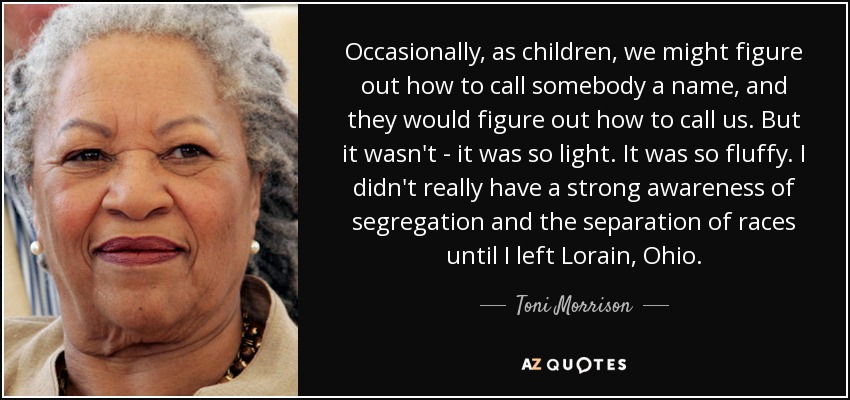
Occasionally, as children, we might figure out how to call somebody a name, and they would figure out how to call us. But it wasn't - it was so light. It was so fluffy. I didn't really have a strong awareness of segregation and the separation of races until I left Lorain, Ohio.
Jesse Owen was bigger than a black hero, he was an American hero. For me, I looked at it from that perspective. Through my research, I obviously learned a lot, much of which made me sad, upset, disappointed and even angry, regarding what Jesse had to go through. Not only was he a black man in America during an age of high racial tension and segregation, but he was also living in the middle of the Great Depression - it was very difficult times for him and his family.
We've gone thorough religious wars and civil wars. America has gone through slavery, we've all gone through two world wars, segregation. Ultimately it's been a bloody, trying, wasteful, but eventually positive struggle.
The Bible Belt, the religious South, is the section of the country that practiced slavery until the war made them give it up. They practiced segregation. They practiced lynchings. I don't see any great value in that.
The 20th century was a turning point; it freed and emancipated women, broke the back of segregation, and began the struggle to give justice to gay and lesbian people. But the Christian church, in both Catholic and Protestant forms, resisted every one of those humanizing developments. The church was on the wrong side of all three of those fights.
...The Court ...[recognizes]...the persistence of racial inequality and a majority's acknowledgement of Congress's authority to act affirmatively, not only to end discrimination, but also to counteract discrimination's lingering effects. Those effects, reflective of a system of racial caste [legal segregation and discrimination] only recently ended, are evident in our work places, markets, and neighborhoods. Job applicants with identical resumes, qualifications, and interview styles still experience different receptions, depending on their race.
To give certain dysgenic groups in our population their choice of segregation or sterilization. g. to apportion farm lands and homesteads for these segregated persons where they would be taught to work under competent instructors for the period of their entire lives.
Give dysgenic groups [people with 'bad genes'] in our population their choice of segregation or [compulsory] sterilization.
When you talk about "white privilege", you're talking about something systemic. When you're talking about "black privilege" it's something spiritual because we as black people tap into a divine system that a lot of other cultures and races can't tap into and that system allows us to prosper in spite of everything that's been thrown our way from slavery to segregation to mass incarceration. We have a privilege pre-ordained by God that nothing and no one can stop.
The persistence of housing discrimination and housing segregation makes it difficult at times to integrate schools. So what flows from that is disappointment and cynicism and the search for what's next. And it's really in the search for what's next after that that we come upon ideas like increasing standardized testing for kids and using those tests scores to hold teachers accountable.
In America, and no doubt elsewhere, we have such a tendency toward the segregation of cultural products. This is a black book, this is a gay book, this is an Asian book. It can be counterproductive both to the literary enterprise and to people's reading, because it can set up barriers. Readers may think, "Oh, I'm a straight man from Atlanta and I'm white, so I won't enjoy that book because it's by a gay black woman in Brooklyn." They're encouraged to think that, in a way, because of the categorization in the media.
The policies enacted during segregation are still being felt in Birmingham.
Women and LBGT people have the advantage that they are everybody's son, daughter, cousin, nephew, aunt, uncle. They are in a position to change hearts, and you saw it happen actually. African-Americans, not so much. They are separated from the white oppressive population by geography, housing, segregation, centuries of slavery. There is a tremendous wall between black America and white. I would say you open the door with the force of law, and then you can start to change hearts.
Unfortunately, most of the major denominations still practice segregation in local churches, hospitals, schools, and other church institutions. It is appalling that the most segregated hour of Christian America is eleven o'clock on Sunday morning, the same hour when many are standing to sing: "In Christ There Is No East Nor West.
Back when they supported segregation, Lott and Thurmond were Democrats.
You know if we were to look back and how we were in 1955 living in Jim Crow, living in segregation, living in segregated schools, it's hard to believe that it was America, but it really was.
If integration will get [black man] that [respect as the human being], all right. If segregation will get him that, all right. If separation will get him that, all right.But after he gets integration and he still doesn't have this dignity and this recognition as a human being, then his problem is still not solved.
With segregation, with the isolation of the injured and the robbed, comes the concentration of disadvantage. An unsegregated America might see poverty, and all its effects, spread across the country with no particular bias toward skin color. Instead, the concentration of poverty has been paired with a concentration of melanin.
Do away with curriculum. Do away with segregation by age. And do away with the idea that there should be uniformity of all schools and of what people learn.
L.A is a huge place, literally and metaphorically. Its beauty and horror. Its unconventional history. Its draw and allure. Its diversity and segregation.
I have known Trent Lott for 20 years, ... I don't believe he's racist. But he must proactively send a message to his colleagues in the Senate and the American people that he is absolutely opposed to any segregation in any form and racism in any form and discrimination in any form.
Personally I do not believe in a national agency devoted only to the negro blind because in spirit and principle I am against all segregation, and the blind already have difficulties enough without being cramped and harassed by social barriers.
Many well-meaning intelligent people have argued since the May 17, 1954, decision of the United States Supreme Court outlawing segregation in the public schools that communication between the races has broken down.
Through the dark days of legalized segregation and on into the civil rights era, jazz shone as a beacon for achieving interracial respect and understanding. It seemed as if the dream of a color-blind society was within reach in the jazz world, where musicians were judged on merit and not skin color.
A law is unjust if it is inflicted on a minority that, as a result of being denied the right to vote, had no part in enacting or devising the law. Who can say that the legislature of Alabama which set up the state's segregation laws was democratically elected?
Follow AzQuotes on Facebook, Twitter and Google+. Every day we present the best quotes! Improve yourself, find your inspiration, share with friends
or simply: