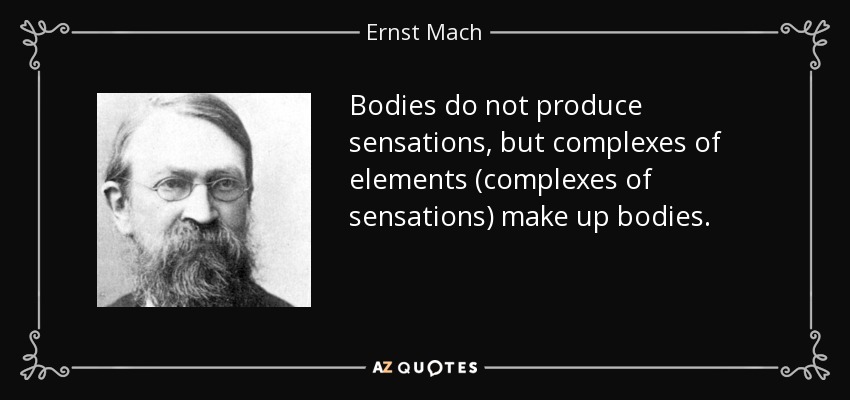
Bodies do not produce sensations, but complexes of elements (complexes of sensations) make up bodies.
Ordinarily pleasure and pain are regarded as different from sensations.
In many instances, order is apprehended first of all by the senses.
I see myself as a man who is searching for meaning in life. This is rather different from being a staunch believer in something. A believer is someone who senses a consciousness or a direction and believes in it. The one who searches for meaning has not found the direction yet.
Adjustment, that synonym for conformity that comes more easily to the modern tongue, is the theme of our swan song, the piper's tune to which we dance on the brink of the abyss, the siren's melody that destroys our senses and paralyzes our wills.
Africa is not a fun place, you know. A fun place is somewhere that lifts the spirits, that cossets the senses. I don't think that can be said of the Africa I traveled in.
Joy is not the same as pleasure or happiness. A wicked and evil man may have pleasure, while any ordinary mortal is capable of being happy. Pleasure generally comes from things, and always through the senses; happiness comes from humans through fellowship. Joy comes from loving God and neighbor. Pleasure is quick and violent, like a flash of lightning. Joy is steady and abiding, like a fixed star. Pleasure depends on external circumstances, such as money, food, travel, etc. Joy is independent of them, for it comes from a good conscience and love of God.
God, we thank you for this earth, our homes; for the wide sky and the blessed sun, for the salt sea and the running water, for the everlasting hills and the never resting winds, for trees and the common grass underfoot. We thank you for our senses by which we hear the songs of birds, and see the splendor of the summer fields, and taste of the autumn fruits, and rejoice in the feel of the snow, and smell the breath of the spring. Grant us a heart wide open to all this beauty; and save our souls from being so blind that we pass unseeing when even the common thorn bush is aflame with your glory.
A buoyant and full-blooded soul has quick senses and miscellaneous sympathies: it changes with the changing world; and when not too much starved or thwarted by circumstances, it finds all things vivid and comic. Life is free play fundamentally and would like to be free play altogether.
What happens when we begin to praise our own abilities? And this is not focusing on an inflated ego, but on appreciation and praise. What happens when we begin sincerely to give thanks for our wonderful minds and our strong and healthy bodies? It's not at all difficult to believe that our own senses of confidence and self-worth are actually activated and strengthened.
I don't mistrust reality, of which I know next to nothing. I mistrust the picture of reality conveyed to us by our senses, which is imperfect and circumscribed.
Do not go looking for problems to feed your soul. Just let life be your teacher. It will nourish you with its inevitable difficulties. How will you know whether you are letting life teach you and nourish you? If your physical senses become more sensitive to the beauty you see, the words of love you hear, and the life you feel touching your body and soul, then you know you have discovered the great value of misfortune.
Earnest is our dog. She senses instantly that something is wrong, and guided by that timeless and unerring nurturing instinct that all female dogs have, she tries to lick my ears off.
Six senses keeping Five around a sense of self
The analytical geometry of Descartes and the calculus of Newton and Leibniz have expanded into the marvelous mathematical method-more daring than anything that the history of philosophy records-of Lobachevsky and Riemann, Gauss and Sylvester. Indeed, mathematics, the indispensable tool of the sciences, defying the senses to follow its splendid flights, is demonstrating today, as it never has been demonstrated before, the supremacy of the pure reason.
Democritus sometimes does away with what appears to the senses, and says that none of these appears according to truth but only according to opinion: the truth in real things is that there are atoms and void. 'By convention sweet', he says, 'by convention bitter, by convention hot, by convention cold, by convention colour: but in reality atoms and void.'
The generality of men are so accustomed to judge of things by their senses that, because the air is indivisible, they ascribe but little to it, and think it but one remove from nothing.
Imagine yourself in the scene. See what there is to be seen. Listen to the sounds. Touch the world. Smell the air. Taste it. Use all of your senses. Then evoke those experiences for the reader. If you give the audience the flavor, they'll flesh out the moment in their own imaginations.
Appealing to the five senses is the feature that will always set writing apart from the visual media. A good writer will tell us what the world smells like, what the textures are, what the sounds are, what the light looks like, what the weather is.
Construed as turf, home just seems a provisional claim, a designation you make upon a place, not one it makes on you. A certain set of buildings, a glimpsed, smudged window-view across a schoolyard, a musty aroma sniffed behind a garage when you were a child, all of which come crowding in upon your latter-day senses -- those are pungent things and vivid, even consoling. But to me they are also inert and nostalgic and unlikely to connect you to the real, to that essence art can sometimes achieve, which is permanence.
There was a time when my whole life was in chaos, really, and I didn't help myself sort it out. But one day I came to my senses, and I think I was lucky because a lot of people don't.
Without renouncing the support of physics, it is possible for the physiology of the senses, not only to pursue its own course of development, but also to afford to physical science itself powerful assistance.
One senses, in all autobiography, a straining toward perfection, perfection of a kind that connects the individual with a cosmic pattern which, because it is perfect in itself, verifies that individuals own potential perfection.
Voluptuaries, consumed by their senses, always begin by flinging themselves with a great display of frenzy into an abyss. But they survive, they come to the surface again. And they develop a routine of the abyss: It's four o clock. At five I have my abyss.
Perhaps, on the whole, embarrassment and perplexity are a kind of natural accompaniment to life and movement; and it is better to be driven out of your senses with thinking which of two things you ought to do than to do nothing whatever, and be utterly uninteresting to all the world.
Follow AzQuotes on Facebook, Twitter and Google+. Every day we present the best quotes! Improve yourself, find your inspiration, share with friends
or simply: