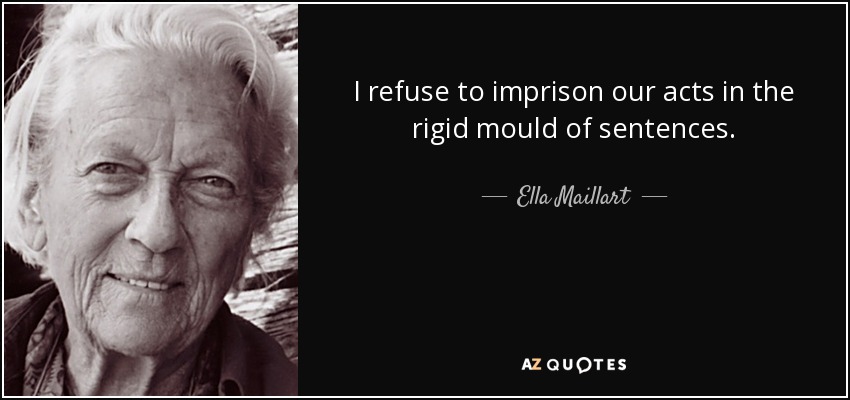
I refuse to imprison our acts in the rigid mould of sentences.
Tormented by the cursed ambition always to put a whole book in a page, a whole page in a sentence, and this sentence in a word. I am speaking of myself.
The moment that I realized my name was going to be said in the same sentence as children and sex, that's really intense. That's something I knew from that very moment, whatever happens past that point, something's out there in the air that is really bad.
A painter must compensate the natural deficiencies of his art. He has but one sentence to utter, but one moment to exhibit. He cannot, like the poet or historian, expatiate, and impress the mind.
I sometimes think, with a sad delight, that if one day, in a future I no longer belong to, these sentences, that I write, last with praise, I will at last have the people who understand me, those mine, the true family to be born in and be loved... I will only be understood in effigy, when affection no longer repays the dead the unaffection that was, when living.
I usually do at least a dozen drafts and progressively make more-conscious decisions. Because I've always believed stories are closer to poems than novels, I spend a lot of time on the story's larger rhythms, such as sentence and paragraph length, placement of flashbacks and dialogue.
In a poem the excitement has to maintain itself. I am governed by the pull of the sentence as the pull of a fabric is governed by gravity.
You can teach almost anyone determined to learn them the basics required to write sentences and paragraphs that say what you want them to say clearly and concisely. It's far more difficult to get people to think like a writer, to give up conventional habits of mind and emotion. You must be able to step inside your character's skin, and at the same time to remain outside the dicey circumstances you have maneuvered her into.
I've been accused of not really paying attention to a sentence unless my name comes up in it twice.
I want to fall in love with beautiful women of all races. Rescue somebody every now and then, improve my painting, and improve my sentence structure. If I can make a living doing that stuff, that's great, and I will keep doing it, and they can do whatever they want with my image. I couldn't care less.
It's not that you get a cliché and then wiggle it about or use synonyms. You don't take an ordinary decorative paragraph and give it style. What you're trying to do is be faithful to your perceptions and transmit them as faithfully as you can. I say these sentences until they sound right. There's no objective reason why they're right. They just sound right to me.
I read 'The Great Gatsby' in high school and was hypnotized by the beauty of the sentences and moved by the story about the irrevocability of lost love.
If you can stand to wait 24 hours before you decide the fate of what you have written - either good or bad - you're more likely to see that invisible thing that is invisible for the first few days in any new writing. We just can't know what all is in a sentence until there are several sentences to follow it. Pages of writing need more pages in order to be known, chapters need more chapters.
I think I am less self-assured when I write English than I would be if I were writing in my first language. I have to test each sentence over and over to be sure that it's right, that I haven't introduced some element that isn't English.
If I have any advantage, maybe, as a writer, it is that I don't think I'm very interesting. I mean, beginning a novel with the last sentence is a pretty plodding way to spend your life.
There is poetry in fiction. If you cannot see it and feel it when you write, you need to step back and examine what you are doing wrong. If you have not figured out how to write a simple declarative sentence and make it sing with that poetry, you are not yet ready to write an entire book.
The rythms of typing favour short, concise sentences, sentences with oral form.
I have seen him in the watchfires of a hundred circling camps They have builded him an altar in the evening dews and damps, I have read His righteous sentence by the dim and flaring lamps, His Day is marching on.
We cannot judge either of the feelings or of the characters of men with perfect accuracy from their actions or their appearance in public; it is from their careless conversations, their half-finished sentences, that we may hope with the greatest probability of success to discover their real characters.
Letters are meaningless unless put together correctly. Words are worthless unless backed by truth. Sentences are handed out and judged accordingly, but only genuinely honest men or women can create writings that change the world forever.
All the elements in an advertisement are primarily designed to do one thing and one thing only: get you to read the first sentence of the copy.
I was always aware, reading Chesterton, that there was someone writing this who rejoiced in words, who deployed them on the page as an artist deploys his paints upon his palette. Behind every Chesterton sentence there was someone painting with words, and it seemed to me that at the end of any particularly good sentence or any perfectly-put paradox, you could hear the author, somewhere behind the scenes, giggling with delight.
Conversation in real life is full of half-finished sentences and overlapping talk. Why shouldn't painting be too?
Every sentence has its drumbeat. rhythm is one of the most powerful dimensions of language: it separates tribes, united families, soothes children, and shocks us into new awarenesses. Every good writer, marching to his or her own drumbeat, marks out a vibrational field as home territory. The cadences of our sentences carry echos of ancestry and influence as surely as the double helix that orchstrates the life of the body.
Native speakers of a language know intuitively whether a sentence is grammatical or not. They usually cannot specify exactly what is wrong, and very possibly they make the same mistakes in their own speech, but they know-unconsciously, not as a set of rules they learned in school-when a sentence is incorrect.
Follow AzQuotes on Facebook, Twitter and Google+. Every day we present the best quotes! Improve yourself, find your inspiration, share with friends
or simply: