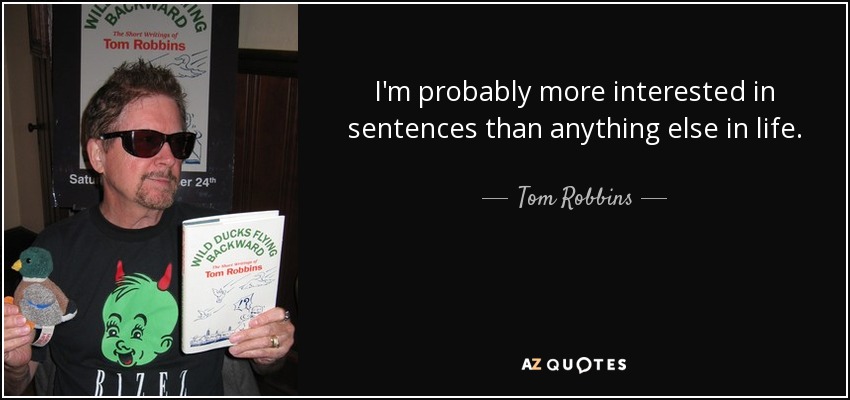
I'm probably more interested in sentences than anything else in life.
I say the sentences again and again in my head until they sound right.
A handwritten letter carries a lot of risk. It's a one-sided conversation that reveals the truth of the writer. Furthermore, the writer is not there to see the reaction of the person he writes to, so there's a great unknown to the process that requires a leap of faith. The writer has to choose the right words to express his sentences, and then, once he has sealed the envelope, he has to place those thoughts in the hands of someone else, trusting that the feelings will be delivered, and that the recipient will understand the writer's intent. How childish to think that could be easy.
There is one straight chain of truth without one heretical sentence in that which I have written.
We stand for organized terror - this should be frankly admitted. Terror is an absolute necessity during times of revolution. Our aim is to fight against the enemies of the Soviet Government and of the new order of life. We judge quickly. In most cases only a day passes between the apprehension of the criminal and his sentence. When confronted with evidence criminals in almost every case confess; and what argument can have greater weight than a criminal's own confession.
I think a single sentence by Van Gogh is better than the whole work of all the art critics and art historians put together.
Don't put Banana and Hammock in the same sentence
Look at all the sentences which seem true and question them.
The way of Heaven and Earth may be completely declared in one sentence: They are without any doubleness, and so they produce things in a manner that is unfathomable.
In Madame Bovary Flaubert never allows anything to go on too long; he can suggest years of boredom in a paragraph, capture the essence of a character in a single conversational exchange, or show us the gulf between his soulful heroine and her dull-witted husband in a sentence (and one that, moreover, presages all Emma's later experience of men). (...) This is one of the summits of prose art, and not to know such a masterpiece is to live a diminished life.
I like the challenge of creating a world with only sentences.
Every word is part of a picture, Every sentence is a picture. All you have to do is link them together.
Look directly into every mirror. Realize our reflection is the first sentence to a story, and our story starts: We were here.
Read as widely as possible, and write every day, even if it's as little as three sentences.
There are words and words and none mean anything. And then one sentence means everything.
Life is terrorism, so spare me your indignation. Life is one big infiltration of our secure defenses. Some people put bombs on buses and blow them up: those are terrorists. Some people speak to you and their words blow you up: what would you call those people? Life is a condemned cell. . . . That's the only way to protect yourself . . . to understand that you're always under sentence of death and to try to get a temporary remission.
Our word choices give a sentence its luster, and they deserve intense attention.
Over the course of several articles, I will give you the tools to become a sentence connoisseur as well as a sentence artisan. Each of my lessons will give you the insight to appreciate fine sentences and the vocabulary to talk about them.
A sentence can offer a moment of quiet, it can crackle with energy or it can just lie there, listless and uninteresting. What makes the difference? The verb.
There is no one way to render an idea. Let’s explore how masters of the sentence play with length and style to make their sentences distinctive.
Writers dream of sentences that sail through the waters of thought. We try to control their shape and size, and we struggle to let them glide, rather than thrash at sea.
I spent my entire youth writing slowly with revisions and endless rehashing speculation and deleting and got so I was writing one sentence a day and the sentence had no FEELING. Goddamn it, FEELING is what I like in art, not CRAFTINESS and the hiding of feelings.
Whenever you listen to a piece of music, what you are actually doing is hearing the latest sentence in a very long story you’ve been listening to - all the pieces of music you’ve ever heard.
I died in 1960 from a prison sentence and poetry brought me back to life.
What I do instead is I will cheerfully spend literally hours on identifier names: variable names, method names, and so forth, to make my code readable. If you read some expression using these identifiers and it reads like an English sentence, your program is much more likely to be correct, and much easier to maintain.
Follow AzQuotes on Facebook, Twitter and Google+. Every day we present the best quotes! Improve yourself, find your inspiration, share with friends
or simply: