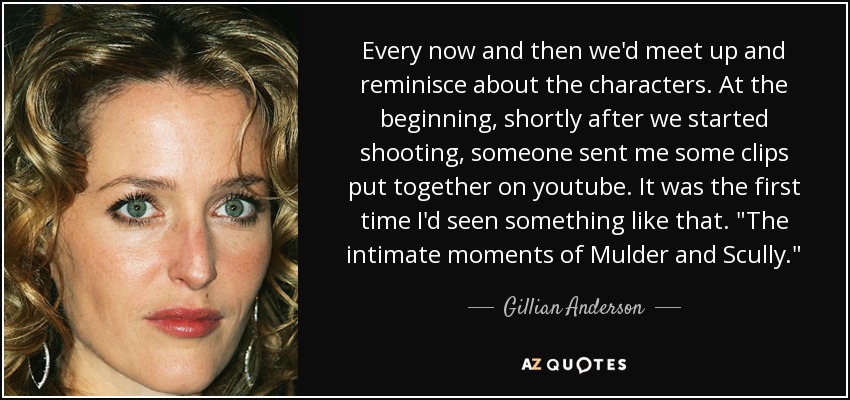
Every now and then we'd meet up and reminisce about the characters. At the beginning, shortly after we started shooting, someone sent me some clips put together on youtube. It was the first time I'd seen something like that. "The intimate moments of Mulder and Scully."
And so you try your best. Sometimes you go in with one thing, with one desire and come out with something else. In the case of 'The Aviator' it was to create a Hollywood spectacle, but by about the second or third week of shooting you just want to literally survive it. Because don't forget, I also go through the editing process too, and when the film is released I have to talk about it. So, I take all of that very seriously.
Sometimes when you're making a film and something happens during a scene that you've just thought of, it can be missed if the wrong lens is on or if you're shooting in the wrong direction but this [performance capture] doesn't miss a thing. So, you might do something that's genius - very rarely, admittedly - but it doesn't miss it.
Shooting at Quentin Tarantino movie was like a masterclass in directing. Although I went back literally right into rehearsal, started shooting... while I was doing it I had to write my Grindhouse trailer and I added two days of shooting. My brother was producing Hostel and the Grindhouse trailer and I was like: "Gabe, just figure this out!"
As an editor, you're constantly dealing with the best way to convey an exchange between two people. So when I'm shooting that, I'm just aware in the back of my head what an editor might want. And also, the problems editors run into when trying to edit performances - it helps me head that off at the pass a little.
I did 50 takes on Robert Shaw assembling the Greener Gun on 'Jaws.' The shark wasn't working, so I just kept shooting to make the production report look like we were accomplishing something and to keep cast and crew from going crazy from boredom. It was a strategic indulgence.
As a young filmmaker, I shot a lot of stuff because I wanted to make sure that I got everything, but now I've gotten much more precise with my shooting. Editing is a whole other layer because then, sometimes you realize characters don't even need to say this or that. It becomes an issue of exposition, and over-explaining something. In the script, I'd reinforce certain things about what I wanted people to know two or three times, but in the editing room, I'd be like, "I only need to say this once, maybe twice."
Once I start shooting I forget the scriptwriter in me. I like things flowing. If you have talented actors who bring their own ideas, it can be much better than what you have worked out.
By the end of the shoot [of Wrestler], my trainer was pushing me up three flights of stairs to my house and holding my arm like I was an old cripple. I had three MRIs in the first two months of working on the film. I felt like it really was over by the time we started shooting the movie.
I am not a fan of improvisation, because it bores me. Working off a tight scenario gives you the confidence and ability to - why don't we change this a little bit and bring it back to the script. You always discover things while shooting.
I believe shooting chronologically gives you a very fresh perspective and you're always aware of where you are in the development of the characters.
I like the idea of chance coming into filmmaking, in shooting, in editing, and I do make space in my rules of game for chance.
Shooting an improv-based film is incredibly liberating, exhilarating, and fun, but editing that kind of movie can be difficult for obvious continuity reasons.
You never have any idea where your movie's going to go when you're shooting - you're in this little bubble. Everything you care about is getting the next step right: getting the script right, finding the right actors, shooting it.
I'm in the gym pretty much every day. I've been very strict about my diet during shooting. It all helps me bring as much authenticity to the role as I can.
I like shooting things in single takes. You have to rely on the idea itself to carry the full weight; you're always watching the idea, not the filmmaking.
There's always something going on on movie sets. Even just from, you know, maybe you come in tired some days and you're not in your best mood. It's different when you're shooting movies because you're on a schedule and you gotta come with your A-game every day.
Never [enter] into dispute or argument with another. I never yet saw an instance of one of two disputants convincing the other by argument. I have seen many on their getting warm, becoming rude and shooting one another.
Watching my own past heartache and experience day after day - it was gut-wrenching, cathartic, beautiful, and painful. That and shooting the film in less than a month.
Film is very much about capturing the essence of things - if you feel it, and you've got the right person shooting it, it'll come across. Theater's a different animal; it's physically different and requires a different discipline. In the theater, you're mining the same material, constantly honing the same thing, executing it and keeping it alive and fresh.
The summer gig turned into my day job. I was an arts administrator who helped make indie flicks. At the filmmakers' encouragement, I tried shooting a couple of shorts of my own. Directing was stressful, it was not my strength. But writing the scripts and helping others with their scripts - that was a gas. Making stuff up the way I wanted to see it was the biggest kick I ever experienced.
[Having bigger budget] allowed me to be a full-time filmmaker for a couple months and not have to have a day job and be balancing a bunch of other stuff. It allowed me to bring in all these people from different parts of the country. It allows me to have an actual food budget, where we could eat healthy for the month we were shooting. It makes all the difference in the world.
The other thing is that when people mention computers - and I'm pretty much the same - they find it hard to comprehend that there's a performance there. They look at it as something that's just been made by a computer but in a way the difference is that when you make a normal film - and I'm simplifying it here - you put on the make-up and you put the scenery in before you start shooting, but with this you still perform in the same way but then you put the make-up on after, along with the costumes and scenery.
I get very close to people when I'm shooting them. We would go and shoot a scene with Lucy, and I would spend the whole time telling her about Rob. Then I would go shoot a scene with Rob and tell him all about Lucy. Eventually they wanted to know each other. These are two people who would never have overlapped in any other way or context. We brought to the garden at Rob's office and just sat and watched what unfolded. I remember weeping behind the camera, because I was so moved by the way they connected.
I think a lot of America turned to art and culture after Sept. 11. I know the sales of bibles went shooting up, but so did the sales of poetry. I think in a crisis one looks to one's culture, partially to give validation to why one would want that culture to survive.
Follow AzQuotes on Facebook, Twitter and Google+. Every day we present the best quotes! Improve yourself, find your inspiration, share with friends
or simply: