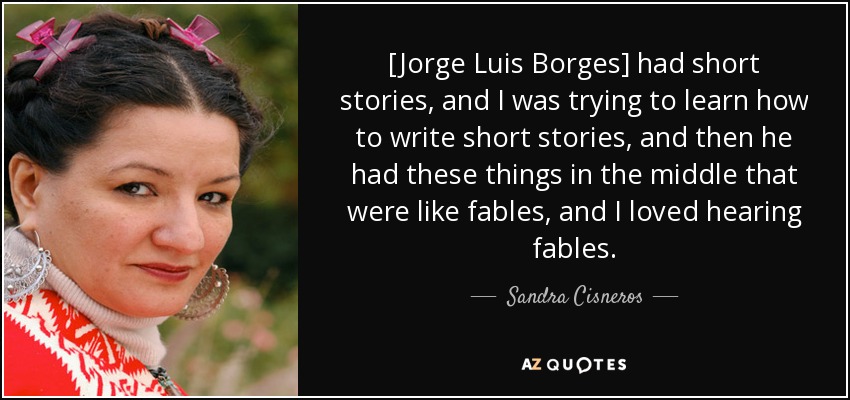
[Jorge Luis Borges] had short stories, and I was trying to learn how to write short stories, and then he had these things in the middle that were like fables, and I loved hearing fables.
If you read my short stories, there's a lot of sex in those in all different ways. To me, it's a really good, useful thing to get to have in a story. And in a movie, it's amazing, because you actually get to show things.
I think because I write so many short stories, it's not that hard to come up with characters that are not me.
What's impossible not to notice, though - it's all around us - is the diminution of American prose: How pedestrian it has become. Pick up any short story and listen to its voice, the tedious easy vernacular that mistakes transcription for realism. This would display an understandable pragmatism if it were a pandering to common-denominator readers; but it is, in fact, a kind of hifalultin literary ideology, the less-is-more Hemingway legacy put through an up-to-the-minute industrial blender.
Sometimes I do work on a longer manuscript in tandem with one or two shorter pieces - whether it's a short story or an essay (though I don't write many of the latter).
I sat down and wrote a short story in two weeks and submitted it to Marion Zimmer Bradley. And Marion bought "Wound On The Moon" .My first sale and my first pro sale rolled into one.
Short stories are like individual jewel stones on a necklace, wonderful in themselves like standalone gleaming entities of semantic intensity.
I began by doing book reviews on the typewriter and then went over to short stories on the machine, meanwhile sticking to pencil for poetry.
If Francoise Sagan hadn't written a book called A Chateau in Sweden, I would certainly write a short story called A Chateau in Puerto Rico. And I may yet.
I couldn't sit down and write a novel or a short story - even now - because of my dyslexia. But I learned narration through movies.
I'm much more drawn to fiction, to short stories, and to plays, than I am to diarists.
I had a short story collection come out in 2006, and then I couldn't work on large projects for a long time because I was finishing my doctoral degree.
Though The Kite Runner was my first completed novel, I had been writing on and off for most of my life, primarily short stories, and primarily for myself.
I found myself sitting at the computer, and I thought I was going to write a kind of simple nostalgic story about two boys and their love of kite fighting. But stories have a will of their own, and this one turned out to be this dark tale about betrayal, loss, regret. The short story which was about 25 pages long sat around for a couple of years.
That same night, I wrote my first short story. It took me thirty minutes. It was a dark little tale about a man who found a magic cup and learned that if he wept into the cup, his tears turned into pearls. But even though he had always been poor, he was a happy man and rarely shed a tear. So he found ways to make himself sad so that his tears could make him rich. As the pearls piled up, so did his greed grow. The story ended with the man sitting on a mountain of pearls, knife in hand, weeping helplessly into the cup with his beloved wife's slain body in his arms.
Kilgore Trout once wrote a short story which was a dialogue between two pieces of yeast. They were discussing the possible purposes of life as they ate sugar and suffocated in their own excrement. Because of their limited intelligence, they never came close to guessing that they were making champagne.
My circumstances of unrelieved responsibility and permanent distraction necessitated the short story form.
Short fiction seems more targeted - hand grenades of ideas, if you will. When they work, they hit, they explode, and you never forget them. Long fiction feels more like atmosphere: it's a lot smokier and less defined.
If we're lucky, writer and reader alike, we'll finish the last line or two of a short story and then just sit for a minute, quietly. Ideally, we'll ponder what we've just written or read; maybe our hearts or intellects will have been moved off the peg just a little from where they were before. Our body temperature will have gone up, or down, by a degree. Then, breathing evenly and steadily once more, we'll collect ourselves, writers and readers alike, get up, "created of warm blood and nerves" as a Chekhov character puts it, and go on to the next thing: Life. Always life.
Many people have said to me, "What a pity you had such a big family to raise." "Think of the novels and the short stories and the poems you never had time to write because of that." And I looked at my children and I said, "These are my poems, these are my stories."
Short stories are designed to deliver their impact in as few pages as possible. A tremendous amount is left out, and a good short story writer learns to include only the most essential information.
The best advice I can give on this is, once it's done, to put it away until you can read it with new eyes. Finish the short story, print it out, then put it in a drawer and write other things. When you're ready, pick it up and read it, as if you've never read it before. If there are things you aren't satisfied with as a reader, go in and fix them as a writer: that's revision.
I would also suggest that any aspiring writer begin with short stories. These days, I meet far too many young writers who try to start off with a novel right off, or a trilogy, or even a nine-book series. That's like starting in at rock climbing by tackling Mt. Everest. Short stories help you learn your craft.
I'm going to marry my novels and have little short stories for children.
A short story is the ultimate close-up magic trick -- a couple of thousand words to take you around the universe or break your heart.
Follow AzQuotes on Facebook, Twitter and Google+. Every day we present the best quotes! Improve yourself, find your inspiration, share with friends
or simply: