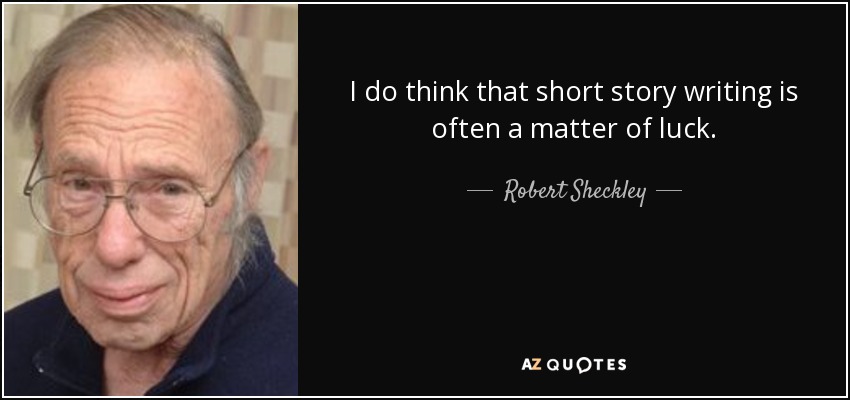
I do think that short story writing is often a matter of luck.
The many magazines, ranging from pulp to slick, that used to serve as both farm teams for writers and lures to readers, with hundreds of short stories every month, don't exist. Most of the doors for new people have been sealed.
I mean, first, almost all writers these days teach because they don't make enough money publishing to live on, to support themselves - people like Tobias Wolff, Anne Beattie, Amy Hempel, Stuart Dybek; a lot of short story writers, for one thing.
Alice Munro is a particular kind of short story writer in that she writes long, character-driven short stories.
Most publishers seem very reluctant to publish short story collections at all; they bring them out in paperback, often disguised as novels.
A novel is what you call something that won't sell if you call it poems or short stories.
People who rarely read long books, or even short stories, still appreciate the greatest examples of the shortest literary genres. I have long been fascinated by these short genres. They seem to lie just where my heart is, somewhere between literature and philosophy.
I believe that the short story is as different a form from the novel as poetry is, and the best stories seem to me to be perhaps closer in spirit to poetry than to novels.
Well, as a short-story writer, I don't think there are any weaknesses to the genre itself. I guess I would say that the difficulty of the form is that one must create an entire world in five to 30 pages, as opposed to 300. There is very little room for fat - you must be economical. And you must begin as close to the end as you possibly can.
I think I got spoiled and that writing a short story and getting it published, or writing a novel and getting it published, you pretty much get to do the first, second and third draft yourself without a whole lot of interference.
Once in 1919, when I was traveling at night by train, I wrote a short story. In the town where the train stopped, I took the story to the publisher of the newspaper who published the story.
I started writing about New York as soon as I arrived. I was 19. I used to write short stories and send them out.
A novel requires a certain kind of world-building and also a certain kind of closure, ultimately. Whereas with a short story you have this sense that there are hinges that the reader doesn't see.
I would say that all short stories have mystery naturally built into them.
Short stories are wonderful and extremely challenging, and the joy of them, because it only takes me three or four months to write, I can take more risks with them. It's just less of your life invested.
I'm not a writer. I think I can write short stories and poetry, but film writing, brilliant film writing, is a talent - you can't just do it like that.
When I was eight years old, I wrote a paragraph-long short story about a goat on my mother's hundred-pound, black-and-white-screen laptop. The story came about largely because I liked the way the word 'goat' looked on the page, but I decided then and there that I wanted to be a writer. That desire never changed.
I found that I could write two kinds of short stories: I could write very absurd, kind of surrealistic, funny stories; or I could write very dark, realistic - hyper-realistic - stories. I was never happy with that, because I couldn't meld the two.
I'm one of those writers who started off writing novels and came to writing short stories later, partly because I didn't have the right ideas, partly because I think that short stories are more difficult. I think learning to write short stories also made me attracted toward a paring down of the novel form.
Songwriters are expanding time rather than compressing time. My short stories tend to be old fashioned, with a beginning, middle and end.
I am drawn to writing books about magic and the supernatural because those are the types of books I like to read. I've written many short stories with realistic settings, and I certainly wouldn't rule out realistic novels in the future!
In college I wrote for the university newspaper, and I had several short stories published in small press. I think it's just been a natural progression of where to go with the imagination and not have to grow up.
I don't revise a lot when writing short stories. As far as the novel, I definitely thought more about plot. Honestly, I'm still pretty confused about what "plot" means. I've been reading some of my Goodreads reviews and one reader noted that the The Last Days of California "reads like a short story stretched to the breaking point, padded and brought into novel range..." I don't know what people want, really.
I like to write short stories more because I never met a writer who wasn't lazy. And a short story is, by its very definition, short. It is something that generally you can turn out in a week to two weeks depending on how well it goes for you. But, at the same time, it gives the same satisfaction of creating a complete world.
I'll give you the sole secret of short-story writing, and here it is: Rule 1. Write stories that please yourself. There is no rule 2. The technical points you can get from Bliss Perry. If you can't write a story that pleases yourself, you will never please the public. But in writing the story forget the public.
Follow AzQuotes on Facebook, Twitter and Google+. Every day we present the best quotes! Improve yourself, find your inspiration, share with friends
or simply: