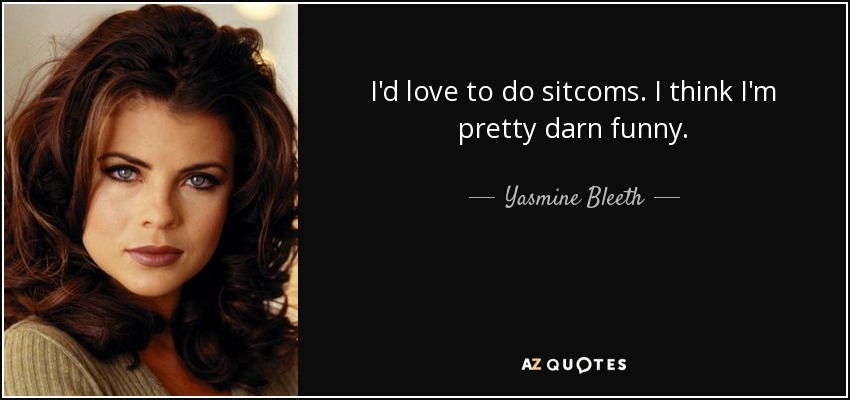
I'd love to do sitcoms. I think I'm pretty darn funny.
I would really like to do a really cool one-hour show, maybe on like HBO or something like that; or something that Ive spent a couple of years developing so it would be exactly the character and exactly in with a huge push behind it; or I would maybe want to do a sitcom; something light and funny.
I had not met Tina Fey before I auditioned for 30 Rock. Some people think were old friends from Second City days. I had always been a fan of Tinas. But I actually never planned on being in a sitcom.
I'd like to do a show that's not a sitcom.
Writing is the greatest thing about really good sitcoms.
Finding a way to find humor in things that are hardcore is definitely something that, I think, the sitcom does best.
The most dramatic moves I have made as an actor have been from stage to screen and from sitcom to drama.
My very first job was something called Nobodys Watching, that Bill Lawrence who created Scrubs, it was his pilot. It was my very first TV job, and it was a sitcom. Ever since that experience, Ive been so itching to get back to that kind of environment and just to be involved with comedy.
My experience tells me that any time you hear people laughing on a sitcom, it's the writers who happen to be closest to the microphones - not the audience.
I have to say Justine Bateman may be the most underrated sitcom actress ever.
Many, many things are dangerous in our world, commercials and TV are dangerous, and so is the world of sitcoms. But nobody does anything about them because they're turning in alot of money.
The reason I'm doing a sitcom is because it's much more approachable.
The film is better for me than the sitcom. But the sitcom is like much more practical approach, if I may say that, because of the cost. Everything costs money, a lot of people don't realize that.
Nerves are always a big problem for me, which is why I loved doing American sitcoms. Because you know when you do the take in front of the audience that you're going to do it again afterwards. A minute after you finish, you just go and do it again. So, there's that sort of safety net. And then if you made a little mistake or two, they'll go pick it up, so there's nothing to worry about.
I think the anti-intellectualism of a lot of contemporary fiction is a kind of despairing of literature's ability to be anything more than perfectly bound blog posts or transcribed sitcoms.
I've always wanted to have a Greek sitcom called Olive Lucy.
We were the daughters of the post-World War II American dream, the daughters of those idealized fifties sitcom families in which father knew best and mother knew her place and a kind of disappointment, and tense, unspoken sexuality rattled around like ice cubes in their nightly cocktails.
I would love to play a main character and then play different characters as well. I would want for it to be a sitcom, multicamera, audience - that's definitely a dream. It's in the works, so... it's closer than everybody thinks it is.
I always try to use my medium, and if I get into a normal sitcom-writing contest with normal sitcom writers, I'm going to lose.
There are so many sitcoms. So, when you get to be a part of something that feels exciting to you, you just want to be a part of it.
I grew up on network sitcoms. If those are gone when I'm 65 years old, I would never forgive myself for not stepping up to that plate, as often as possible. I'm already bummed out that DVDs are dying off because, in my 20s, those were a huge thing.
It's the opposite on a sitcom. People crave the character to not learn from their mistakes. They want to just see the situation, and then see how that character is going to react to that particular chaotic catastrophe. That's just my take on it, anyway. I don't really get too hung up on what the future of the show is.
I always tell that to young people - go to college, do theater, work with an audience. Don't try to learn how to act in front of millions and millions of people. Don't make that your first ambition, to be on a sitcom or get into the movies. Learn who you are as an actor, and the best way to do that is to do it in front of an audience.
I started on television, and on sitcoms, and loved them, but then they sort of seemed to be going through sort of an ice age, and they started dying off one by one, and I recognized that, and my representatives recognized that, and we said 'Well, let's look at dramas and other things like that.'
The generations that were exposed to sitcom have the people actually saying the line, saying the joke, whereas sort of before that you have much more observational humor.
Follow AzQuotes on Facebook, Twitter and Google+. Every day we present the best quotes! Improve yourself, find your inspiration, share with friends
or simply: