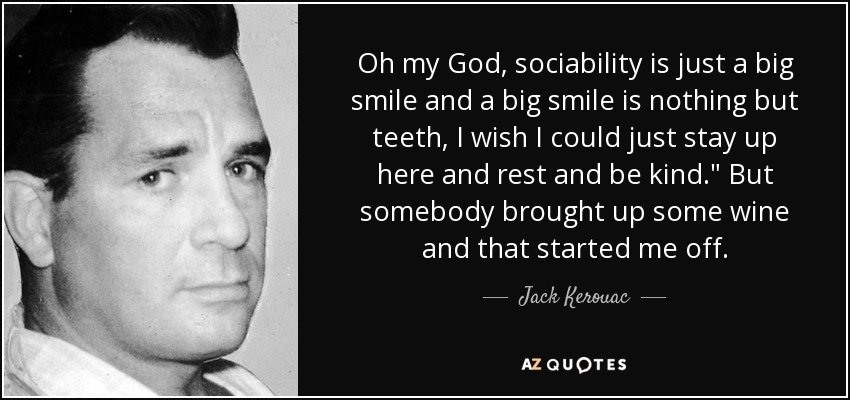
Oh my God, sociability is just a big smile and a big smile is nothing but teeth, I wish I could just stay up here and rest and be kind." But somebody brought up some wine and that started me off.
I was very inventive. I lived in my own world - my dad said I was a loner. Not lonely, just happy in my own company. It's the same now. I need time alone, which is maybe why I love to write. Having said that, I love the sociability of telly. It's a nice contrast.
The savage hatred I feel for crowds is getting worse, natural enemies that they are of imagination and of thought.
if networks of women are formed, they should be job related and task related rather than female-concerns related. Personal networks for sociability in the context of a work organization would tend to promote the image of women contained in the temperamental model - that companies must compensate for women's deficiencies and bring them together for support because they could not make it on their own. But job-related task forces serve the social-psychological functions while reinforcing a more positive image of women.
If we define a misanthrope as 'someone who does not suffer fools and likes to see fools suffer,' we have described a person with something to look forward to.
My object is to live in a place that does not call itself 'the community with a heart.' I want one of those godforsaken towns where all the young people leave and the rest sit on the porch with a rifle across their knees.
If you ever meet someone who cannot understand why solitary confinement is considered punishment, you have met a misanthrope.
Introversion - along with its cousins sensitivity, seriousness, and shyness - is now a second-class personality trait, somewhere between a disappointment and a pathology.
It is very unreasonable of people to expect one should be at home, because one is in the house. Of all privileges, that of invisibility is the most valuable.
Visitors should conform as much as possible to the habits and customs of the house. They should be moderate in their demands for personal attendance. They should not carry their moods into the drawing-room or to the table, and, whether they are bored or not, should be ready to contribute as much as in their power to an atmosphere of pleasure. If the above involves too much self-sacrifice, then an invitation to visit should by no means be accepted.
I can easily do without people (there are days when I could easily do without myself), and ... in the country of books where I dwell, the dead can count entirely as much as the living.
I cannot love people in the country, I discover, because there is always this danger that they may be acquaintances, with all the perils and choleras of acquaintance implicit in them; but in London they seem as charming as rabbits.
the present Western civilization ... is dominated by the extravert viewpoint. There are plenty of reasons for this domination: extraverts are more vocal than introverts; they are more numerous, apparently in the ratio of three to one; and they are accessible and understandable, whereas the introverts are not readily understandable, even to each other, and are likely to be thoroughly incomprehensible to the extraverts.
The need for sociability induce man to be in touch with his fellow men. However, this need might not ("ne saurait", Fr.) find its full (or complete) satisfaction in the conventional (or superficial, - "conventionnel", Fr.) and deceitful world, in which (or where) everyone is mainly (or mostly) trying to assert oneself in front of others ("devant les autres", Fr.), to appear, and hoping to find in society ("mondaine", Fr.) relationships some advantages for his interest and vanity (or vainglory or conceit", Fr).
I love sharing photographs and websites, I'm for all of these things. I'm for Facebook. But to say that this is sociability? We begin to define things in terms of what technology enables and technology allows.
A party is a slightly artificial event where one learns the rudiments of human behavior at its most admirable: speaking when spoken to, looking somebody in the eye, shaking hands and being friendly under duress.
at a certain moment in social proceedings, I am on FIRE to leave: I have a leaving-FIT.
Extreme cold when it first arrives seems to generate cheerfulness and sociability. For a few hours all life's dubious problems are dropped in favor of the clear and congenial task of keeping alive.
My father was never very friendly. When I was growing up, I thought the doorbell ringing was a signal to pretend you weren't home.
I'm fond of human beings, but only one at a time.
It is, indeed, a fact that, in the midst of society and sociability every evil inclination has to place itself under such great restraint, don so many masks, lay itself so often on the procrustean bed of virtue, that one could well speak of a martyrdom of the evil man. In solitude all this falls away. He who is evil is at his most evil in solitude: which is where he is at his best - and thus to the eye of him who sees everywhere only a spectacle also at his most beautiful.
My idea of everything going smoothly on an airplane is (a) that I not die in a slow-motion fiery crash or get stabbed to death by terrorists and (b) that none of the other passengers try to talk to me. All conversation should end at the moment the wheels leave the ground.
[On sociability in Italy:] You may be a hermit or an innkeeper.
[Emily] Dickinson, our supreme poet of inwardness.
Our age is so gregarious that there is at present a marked prejudice against anyone being alone. It is looked down on, and a need to be alone is almost considered a fault, a weakness, as though if one cannot endure - more - enjoy being with other people every minute one is aloof, unreal, and somehow to be pitied.
Follow AzQuotes on Facebook, Twitter and Google+. Every day we present the best quotes! Improve yourself, find your inspiration, share with friends
or simply: