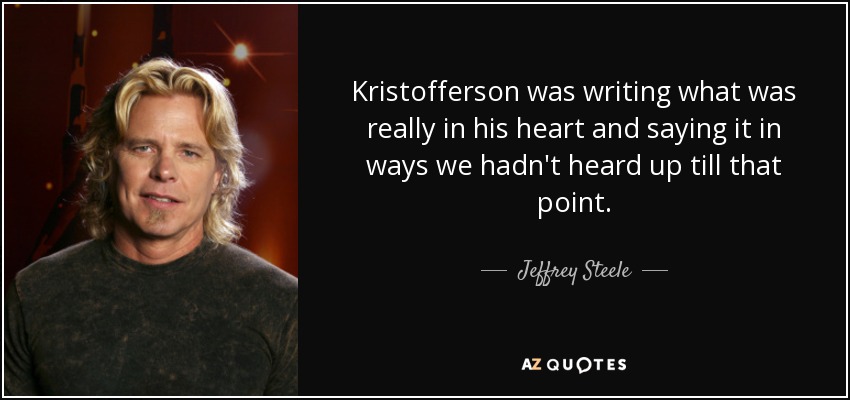
Kristofferson was writing what was really in his heart and saying it in ways we hadn't heard up till that point.
Being a good songwriter means paying attention and sticking your hand out the window to catch the song on the way to someone else's house!
As a singer I tried on all these hats, these voices, these clothes, and eventually out came me.
We've always just gotten up there and played. We don't have any dancers, we don't have all that stuff going on, we just get up there and play.
Songwriting is about getting the demon out of me. It's like being possessed. You try to go to sleep, but the song won't let you. So you have to get up and make it into something, and then you're allowed to sleep. It's always in the middle of the night, or you're half-awake or tired, when your critical faculties are switched off. So letting go is what the whole game is. Every time you try to put your finger on it, it slips away. You turn on the lights and the cockroaches run away. You can never grasp them...
I'm just following the Irish tradition of songwriting, the Irish way of life, the human way of life. Cram as much pleasure into life, and rail against the pain you have to suffer as a result. Or scream and rant with the pain, and wait for it to be taken away with beautiful pleasure . . .
To begin with, the key principle of American indie rock wasn't a circumscribed musical style; it was the punk ethos of DIY, or do-it-yourself. The equation was simple: If punk was rebellious and DIY was rebellious, then doing it yourself was punk. 'Punk was about more than just starting a band,' former Minutemen bassist Mike Watt once said, 'it was about starting a label, it was about touring, it was about taking control. It was like songwriting; you just do it. You want a record, you pay the pressing plant. That's what it was all about.'
I feel some kind of duty to be really, really honest as a writer. The same is true of my songwriting.
Songwriting is like editing. You write down all this stuff - all this bad, stupid stuff - and then you have to get rid of everything except the very best.
I wanted to play rock and roll when I started playing. Nobody at that time ever thought about songwriting. You sang songs, that's all. You sang other people's songs. That's all there were.
Songwriting is like a therapy, it's a connection that you have with another person, and I'm not scared of it at all for some reason.
It's not that I have resisted songwriting, it's just not something I felt I have had to do. I've just not woken up and thought, I must do this. But I have often heard music that I have instantly felt 'I have to sing that song'
I feel like the inspiration is that I've managed to change my songwriting over the past couple of years and also production styles. I could get a sense of what really worked well, and I think this sound developed naturally. That's what happens when you're doing it all the time and changing as a person. Some songs were really dark, and others were more psychedelic. It was useful to have that to figure out exactly what I wanted to do.
I don't really have a set-in-stone process or formula. Sometimes the melody is there and I have to chase down the lyrics. Sometimes, the song is there and I have to make the melody fit. What I've learned so far about songwriting is that I can't force a song. If I try to do that, it's hollow, and people know a hollow song when they hear it. It's the song they stop listening to and forget about. I'd prefer not to write those kinds of songs.
There's this art form in songwriting that's incredibly difficult - to be really funny in a song and also really touching. I can't do that.
Tom [Collins] was a great influence on me. He really pushed me...constantly demanded rewrites. And, as much as I despised them, it was the best thing that could have happened because he just wouldn't settle for less. It had to be right, and it had to be good.
I knew a lot of chords, but they weren't the chords that came with the melody that came with the idea I had for the song. Melodies are simple things. If you see a train wreck, there's a melody. If you see a little daisy blowing in the breeze, there's a melody.
Raksin worked for Alfred Hitchcock, about whom one of the most famous Raksin anecdotes was spoken. The legendary director declared he wanted no music at all for the oceanic Lifeboat, because he felt audiences would wonder where the music was coming from in the middle of the sea. Raksin said, Ask Hitch where the cameras are coming from.
I typically will work on a lyric in a three-ring binder. On the right side, I'll write the lyric, and on the left side, I put in alternate things...and things that might be alternates or improvements. I'll turn the page and do it again. I'll turn the page and do it again, or incorporate the improvements. Eventually, I end up with some material, and often it needs to be ordered.
But it's only after you've played it on the road 20 or 30 times that it becomes really finished and polished...and you realize what it means, and you get the phrasing right.
['Fire and Rain'] is sort of almost uncomfortably close. Almost confessional. The reason I could write a song like that at that point, and probably couldn't now, is that I didn't have any sense that anyone would hear it. I started writing the song while I was in London...and I was totally unknown.... So I assumed that they would never be heard. I could just write or say anything I wanted. Now I'm very aware, and I have to deal with my stage fright and my anxiety about people examining or judging it. The idea that people will pass judgment on it is not a useful thought.
We were on a tour, and there were some chord formations that were tough for me to play when I was a kid...it had become apparent that there was some stuff I wanted to do that [would require me] to learn how to do that. So I wrote the song and used some of these chord formations so I would have to play them. I thought it would be a great teaching vehicle for a while, and it was, but it ended up as a performance song.
I started with the chorus of that song, kind of like a fun bouncy thing to play, and then one of the lines popped up: 'I got things to do today, people to see, things to say.' I wrote about a dozen verses for it, but no song needs to be that long unless you're Bob Dylan. So when we recorded it I started to tear it down to some of the lines I thought were the funniest.
Some hit songs are really stupid, and who knows why they're hits. But a lot of hit songs are really good. I agree with Jim [Lauderdale] in that I think the really good ones are songs that when you hear it [sic]...there's just something about it that touches your heart, and you don't know why.
What inspires me is anxiety and the quest to try to change things in my life. ...I got addicted to endings and beginnings and to the idea of always moving around. ...Obviously, whenever you're going through something that's the best time to create, if you're going through something amazing, or horrible, or nothing at all you should be creating. Unfortunately the songwriters of today generally torture themselves to make sure they're writing good songs and take it a little too seriously.
Follow AzQuotes on Facebook, Twitter and Google+. Every day we present the best quotes! Improve yourself, find your inspiration, share with friends
or simply: