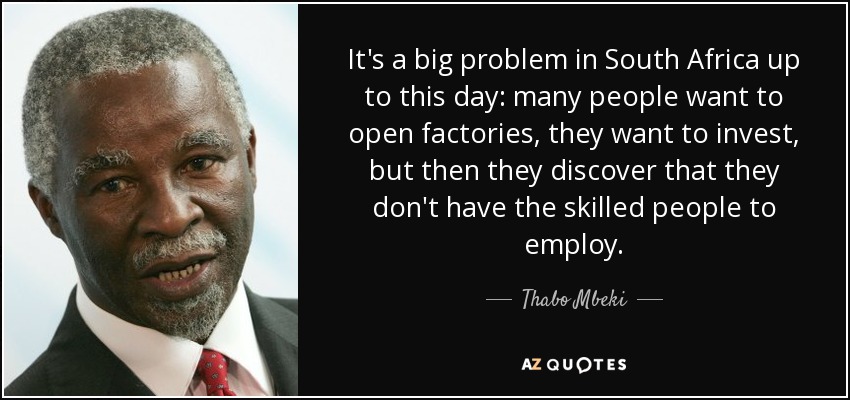
It's a big problem in South Africa up to this day: many people want to open factories, they want to invest, but then they discover that they don't have the skilled people to employ.
Your developed countries are taking teachers from South Africa, they are taking nurses, because people are better paid where they are going.
Politically, [Albert Camus] was in favour of a federation, and effectively he considered that like South Africa today (or as they are trying to do), there should be a mixed population with equal rights, the same rights for the Arab and the French populations, as well as all the other races living there.
When I was 10 I went to the Drakensberg Boys Choir School, which is this idyllic Harry Potter-esque music boarding school in the mountains in South Africa, and that's when everything started to change for me and I realised that music is my thing.
I think every child in every country, not just South Africa, every year should go to a national park, and it should be part of their basic curriculum.
Certainly we must combine forces . South African troops are within the country.We raised this matter with Mrs [Margaret] Thatcher and Lord [Peter] Carrington when we met them and we wanted to get from them a definite commitment that they were going to get the South African troops out.
My family still lives over there [ in South Africa] .I miss them terribly. I would say that most of my life over there was probably very similar to the sort of life someone would experience growing up somewhere like Australia or in the US.
The matter of people being attracted to other countries is a permanent problem in my view, it doesn't only face South Africa. A whole lot of countries in the world are faced with this problem.
I think the critical point, really, is that we need to focus black economic empowerment more on the creation of new wealth rather than on these big deals that have been characteristic of this process in the past, of people going to banks, borrowing a lot of money, buying this and when the shares don't perform very well, the shares go back to the banks, because there's other people who own this anyway. I think we need to re-focus it so that it really does impact on growth, new investment, new employment and a general, better spread of wealth in South Africa.
There were times when I would suddenly realize making music is a crazy pipe dream. I would see bands that did super well in South Africa still struggling to survive, or even people on the international level who are doing well but financially can't really support themselves.
When I was growing up, it was still during Apartheid, so the country was very shielded from the outside artistic world. Anything that was too subversive was basically banned. All the music that we got from outside of South Africa was the poppiest, least subversive music that you could get.
I think anybody who knows anything about South Africa and the South African economy would know that one of the big constraints to growth and development is skills shortages. So all of us, need to come at this thing as vigorously as is possible and, of course, the private sector has the capacity to take it on board.
In 1989, thirteen nations comprising 1,695,000 people experienced nonviolent revolutions that succeeded beyond anyone's wildest expectations . . . If we add all the countries touched by major nonviolent actions in our century (the Philippines, South Africa . . . the independence movement in India . . .) the figure reaches 3,337,400,000, a staggering 65% of humanity! All this in the teeth of the assertion, endlessly repeated, that nonviolence doesn't work in the 'real' world.
They don't stand for anything different in South Africa than America stands for. The only difference is over there they preach as well as practice apartheid. America preaches freedom and practices slavery.
I hate racial discrimination most intensely and all its manifestations. I have fought all my life; I fight now, and will do so until the end of my days. Even although I now happen to be tried by one, whose opinion I hold in high esteem, I detest most violently the set-up that surrounds me here. It makes me feel that I am a Black man in a White man's court. This should not be I should feel perfectly at ease and at home with the assurance that I am being tried by a fellow South African, who does not regard me as an inferior, entitled to a special type of justice.
Pick any player of the world. Make him the captain of India. I can assure you that the results will still be the same. MS Dhoni just not lucky enough to have the kind of bowlers that top teams like Australia, South Africa and New Zealand have.
South Africa is blessed to have women and men like yourselves who have little to give but give what you have with open hands and open hearts.
When a Jew, in America or in South Africa, talks to his Jewish companions about 'our' government, he means the government of Israel.
I have a sense that South Africa is my other country apart from my native country that I particularly love, [that I] want to see succeed, and I did really want my message to be listened to.
South Africa is regarded as being an extraordinarily important country - not just for South Africa, but for Southern Africa, for the BRICS, working now in a new way in which power is becoming more shared - thankfully.
I don't like a bipolar or a unipolar world. I like a multipolar world but on many occasions people have been surprised that South Africa has not seemed, internationally as well as internally, to take a decision that affirms the true values of your Constitution and the vision of those who were there at the beginning - Madiba himself and others.
I want people to understand that, look, we're in a period of democratic deficit, democratic recession. There are fewer democracies in the world today than in 2005, and in many of the countries that are still technically democracies, we're seeing a reduction in the rule of law. And that's especially true in Central Europe, but it's also true of places like South Africa, the Philippines.
I was in South Africa, and Joe [Wright] asked the same exact question that you just asked: "Have you ever seen an episode of Black Mirror?" I went back and played the video for Joe. The episode that I did is called "Nosedive," and it was a year to the week from when I first watched it. It was just very bizarre, this very weird coincidence.
South Africa, with US support, after the fall of the Portuguese empire, invaded Angola and Mozambique to establish their own puppet regime there. They were trying to protect Namibia, to protect apartheid, and nobody did much about it; but the Cubans sent forces, and furthermore they sent black soldiers and they defeated a white mercenary army, which not only rescued Angola but it sent a shock throughout the continent-it was a psychic shock-white mercenaries were purported to be invincible, and a black army defeated them and sent them back fleeing into South Africa.
Cuba forces in Angola gave a real shot in the arm to the liberation movements, and it also was a lesson to the white South Africans that the end is coming. They can't just hope to subdue the continent on racist grounds.
Follow AzQuotes on Facebook, Twitter and Google+. Every day we present the best quotes! Improve yourself, find your inspiration, share with friends
or simply: