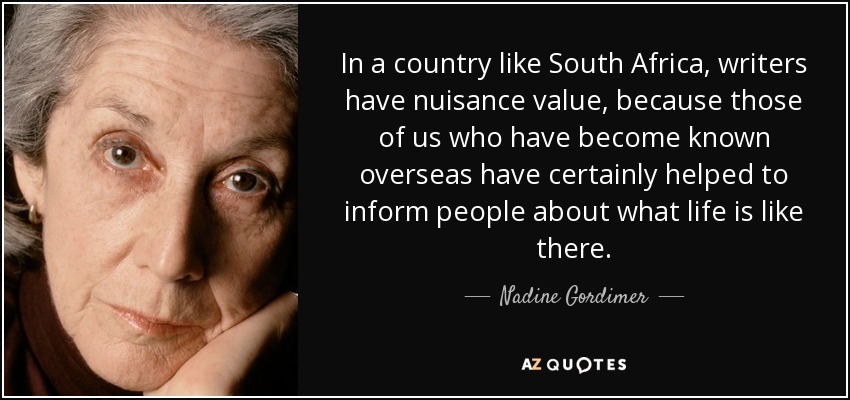
In a country like South Africa, writers have nuisance value, because those of us who have become known overseas have certainly helped to inform people about what life is like there.
I decided that I wanted nothing to do with South African government television while any of my fellow writers were banned and couldn't speak publicly.
Once you have some sort of reputation in the outside world, they will try to woo you. They will say, "Won't you come and be on a talk program about books? That's not political." Then they can say to the outside world, "See how free it is, she appears on television. See how free it is." So I refused to have anything of mine read or dramatized on South African television.
The far right is saying to us: Forget about the two-state solution, it is going to be a Jewish state from the coast to Jordan. The left wing says you have to forget about Jewish self-determination, you will have to live as a minority in an Arab state - just like the whites in South Africa. The key word that both have in mind is that the situation in the West Bank is "irrevocable." It is one of the words I dislike the most.
The inaction of the international community towards Guatemala is injustifiable. The community should play an active role with concrete measures and sanctions imposed, as was the case in South Africa, Iraq, Yugoslavia, Cuba and Haiti. Why for us no? Why legalize death in one place and somewhere else no? This is clear in our memories.
If you look at the history of the Ford Foundation and Rockefeller, in Latin America, in Indonesia, where almost a million people, mainly Communists, were killed by General Suharto, who was backed by the CIA, in South Africa, in the US Civil Rights Movement - or even now, it's very disturbing. They have always worked closely with the US State Department.
There are people here [in South Africa] who, whatever the debate is on a particular issue, their dominating idea is that at the end of the debate we must emerge stronger than we were before and closer to one another.
I grew up in a farm in South Africa and I was scouted there and they sent me to Europe. It's kind of been blessed, since then it happened all so fast.
I believe that here in South Africa, with all our diversities of colour and race; we will show the world a new pattern for democracy. There is a challenge for us to set a new example for all. Let us not side step this task.
It was only in South Africa that I got over this shyness, though I never completely overcame it. It was impossible for me to speak impromptu. I hesitated whenever I had to face strange audiences and avoided making a speech whenever I could. Even today I do not think I could or would even be inclined to keep a meeting of friends engaged in idle talk.
South African rugby doesn't have to stand back for anyone.
One of the reasons to go to South Africa is because we can create great standing sets, both interior and exterior, and have the opportunity to create an actual water set outside, which will allow us to build a boat and probably part of another ship to be able to really bring that world to life.
There was a time in South Africa that people would put flaming tires around peoples' necks if they dis-sented. And in some ways the fear is that you will be necklaced here, you will have a flaming tire of lack of patriotism put around your neck. Now it is that fear that keeps journalists from asking the toughest of the tough questions... And again, I am humbled to say, I do not except myself from this criticism.
In some respects, South African apartheid was more vicious than Israeli practices, and in some respects the opposite is true.
In my many trips to South Africa, I have met and spoken to a lot of people there, and they all seem to find apartheid as repellent as you would.
Nelson Mandela will always be the face of South Africa. The traveler passing through the country will see Mandela's face almost everywhere he looks. Truly, the man is omnipresent.
The history of apartheid-era South Africa is incredibly sad and at times infuriatingly incomprehensible.
I listen to everything. As I told you, sometimes I just want to shut off from music and be silent. Then I play a song and it's refreshing. It's almost like initializing yourself. Recently I was in South Africa doing a press day for my tour. I listened to this band called "Freshly Ground." They were doing a live gig there so that's the last thing I've heard.
My list would be Russia, Morocco, Turkey, and South Africa I'm doing which is somewhere I've wanted to go, Australia, Japan maybe, and China, if I have the energy to go and play at all those places.
Trying to understand, inside, what it is to be Ugandan was crucial to the character, because there are Ugandan ways of doing things that I was trying to capture. Even if I had made this movie in South Africa, it would not have been the same, because it is so specific to Uganda.
South Africans must recall the terrible past so that we can deal with it, forgiving where forgiveness is necessary but never forgetting.
Well, Smoke n' Mirrors has very much a world music flavor and it doesn't park itself in one country. It borrows heavily from the Brazilian angle, which is dear to my heart, and I recorded several albums with that flavor. Probably even more so than the Brazilian flavor, there's an African, South African and West African influence and on a couple of other tracks there's some Latin flavor and there's some Indian tables on one track, all centered around my jazz guitar and acoustic guitars, and very much a Lee Ritenour sound.
Hateful material travels the globe. A few years ago, CNN, America's Der Sturmer, ran a story about Black parents being so low down that they abandoned their children and the children had to eat rats. I was at a University in Wisconsin at the time and the mother of a student from South Africa called to see whether the story was true. She had seen it all the way over there. The story was untrue. The children lied. CNN never corrected the story.
South Africa, with US support, after the fall of the Portuguese empire, invaded Angola and Mozambique to establish their own puppet regime there. They were trying to protect Namibia, to protect apartheid, and nobody did much about it; but the Cubans sent forces, and furthermore they sent black soldiers and they defeated a white mercenary army, which not only rescued Angola but it sent a shock throughout the continent-it was a psychic shock-white mercenaries were purported to be invincible, and a black army defeated them and sent them back fleeing into South Africa.
Cuba forces in Angola gave a real shot in the arm to the liberation movements, and it also was a lesson to the white South Africans that the end is coming. They can't just hope to subdue the continent on racist grounds.
Follow AzQuotes on Facebook, Twitter and Google+. Every day we present the best quotes! Improve yourself, find your inspiration, share with friends
or simply: