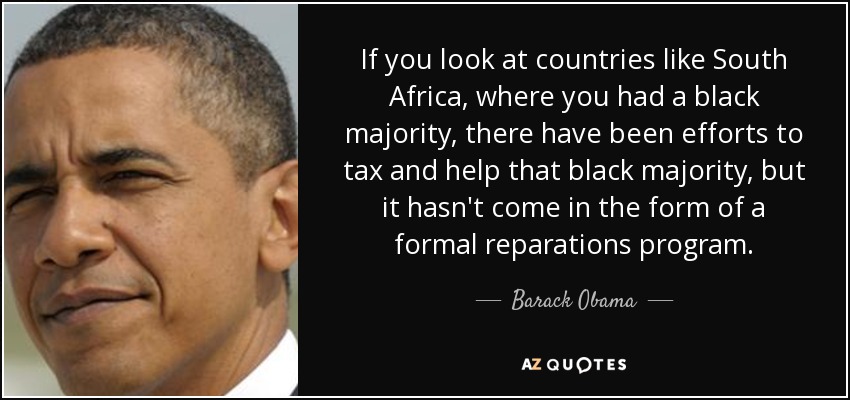
If you look at countries like South Africa, where you had a black majority, there have been efforts to tax and help that black majority, but it hasn't come in the form of a formal reparations program.
Going out in the field, it's always enlightening to see what's working and what's not and to sit down and talk - I was with young girls in south Africa - understanding why our tools for prevention aren't being adopted, and what way may need to invent to help protect them.
My theatrical background was in the great work of the South African playwright Athol Fugard.
If you look for instance at the automobile industry, part of the reason that you have the expansion of that sector, is precisely because we have gone out to talk to the automobile companies to explain government policy with regard to that sector, to talk to them about the MIDP and things like that. And indeed, it has been a very important part of attracting those investors to put in money in the South African economy and build motorcars in South Africa.
For an investor who is sitting in the United States, and South Africa is very far from the United States, you need to go out to that investor to say, these are the possibilities in this particular sector.
The principal investors in the South African economy are South Africans. And this is something, I think, we should really pay attention to.
There is a tendency just to talk about foreign investors. Over 80 per cent of new investment in the South African economy is South African and therefore the engagement of the South African investor is also a critical part of this process.
I should also say that apart from the negotiations that are taking place within the WTO, we are ourselves involved in all manner of bilateral negotiations, or, if they are not bilateral, with the South African Customs Union and the European Union. All the member countries of the European Union have now ratified the agreement that we have with the EU and that opens up the EU market in various ways.
While the WTO negotiations will continue, there are other trade negotiations of a bilateral nature, which among other things, should help to open up these markets for South African products.
South Africa now needs skilled and educated people to say 'How do we manage and develop this democratic country?'
I can still go grocery shopping and not get mobbed. But when I was in South Africa this summer, I had people asking for autographs, and that scared me.
People in apartheid South Africa can tell you that God cursed black people when they cursed Him. And so the hermetic people were condemned to be drawers of water and of wood.
The late Nadine Gordimer in South Africa, for example, had a wonderful ability to get her country's injustices and contradictions down on paper. Ditto for her countryman the great playwright Athol Fugard.
There is a section of our population in South Africa that you can't expect to get integrated in the economy of its own. These are people without skills and that will include young people who might very well have matric certificates, but don't have the skills to be absorbed in the economy. So we need to target people like those in a special way, in a focused way so that they have the skills and the capacity to participate in the economy. That requires special programmes.
The public service needs lots of people, South Africa generally, needs lots of people.
I think anybody who knows anything about South Africa and the South African economy would know that one of the big constraints to growth and development is skills shortages. So all of us, need to come at this thing as vigorously as is possible and, of course, the private sector has the capacity to take it on board.
Your developed countries are taking teachers from South Africa, they are taking nurses, because people are better paid where they are going.
Doing a movie in Tel Aviv or London or South Africa or Mexico. It's this great second act to my career, and it's a real good time.
I was extremely frustrated, almost at the point of giving up on coming up with a name for the project (because I'm awful at it), when I decided to play the 'put a pen somewhere on a map with your eyes closed' game with South Africa. About the 5th try was St. Lucia in South Africa, which coincidentally also happens to be an idyllic sub-tropical seaside resort town. The name seemed to fit with the mood of the music, and so after a while it just stuck.
Certainly we must combine forces . South African troops are within the country.We raised this matter with Mrs [Margaret] Thatcher and Lord [Peter] Carrington when we met them and we wanted to get from them a definite commitment that they were going to get the South African troops out.
My family still lives over there [ in South Africa] .I miss them terribly. I would say that most of my life over there was probably very similar to the sort of life someone would experience growing up somewhere like Australia or in the US.
When I was 10 I went to the Drakensberg Boys Choir School, which is this idyllic Harry Potter-esque music boarding school in the mountains in South Africa, and that's when everything started to change for me and I realised that music is my thing.
Politically, [Albert Camus] was in favour of a federation, and effectively he considered that like South Africa today (or as they are trying to do), there should be a mixed population with equal rights, the same rights for the Arab and the French populations, as well as all the other races living there.
One of the issues that I have raised in that context is our transport system, road, rail and ports. We have raised this before, that the South African economy has grown at a rate that has overtaken the capacity of the transport system. And therefore, we have said that it is necessary to expand our capacity in the ports.
I don't think there would be many examples of South Africa pushing its weight around the African Continent. I don't think the facts would substantiate that argument.
Follow AzQuotes on Facebook, Twitter and Google+. Every day we present the best quotes! Improve yourself, find your inspiration, share with friends
or simply: