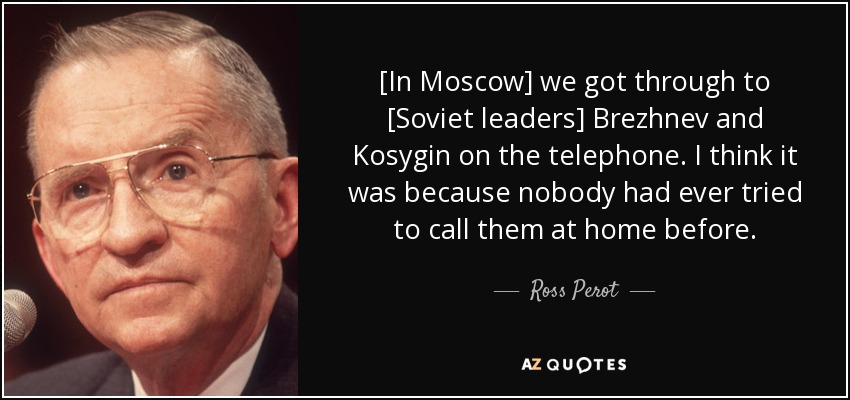
[In Moscow] we got through to [Soviet leaders] Brezhnev and Kosygin on the telephone. I think it was because nobody had ever tried to call them at home before.
Having lived in a collapsed empire before - I lived in Russia right after the Soviet Union collapsed - you can see a lot of the classic signs of an empire that's on its way out.
The fight against Jewish world Bolshevization requires a clear attitude toward Soviet Russia. You cannot drive out the Devil with Beelzebub.
The language of these Soviet show trials... could only be understood in the Aesopian imagery of the closed Bolshevik universe of conspiracies of evil against good in which 'terrorism' simply signified 'any doubt about the policies or character of Stalin.' All his political opponents were per se assassins. More than two 'terrorists' was a 'conspiracy'.
The Soviet assumption that all other political life-forms and beliefs were inherently and immutably hostile was the simple and central cause of that Cold War.
Mr. Gorbachev initiated Glasnost, Perestroika, so he was already, you know, way disenchanted with the rigid Communist ideology, and he was looking to become an international leader. He was more accepted actually outside of the Communist Soviet Union than inside.
The breakup of the Soviet Union is a national tragedy on an enormous scale only the elites and nationalists of the republics gained.
I have a consistent rule: The American people should know as much about the Pentagon as the Soviet Union and China do, as much about General Motors as Ford does, and as much about City Bank as Chase Manhattan does.
We lived in a totalitarian system for more than 70 years, and our views are still under its influence. Many heads of state in the former Soviet republics believe that they must have total power.
When the whole discussion of "developing a national idea" hastily began in post-Soviet Russia, I tried to pour cold water on it with the objection that, after all the devastating losses we had experienced, it would be quite sufficient to have just one task: the preservation of a dying people.
It is painful to talk about it, but even with its 110,000 elite soldiers, the Soviet Union never managed to gain control over the entire Afghan territory.
I believe that renunciation of the Soviet Union was an expression of the free will of the Russian people.
When the Soviet Union was dissolved, most of us didn't even have the feeling that the country was falling apart. We thought we would continue with our lives as in the past, but as good neighbors.
Soviet-era nostalgia has strong support among the people. But not among the elite and, in my opinion, not with the president. We are not interested in keeping remnants of the communist era alive.
During the Cold War era, the issue was the containment of Soviet influence, and we tolerated many an authoritarian regime as long as they were useful to us in this respect.
You want to favor systems that benefit from error, disorder, variability and things like that. You want to favor these systems and unfortunately, when - there's something I call the Soviet Illusion. The more the government becomes intrusive, the more things have to follow a script, and it can't handle this kind of system.
When [Vladimir] Putin, a former lieutenant-colonel in the KGB, became Russia's president on December 31, 1999 - eight years after the failed coup attempt against (then Soviet leader Mikhail) Gorbachev, and eight years after the people had torn down the statue of Felix Dzerzhinsky, the hated founder of the KGB, in Moscow - it was admittedly a shock. Nevertheless, I decided to give Putin a chance. He seemed dynamic and capable of learning. But I had to bury my hopes after just a few months. He proved to be an autocrat - and, because the West let him do as he pleased, he became a dictator.
The Soviet Union is going to have a human-rights explosion. You'll have hundreds of thousands of dissidents.
One ironic thing is that although (the Soviet Union) was one of the most oppressive systems, with no respect for the individual, it somehow produced the freest hockey on the planet. These guys, when they got on the ice, it was like watching jazz. They could do anything. I find that a paradox. It's interesting because I think the North American style was a lot less free. It was not encouraged to be creative.
Growing up, I didn't know very much about my heritage and the Soviet Union and things of that nature. But when I saw the Soviet Union play hockey for the first time, to me, it was profound.
When I looked into the story of Soviet hockey and its players, I realized that it has nothing to do with hockey. It was a larger story using hockey as a window into the story of the rise and fall of the Soviet Union, the Russian people, with friendships and betrayals, paranoia and oppression, and the meaning of sports to people and nations around the world, and how sports was used as a political tool.
What I found interesting about Slava Fetisov was that he went through three different generations of Soviet hockey. In the late 70's, he experienced the Miracle on Ice, and then in the 80's became with his teammates the Russian Five, the most dominant team in the history of hockey, and then helped bring down the hockey system when the Soviet Union collapsed and became one of the first players to play in the NHL, and then ultimately came back to Russia.
Anatoli Tarasov, the guy that created the Soviet style of play, was a visionary. He was a creative thinker. He studied ballet and chess and art and read a lot.
There (in the Soviet Union) it was a science. In order to be a coach, you had to study in school.
I guess the prime example is in North America there's a thing where if there's no opportunity to move forward with the puck, then a [hockey] player is told to dump the puck into the other zone. Just give up the puck and dump it in. Give it to the other team. And to the Soviet mentality in coaching, it just doesn't make any sense. If you're a skilled player, why are you going to give the puck away to the other team? Just give it away, right?
Follow AzQuotes on Facebook, Twitter and Google+. Every day we present the best quotes! Improve yourself, find your inspiration, share with friends
or simply: