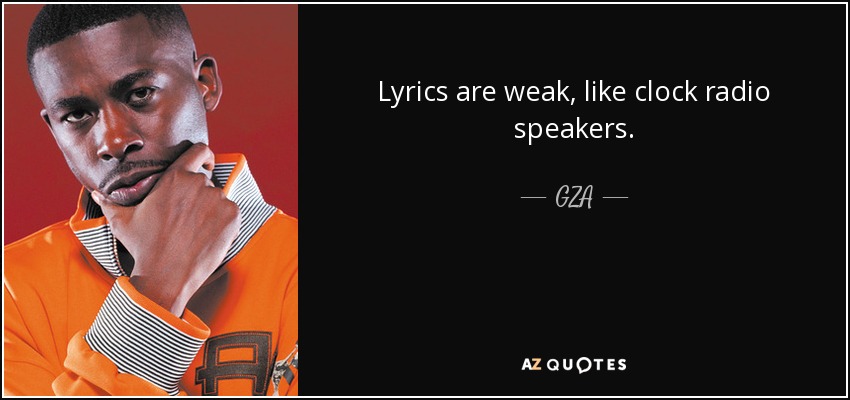
Lyrics are weak, like clock radio speakers.
Mr Speaker, Mr Vice President, members of Congress, distinguished guests, and fellow Americans, last month I went to Andrews Air Force Base and welcomed home some of our last troops to serve in Iraq. Together, we offered a final, proud salute to the colors under which more than a million of our fellow citizens fought, and several thousand gave their lives. We gather tonight knowing that this generation of heroes has made the United States safer and more respected around the world.
Say not always what you know, but always know what you say.
House Speaker Pelosi worried about the opposition, the tone of it, perhaps leading to violence as it did in the 70s. Theres more recent examples of anti-government violence - occurring even in the mid-90s. Do you worry about that?
Mr. Speaker, our Nation must no longer be complacent about underage drinking and its alarming consequences. We must bring this national public health crisis out of the shadow and into the bright light of a national priority.
It becomes 'one's own' only when the speaker populates it with his own intentions, his own accent, when he appropriates the word, adapting it to his own semantic and expressive intention. Prior to this moment of appropriation, the word does not exist in a neutral and impersonal language (it is not, after all, out of a dictionary that the speaker gets his words!), but rather it exists in other people's mouths, in other people's contexts, serving other people's intentions: it is from there that one must take the word, and make it one's own
Words belong to nobody, and in themselves they evaluate nothing. But they can serve any speaker and be used for the most varied and directly contradictory evaluations on the part of the speakers.
An important fact about verbal behavior is that speaker and listener may reside within the same skin.
Speakers have been showering us with pearls of wisdom for centuries, and if all of their valuable advice were laid end to end, it would still be just as good as new. Very little of it has ever been used.
The creative musician ... is ... the radio receiver, not the broadcasting station. His personal discipline is to improve the quality of the components, the transistors, the speakers, the alloys in the receiver itself, but never to concern himself overmuch with putting out the program. The program is there; all he has to do is receive it as far as possible.
In an ideal world, one populated by vegetarians and Esperanto speakers, derivatives would be used for one thing only: reducing levels of risk. The list of individual traders who have lost more than a billion dollars at a time betting on derivatives is not short.
An evil-speaker differs from an evil-doer only in the want of opportunity.
Whenever you hear anyone talking about a cultural or even about a human problem, you should never forget to inquire who the speaker really is. The more general the problem, the more the person will smuggle his or her own personal psychology into the account he or she gives of it.
Find out what's keeping them up nights and offer hope. Your theme must be an answer to their fears
A good speaker does not stutter.
I have been in America only once since Mr. Clinton became your president - as a speaker at the United Nations.
A speaker who does not strike oil in ten minutes should stop boring.
Most people have to talk so they won't hear.
Mr. Speaker, less than 10 percent of our Nation's children walk or ride their bicycles to school, and too many schools continue to invite fast-food vendors into their cafeterias.
Better never begin than never make an end.
I can't resist telling you that when the Vienna Economics Institute celebrated its centennial, many years ago, they invited, as their keynote speaker, my father [John Kenneth Galbraith]. The leading economists of the Austrian school- including von Hayek and von Haberler - returned for the occasion. And so my father took a moment to reflect on the economic triumphs of the Austrian Republic since the war, which, he said, "would not have been possible without the contribution of these men." They nodded - briefly - until it dawned on them what he meant. They'd all left the country in the 1930s.
Wes Clark is a man of whom you can ask a question, and he will look you directly in the eye, and give you the most truthful and complete answer you can imagine. You will know the absolute truth of the statement as well as the thought process behind the answer. You will have no doubt as to the intellect of the speaker and meaning of the answer to this question....So you can see, as a politician, he has a lot to learn.
By focusing on the interior of a speaker's larynx and using infrared, he was able to convert the visible vibrations of the vocal cords into sound of fair quality, but that did not satisfy him. He worked for a while on vibrations picked up from panes of glass in windows and on framed pictures, and he experimented briefly with the diaphragms in speaker systems, intercoms and telephones. He kept on into October without stopping, and finally achieved a device that would give tinny but recognizable sound from any vibrating surface - a wall, a floor, even the speaker's own cheek or forehead.
The composer must bear in mind that the radio listener does not hear music directly. He hears it only after the sound has passed through a microphone, amplifiers, transmission lines, radio transmitter, receiving set, and, finally, the loud speaker apparatus itself.
When both a speaker and an audience are confused, the speech is profound.
Follow AzQuotes on Facebook, Twitter and Google+. Every day we present the best quotes! Improve yourself, find your inspiration, share with friends
or simply: