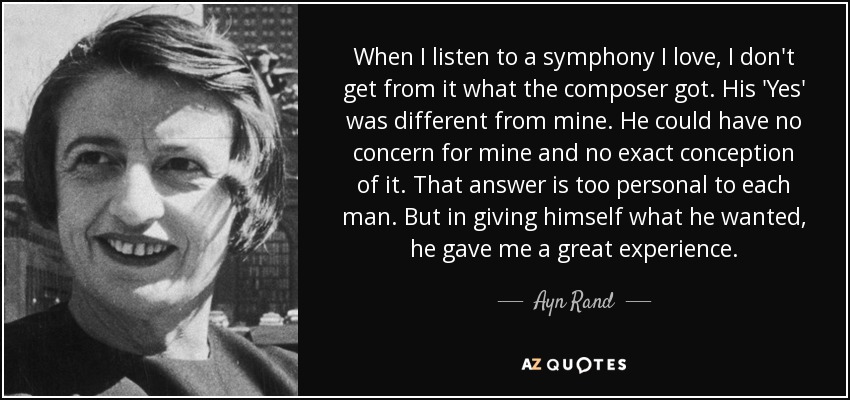
When I listen to a symphony I love, I don't get from it what the composer got. His 'Yes' was different from mine. He could have no concern for mine and no exact conception of it. That answer is too personal to each man. But in giving himself what he wanted, he gave me a great experience.
I don't know if this is true to you but for me sometimes it gets so bad that anything else say like looking at a bird on an overhead power line seems as great as a Beethoven symphony. then you forget it and you're back again.
I grew up a Red Sox fan. I grew up going to Fenway Park and the Museum of Fine Arts and the Science Museum and Symphony Hall and going to the Common, walking around. My whole family at different times lived and worked in Boston.
I hear entire symphonies, oratorios, in my head, but I can't write a note.
I would think, of all the saxophones, the baritone would be the most logical instrument if anybody was adding a voice to the symphony orchestra.
I was always the kid on scholarship, I was a soloist with my company, I'd been working with the symphony since I was 14.
He wanted us to play whatever we played in the most characteristic and appropriate style. Even it was the theme from 'The Godfather,' you needed to play that then the way that a Hollywood producer would expect it to be played. Whether it was that or the posthorn solo from Mahler's Symphony No. 3, he would expect that to be played in the way that Leonard Bernstein wanted to hear it. In retrospect, I think it was a sensational way to teach this particular group of students. By the time you graduated you could absolutely read anything with any trumpet.
During a rehearsal of Beethoven's Ninth Symphony the members of the orchestra were so overwhelmingly moved by the conducting of Arturo Toscanini that they rose as one man and applauded him. When the spontaneous cheering has subsided, Toscanini turned to his men, tears glistening in his eyes. "Please . . . please! Don't do this! You see, gentlemen, it isn't me you should applaud. It's Beethoven!"
Karen rowed for what the venerable American shell builder George Pocock called `the symphony of motion.' As dawn breaks over the river, the shell is lifted from its rack out into the morning. On another rack the oars hang ready to be greased and slipped into the locks. Then, awakened to the river and the feel of the oars, the oarsmen blend in fulfillment of the shell. The symphony is not of competition. It is the synchronous motion over water, the harmonic flexing of wood and muscle, where each piece of equipment and every oarsman is both essential to, and the limit of motion itself.
I don't see myself necessarily having a burning desire to write a symphony.
In a purely technical sense, each species of higher organism-beetle, moss, and so forth, is richer in information than a Caravaggio painting, Mozart symphony, or any other great work of art.
Our biological rhythms are the symphony of the cosmos.
Lord # God , I praise Your Holy Name. Let every beat of my heart be a note of love in the symphony of my life.
The creation of art is not the fulfillment of a need but the creation of a need. The world never needed Beethoven's Fifth Symphony until he created it. Now we could not live without it.
We in the "developed" world seem to have many auditory strategies that insulate us from the presence of silence, simplicity, and solitude. When I return to Western culture after time in desert, mountain or forest, I discover how we have filled our world with a multiplicity of noises, a symphony of forgetfulness that keeps our won thoughts and realizations, feelings and intuitions out of audible range.
The critics say that Shostakovich's Fourth Symphony has no form. They are wrong; it has the form of Shostakovich's Fourth Symphony.
Mozart, striving for perfection, wrote the same symphony forty-one times. In his case, it worked. He wrote a perfect symphony.
When we look at a painting, or hear a symphony, or read a book, and feel more Named, then, for us, that work is a work of Christian art. But to look at a work of art and then to make a judgment as to whether or not it is art, and whether or not it is Christian, is presumptuous. It is something we cannot know in any conclusive way. We can know only if it speaks within our own hearts, and leads us to living more deeply with Christ in God.
Revolution is only truly revolution if it is a continuous struggle-not just an external struggle against an enemy, but an inner struggle, fighting and subduing all negative aspects which hinder or do damage to the course of the revolution. In this light, revolution is ... a mighty symphony of victory over the enemy and over oneself.
The point of recapitulation in the first movement of the Ninth [Symphony of Beethoven] is one of the most horrifying moments in music, as the carefully prepared cadence is frustrated, damming up energy which finally explodes in the throttling, murderous rage of a rapist incapable of attaining release.
The truth is . . . that the great artists of the world are never puritans, and seldom ever ordinarily respectable. No virtuous man - that is, virtuous in the YMCA sense - has ever painted a picture worth looking at, or written a symphony worth hearing, or a book worth reading, and it is highly improbable that the thing has ever been done by a virtuous woman.
From the glow of enthusiasm I let the melody escape. I pursue it. Breathless I catch up with it. It flies again, it disappears, it plunges into a chaos of diverse emotions. I catch it again, I seize it, I embrace it with delight... I multiply it by modulations, and at last I triumph in the first theme. There is the whole symphony.
A thing of orchestrated hell-a terrible symphony of light and flame.
Whenever we would prepare the mind by a forcible appeal, an opening quotation is a symphony preluding on the chords whose tones we are about to harmonize.
Moving pictures need sound as much as Beethoven symphonies need lyrics.
Follow AzQuotes on Facebook, Twitter and Google+. Every day we present the best quotes! Improve yourself, find your inspiration, share with friends
or simply: