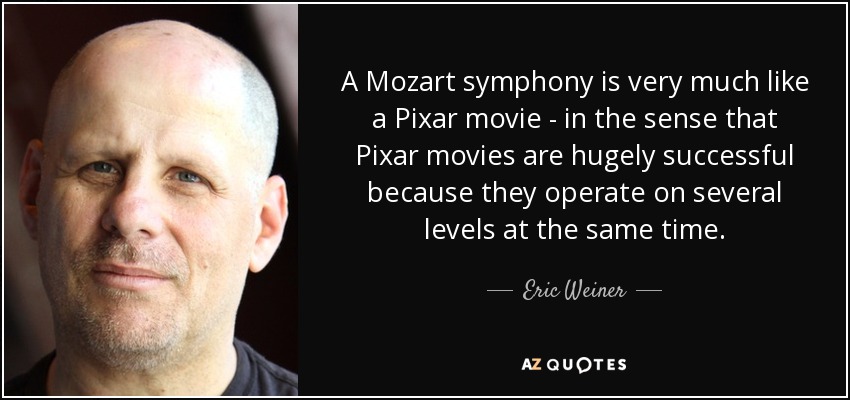
A Mozart symphony is very much like a Pixar movie - in the sense that Pixar movies are hugely successful because they operate on several levels at the same time.
I still love how Phil Spector turned teenage experiences into wonderful symphonies, but I find it a little more difficult to put myself in that place.
I found a deep kinship between Mahler's recurrent attempts to confront all sides of life and to affirm himself in the face of his own finitude, and Aschenbach's dedication to persevere in the literary evocation of beauty. Exploring this kinship led me to reflect on many of Mahler's songs and symphonies - and particularly his great masterpiece, Das Lied von der Erde. The end result was a way of reading Mann that I hadn't originally anticipated at all.
I'm just not arbitrarily choosing to have five guitars play one type of thing. In that way there's a definite similarity between a symphony orchestra and the 100 guitar symphony.
Like everyone else, I get swept along just trying to keep up with that endlessly growing to-do list, but I do my best to treat the day as one big meditation or symphony.
If man merely sat back and thought about his impending termination, and his terrifying insignificance and aloneness in the cosmos, he would surely go mad, or succumb to a numbing sense of futility. Why, he might ask himself, should he bother to write a great symphony, or strive to make a living, or even to love another, when he is no more than a momentary microbe on a dust mote whirling through the unimaginable immensity of space?
My musical genius reached its apex thirty years ago when I played the triangle in Haydn's children's symphony, so I could not play unless you needed someone to make one sustained note!
It is so easy to waste our lives: our days, our hours, our minutes. It is so easy to take for granted the pale new growth on an evergreen, the sheen of the limestone on Fifth Avenue, the colour of our kids’ eyes, the way the melody in a symphony rises and falls and disappears and rises again. It is so easy to exist instead of live. Unless you know there is a clock ticking.
When I was to come to Washington the first time as Music Director of the Boston Symphony, Mrs. Johnson phoned us to find out if they could give us a party and who we would like to meet.
The mature person becomes able to differentiate feelings into as many nuances, strong and passionate experiences, or delicate and sensitive ones, as in the different passages of music in a symphony. Unfortunately, many of us have feelings limited like notes in a bugle call.
The music left only this bad hurt in her, and a blankness. She could not remember any of the symphony, not even the last few notes. She tried to remember, but no sound at all came to her. Now that it was over there was only her heart like a rabbit and this terrible hurt.
When I was 20, Shostakovich was my favorite composer. I still find his Fifth Symphony wonderful, with its outstanding themes and rhythms. That's the piece that made me want to be a classical composer.
When I was very young, I remember my mother telling me about a friend of hers in Germany, a pianist who played a symphony that wasn't permitted, and the Germans came up on stage and broke every finger on her hands. I grew up with stories of Nazis breaking the fingers of Jews.
I never listen to music when I am writing. It would be impossible. I listen to Bach in the mornings, mostly choral music; also some Handel, mostly songs and arias; I like Schubert's and Beethoven's chamber music and Sibelius' symphonies; for opera, I listen to Mozart and in recent years Wagner.
The alarm in the morning? Well, I have an old tape of Carlo Maria Giulini conducting the Vienna Philharmonic Orchestra in a perfectly transcendent version in Shubert's seventh symphony. And I've rigged it up so that at exactly 7:30 every morning it falls from the ceiling onto my face.
Perhaps the experience had been so complete that repetition would be vulgarity - like asking to hear the same symphony twice in a day.
Every time I open the paper, there's some symphony orchestra collapsing somewhere in the United States. What the hell is going on? And then you find out that the board members try to run these things as businesses.
What a director does... essentially, it's storytelling, but a director also controls the feeling and the sounds and the texture. It's an act of creation, like a symphony or a painting or a story. But with different tools.
When I auditioned actors I never make them act. I choose a long symphony, then I tell them to sit down and I play the symphony for them. Then I sit and I look at them. I always pick a piece of music that has up and downs, very dramatic parts, very quiet parts and really sensitive parts so that it can produce different emotions.
Conversation never sits easier upon us than when we now and then discharge ourselves in a symphony of laughter, which may not improperly be called the chorus of conversation.
Actors want to work with you but they want you to do their thing. Actors, whom I love with a blind partiality, sometimes they want to be soloists in the symphony, not a part of the orchestra.
A man must pay the fiddler. In my case it so happened that a whole symphony orchestra often had to be subsidized.
You know how it is in the symphony when you are listening to the symphony, the last notes die away, and there's often a beat of silence in the auditorium before the applause begins. It's a very full and pregnant silence. Now theology should bring us to live into that silence, into that pregnant pause.
The majority of my symphonies are tombstones.
You can play Bach on the piano, a symphony orchestra or a quartet of saxophones, but let's stop this silly, childish business of knit your own musicology
Follow AzQuotes on Facebook, Twitter and Google+. Every day we present the best quotes! Improve yourself, find your inspiration, share with friends
or simply: